

TLDR
Two Royal New Zealand Navy ships completed the first transit of the Taiwan Strait by a New Zealand frigate since 2017, drawing simulated attack runs from Chinese jets. Wellington called it lawful under international law; Beijing said it remained vigilant against threats to its sovereignty.
A nine-year gap and what it signals
There is something instructive about the language governments choose when warships sail through contested water. Wellington calls it routine. Beijing calls it a matter of vigilance. The ships themselves say nothing; they simply pass through, and the distance between those two descriptions becomes the story.
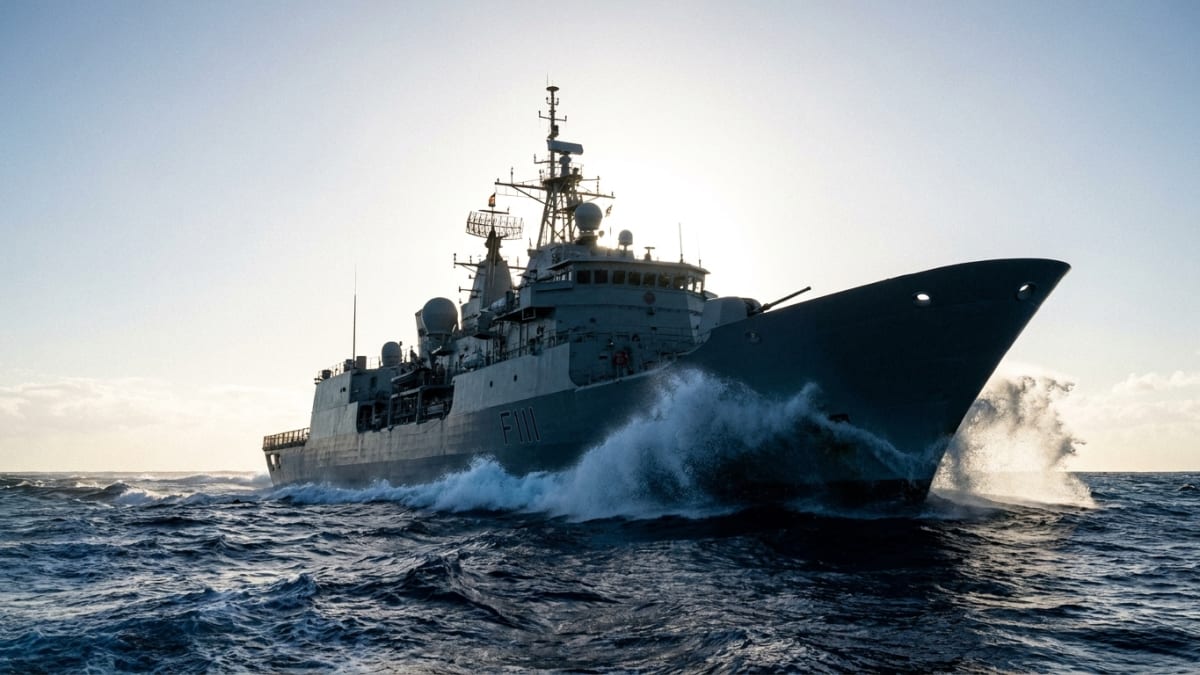
On 18 September 2026, HMNZS Te Mana and HMNZS Aotearoa transited the Taiwan Strait as part of a three-month Indo-Pacific deployment.[1] The People's Liberation Army responded with simulated attack runs on both vessels during the passage, which is a pointed kind of welcome.
Nine years since the last frigate
The last Royal New Zealand Navy frigate to make the transit was HMNZS Te Kaha, in 2017; the tanker HMNZS Aotearoa passed through in November 2025 and, alongside Australian and Japanese ships, in September 2024.[2] Nine years is a policy position dressed as a scheduling gap, and its reversal carries weight precisely because of its duration. Allied navies from the United Kingdom, Canada and the United States have made the strait passage repeatedly in recent years; New Zealand's prolonged absence from that list had its own message, and this transit ends it.
Commodore Shane Arndell, Maritime Component Commander for the New Zealand Defence Force, left little ambiguity about Wellington's legal footing. "The New Zealand Defence Force conducts all activities in accordance with international law and best practice. This was a routine activity, consistent with international law, including the right of freedom of navigation as guaranteed under the United Nations Convention on the Law of the Sea," Arndell said.[2] UNCLOS is the instrument Wellington reaches for; it is the instrument Beijing contests.
Beijing's measured reply
China's Foreign Ministry spokesperson Lin Jian offered the calibrated response the occasion seemed to demand. "China handles foreign warships' transit through the Taiwan Strait in accordance with laws and regulations, and meanwhile we stay vigilant against any acts that might jeopardize China's sovereignty and security," Lin said.[3] The phrase "laws and regulations" is doing considerable work in that sentence, implying a Chinese legal framework governing the strait that UNCLOS, in Wellington's reading and that of most Western navies, does not recognise.
The PLA's aerial response was more direct than any press conference. Simulated attack runs are a practised form of displeasure, calibrated to demonstrate capability without escalating to incident; they register, and they are meant to.
What Taiwan's defence ministry recorded
Between 6 a.m. on 20 September and 6 a.m. on 21 September 2026, Taiwan's Ministry of National Defense detected four PLA aircraft sorties and seven People's Liberation Army Navy ships operating around Taiwan, with three sorties crossing the Taiwan Strait median line into Taiwan's air defence identification zone.[4] Taiwan welcomed the New Zealand passage, and the median-line crossings in the days immediately following suggest Beijing was making a broader point about its reach, addressed to multiple audiences at once.
The Australian dimension
For Canberra, the transit carries practical value beyond the symbolic. New Zealand's passage reinforces the trans-Tasman defence posture in the Indo-Pacific and complements Australia's own freedom-of-navigation activities in the region, with joint operations, replenishment exercises and coordinated deployments having built the operational groundwork for exactly this kind of aligned messaging.[1]
The three-month Indo-Pacific deployment also encompasses United Nations Security Council sanctions monitoring against North Korea, placing the strait passage within a broader commitment to rules-based maritime order.[2] Te Mana and Aotearoa are expected to continue operating in the region through the remainder of the deployment.
KEY TAKEAWAYS
SOURCES & CITATIONS
FREQUENTLY ASKED QUESTIONS
Why does the Taiwan Strait transit matter legally?
What ships made the transit?
When did New Zealand last make this transit?
Margaret Hale writes about politics, policy and the culture of business. She is drawn to the people behind decisions and to the moments when a political story turns out to be a human one.