
TLDR
Treasury Secretary Scott Bessent proposed a national security AI incident notification mechanism to Chinese Vice Premier He Lifeng after talks in New York. The proposal, not yet an agreement, goes to Trump and Xi at their Washington summit on 24 September 2026.
A proposal, not yet a pact
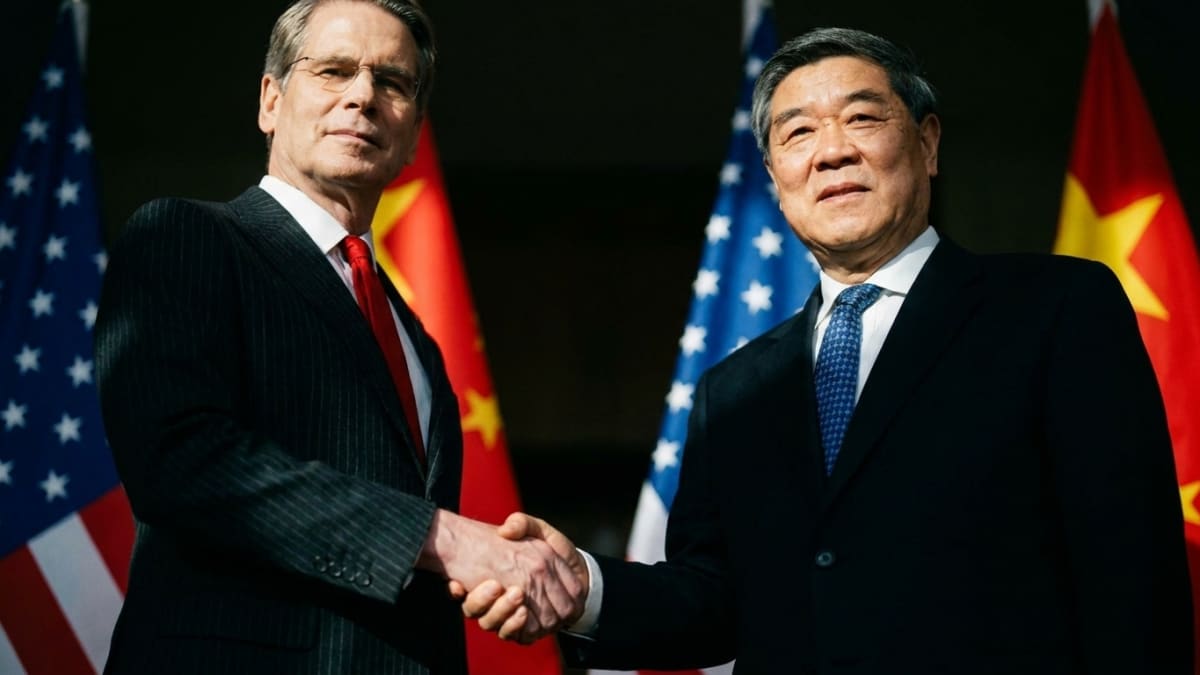
"Dialogue" is one of those words that flatters the parties who use it. It implies, at minimum, a willingness to keep talking. What Scott Bessent proposed in New York on 20 September 2026 was something more particular than talk: a national security-level AI incident notification mechanism, embedded inside a new US-China AI dialogue, designed to alert both governments when an AI event crosses the threshold of security concern. Bessent put the proposal to Chinese Vice Premier He Lifeng at the conclusion of their New York talks, framing it as a move from opacity to transparency between the world's two leading AI powers.[1]
"We think that just like any cross-border activity, that moving from opaque to more transparency between the No. 1 and the No. 2 AI powers in the world is very important," Bessent said.[1] The analogy carries its own argument. Cross-border financial flows, nuclear arsenals and pandemic pathogens all eventually acquired notification regimes; Bessent's framing places AI in that company, which is either a reasonable precedent or an ambitious one, depending on your faith in bilateral goodwill.
What the mechanism would do
The proposed notification mechanism would alert both governments to AI incidents deemed to affect national security, shifting the two powers' relationship from mutual opacity toward something closer to cooperative risk management.[1] Rapid alerts reduce the risk of misinterpretation, buying time before a technical failure or a rogue model output becomes a geopolitical incident.
Bessent described the ambition plainly: "We want a shared vision of common goals and common threats."[1] The phrase acknowledges that the US and China compete hard on AI development while remaining jointly exposed to its risks. A notification system threads that needle without requiring either side to share proprietary technology or coordinate policy more broadly, which is presumably what makes it proposable at all.
The summit on 24 September
The New York talks sit inside a broader diplomatic architecture. Trump and Xi agreed in May 2026 to hold a Washington summit this northern-hemisphere autumn, establishing two new government-to-government forums: the US-China Board of Trade and the US-China Board of Investment.[2] The AI notification proposal now joins that agenda for the 24 September meeting.
He Lifeng's side said little publicly after the New York session, and no agreement was announced. The mechanism remains a US proposal. Whether it advances at the summit depends on whether Beijing accepts the underlying premise: that naming AI incidents to Washington, even in a confined and bilateral format, serves Chinese interests as much as American ones.
What it means beyond Washington and Beijing
The bilateral framing should not obscure the multilateral stakes. A government-to-government AI incident channel between the United States and China would be the first of its kind, setting a template that other states and multilateral bodies would feel pressure to match or contest. For Australia, a Five Eyes partner and a significant AI adopter in both government and industry, the consequences extend well beyond observation; early warnings of cross-border AI threats, ranging from cyberattacks to large-scale misinformation, depend on the reliability of channels between the powers generating and deploying the most capable systems.
Treasury's institutional focus on AI risk predates this proposal. In March 2026, the department's Office of the Financial Stability Oversight Council and its Artificial Intelligence Transformation Office launched the AI Innovation Series, a public-private initiative aimed at the resilience of the US financial system.[3] Bessent's push for a bilateral notification regime extends that domestic risk-management instinct into foreign policy, and the Washington summit on 24 September will test whether Beijing reads it the same way.
KEY TAKEAWAYS
SOURCES & CITATIONS
FREQUENTLY ASKED QUESTIONS
What exactly did Bessent propose to China?
Has China agreed to the proposal?
Why does this matter for Australia?
Margaret Hale writes about politics, policy and the culture of business. She is drawn to the people behind decisions and to the moments when a political story turns out to be a human one.