
TLDR
Ukraine launched more than 1,600 drones at Russia overnight into 20 September 2026, with 450 aimed at Moscow alone, making it the largest drone assault of the war. Three people died, 20 were injured, and fires broke out near the Moscow oil refinery as Russia's three-day Duma election reached its final day.
The night Moscow counted drones instead of ballots
Russia's three-day State Duma election, running from 18 to 20 September 2026, was designed to project domestic order and political permanence. Ukraine chose the final hours of that vote to launch more than 1,600 unmanned aerial vehicles at Russian territory, with 450 of them aimed directly at Moscow.[1] The message, whatever its military effect, required no translation.
Air defences were activated across multiple fronts through the night. Moscow Mayor Sergei Sobyanin said authorities shot down all 1,600 drones before they could reach populated areas, including the 450 on approach to the capital.[2] Official lines, as a rule, hold the line.
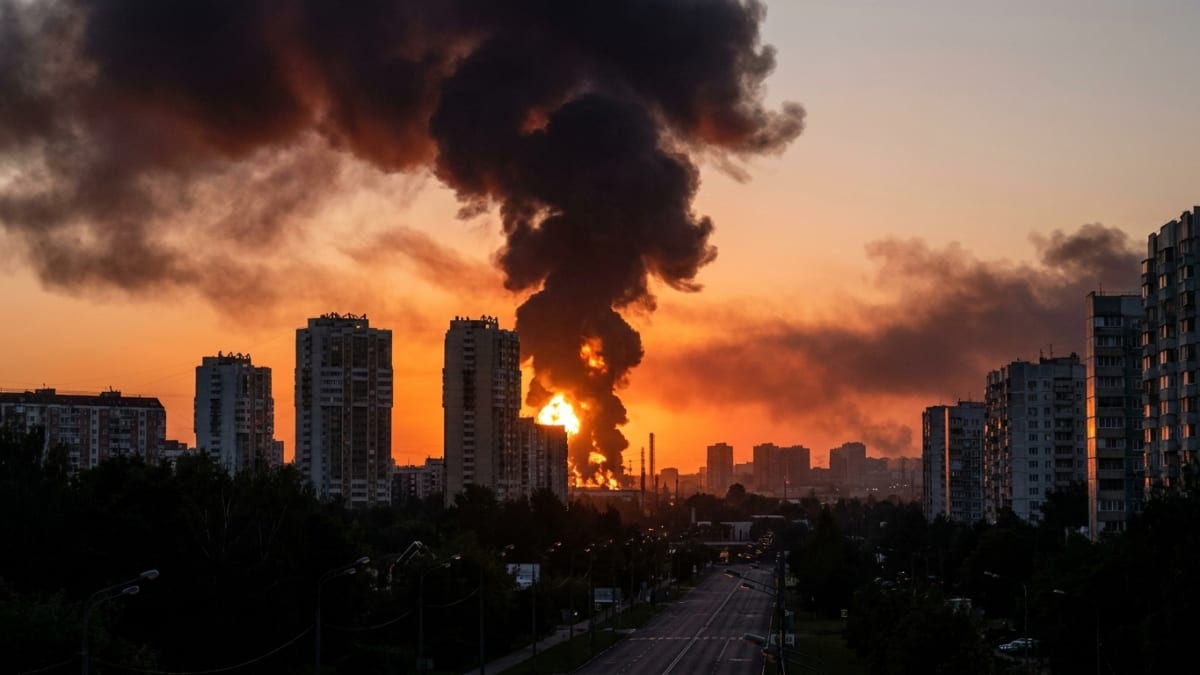
The refinery told a different story. Drones reached the territory of the Moscow Oil Refinery and damaged at least one facility, with fires visible from surrounding areas.[2] Hundreds of flights were disrupted at Moscow's airports. Three people died and twenty were injured, among them three children.
It is important that our partners also look for and find ways to make Russia feel its war
September 20, 2026 · View on XSobyanin frames it as electoral sabotage
Sobyanin moved quickly to interpret the attack in political terms. "The most massive attack by enemy drones has been repelled," he said. "Since Saturday, more than 1600 drones have been shot down across all fronts, including 450 approaching Moscow. This unprecedented attack was clearly planned to disrupt the elections, but the enemy failed."[2] The framing was tidy: a repelled attack, a failed disruption, an election proceeding regardless.
Whether the attack in fact disrupted voting is a harder question. United Russia was tracking above 57 per cent with a quarter of ballots counted as the strikes unfolded. The Duma election, legislated to run across three days ending 20 September, had been positioned by the Kremlin as a demonstration of domestic unity behind the government's conduct of the war.[4] An air-raid alarm over the capital on the final morning of voting is not, by any measure, an unremarkable backdrop.
What the election-day timing signals
Ukraine has spent more than four years developing drone capabilities capable of reaching deep into Russian territory, progressively testing air defence systems that Moscow insists are impenetrable. Deploying more than 1,600 aircraft in a single overnight operation marks a threshold the war had not previously reached.[1] Kyiv has not publicly detailed the operational objective beyond the attack itself, though President Volodymyr Zelenskyy posted that partners should "look for and find ways to make Russia feel its war."
The election-day timing carries its own logic regardless of Kyiv's said position. A government that presents a three-day vote as evidence of national confidence cannot easily quarantine images of burning refineries and grounded passenger flights from the same news cycle.
Russia struck Ukraine on the same day
Russian forces conducted their own strikes across Ukrainian territory on 20 September. The Russian Ministry of Defense said operational-tactical aviation, strike drones, missile troops and artillery struck "transport infrastructure, ammunition depots, military-technical equipment, UAV production workshops and storage sites" inside Ukraine.[3] Both sides made the same day count.
The Duma election closed on the evening of 20 September 2026, with full results expected in the days following.
KEY TAKEAWAYS
SOURCES & CITATIONS
FREQUENTLY ASKED QUESTIONS
How many drones did Ukraine launch in this attack?
Why did the attack coincide with Russia's Duma election?
What damage was caused in Moscow?
Margaret Hale writes about politics, policy and the culture of business. She is drawn to the people behind decisions and to the moments when a political story turns out to be a human one.