
TLDR
At the UN General Assembly on 22 September 2026, President Trump offered Iran two options: annihilation or a post-midterm peace deal. The conflict, running since February 2026, has cost American consumers and taxpayers roughly 132 billion dollars, with Brent crude falling to about 99 dollars a barrel on 22 September as Iran floated reopening the Strait of Hormuz.
A hall full of witnesses
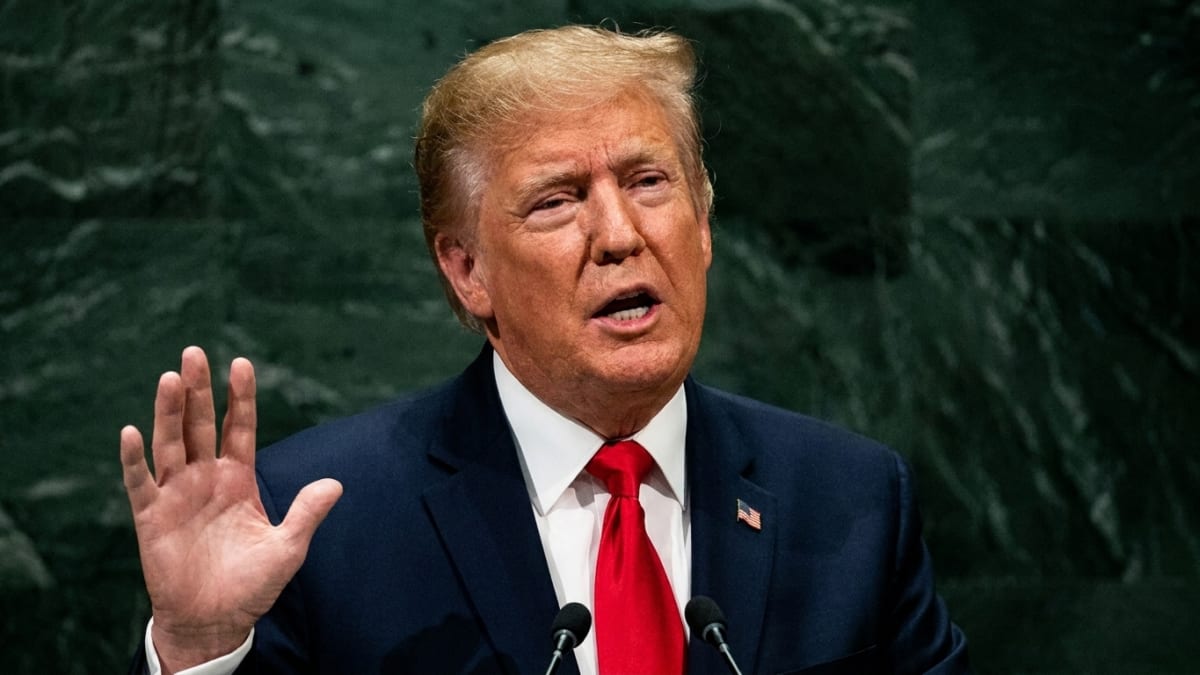
There is something instructive about choosing the United Nations General Assembly to deliver an ultimatum. The Iranian delegation, by convention, sits in the room. Whatever is said lands as a performance, witnessed by the very parties it concerns. Donald Trump, who has never been confused about the value of spectacle, understood this perfectly on 22 September 2026.
Trump characterised Iran as the world's leading sponsor of terrorism and reiterated his administration's commitment to preventing Iranian nuclear weapons development. [1] The offer that followed was spare: Iran could negotiate a peace arrangement permitting it to rebuild under strict conditions, or face outright annihilation. The timing, he made clear, was tethered to the November midterm elections and whatever congressional arithmetic followed them.
What the war has already cost
Moody's Analytics estimated the conflict has cost American consumers and taxpayers about 132 billion dollars, a figure entered into the Senate Congressional Record on 23 June 2026. [2] The Center for Strategic and International Studies placed Operation Epic Fury's direct military spending at 40 billion dollars, while Americans spent over one hundred billion dollars on extra gasoline and diesel costs alone since the war began on 28 February 2026. [3]
The Senate Congressional Record recorded fourteen American service-members killed and hundreds wounded since hostilities began. [2] These are numbers that accumulate quietly until a president says them aloud in a chamber designed for exactly that kind of accounting.
Oil, the strait, and the price of posturing
Markets do not wait for speeches to end before drawing conclusions. Brent crude fell to about 99 dollars a barrel on 22 September 2026, a two-week low, a price that concentrates minds along the Persian Gulf and in every capital that depends on uninterrupted energy flows. [4] The Strait of Hormuz, through which nearly a fifth of the world's oil and a quarter of its liquefied natural gas pass, sits at the centre of every calculation.
Qatar's Ministry of Foreign Affairs staked out its position clearly on 8 September 2026, calling the immediate and unconditional reopening of the strait a top priority for global trade, energy supplies and economic stability. [5] Saudi Arabia, another Gulf Cooperation Council member with acute exposure to any escalation, pressed similar concerns through regional channels. The Gulf states need the waterway open regardless of which version of Trump's binary eventually prevails.
Tehran's answer
Iran's Islamic Revolutionary Guard Corps offered its own reading of the situation on the same day Trump spoke. IRGC Brigadier General Hossein Mohebbi said Washington would gain nothing but failure from any such action against Iran. [6] The statement was directed at the possibility of a strike on Pickaxe Mountain, a fortified position the IRGC described as fully defended.
Trump framed the diplomatic window in electoral terms: what happens after November depends on which party controls Congress. The midterms function as a structural pause in the conflict's logic, a moment when the arithmetic of American domestic politics intersects with the arithmetic of Persian Gulf oil prices, and Brent crude fell to about 99 dollars a barrel on 22 September 2026. [4]
KEY TAKEAWAYS
SOURCES & CITATIONS
FREQUENTLY ASKED QUESTIONS
When did the US-Iran conflict begin?
What exactly did Trump offer Iran at the UN?
How much has the conflict cost the United States?
Why does the Strait of Hormuz matter to this conflict?
Margaret Hale writes about politics, policy and the culture of business. She is drawn to the people behind decisions and to the moments when a political story turns out to be a human one.
Important
This article contains general information about commodity prices and economic impacts. It does not constitute financial advice. Readers should seek professional financial advice before making investment decisions based on energy price movements or geopolitical analysis.