TLDR
Emmanuel Macron used his final UN General Assembly address to call for open-source frontier AI models built outside US and Chinese control, warning against a return to the law of the jungle. He also proposed a moratorium on strikes targeting Ukrainian energy and civilian infrastructure, and condemned the absence of humanitarian corridors in Gaza.
The farewell with a blueprint attached
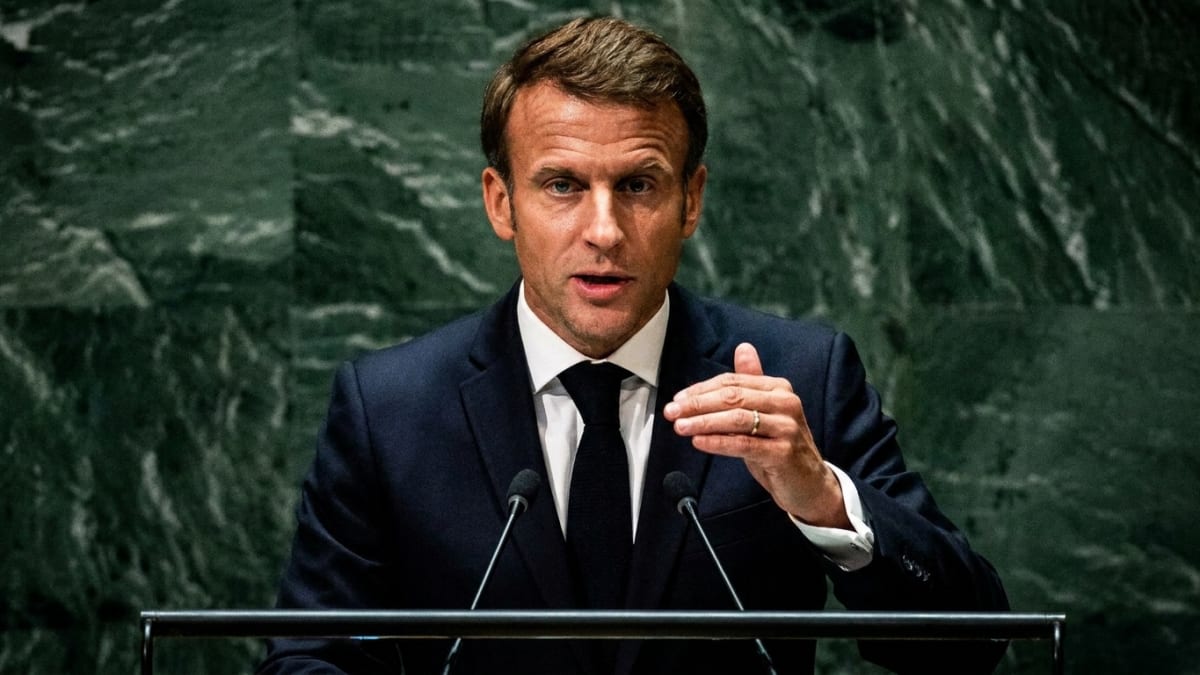
There is something telling about a leader who uses his final appearance on the world's most ceremonial stage to talk about software architecture. Emmanuel Macron addressed the 81st session of the United Nations General Assembly on 22 September 2026, and the speech was, by design, his last in that room as French president.[1] He chose to spend a considerable portion of it on artificial intelligence. The institution was both his subject and his metaphor.
Macron's central warning concerned power concentrating in too few hands. He urged nations to stand firm against the abuse of power by empires and a return to the law of the jungle.[2] The phrase could describe geopolitics broadly, and Macron made clear it applied specifically to the technology shaping it.
The AI sovereignty argument
Macron called for countries to build open-source frontier AI models independent of Washington and Beijing.[3] As reported from the address, he said no nation should become the instrument of one of the great powers, and that nations must instead unite their forces to create an open-source frontier model, a cutting-edge system that harnesses all their computing capacities.
Macron has made European digital sovereignty a recurring theme, but the audience in New York shifted the ambition considerably. Addressing the General Assembly rather than European partners, he pitched a third-bloc model to a room containing both the non-aligned world and the great powers he named by implication. The pitch asks nations to pool computing capacity and contribute to a shared model outside proprietary US and Chinese systems, though what governance framework would administer such a model, and who would audit it, went unspecified.
For Australia, the implications are concrete even if the pathway remains unclear. Canberra's AI research partnerships run overwhelmingly through US institutions and US-based platforms. A credible third-bloc model, open-source and multilaterally governed, would present genuine alternatives across defence technology supply chains, university research agreements and sovereign data infrastructure. Whether Australia would join such an arrangement involves the same tension running through every AUKUS conversation: alignment with Washington versus strategic hedge. Macron named that tension without resolving it.
Ukraine, Gaza and the test of said principles
Macron proposed securing a moratorium on strikes on energy infrastructure and against Ukrainian civilian infrastructure, framing it as a measurable test of multilateral resolve.[4] Read one way, the proposal is modest: a pause on one category of attack rather than a ceasefire. Read another, it is a direct challenge to Russia to do something verifiable in full view of the assembly.
On Gaza, Macron discarded diplomatic hedging entirely. He told the assembly that not a single humanitarian corridor had been reopened in the enclave despite the proclaimed peace, then asked whether the world must stand by and watch what he called a spectacle that shames us all.[2] The word spectacle did the work he intended, characterising the diplomatic performance as theatre staged at the expense of people without food or medical access.
Macron's nine years of UN addresses closed without a soft landing. His term as French president ends before the next General Assembly session, so the next address from the Élysée will belong to someone else. The 81st session of the UN General Assembly continues through late September 2026.[1]
KEY TAKEAWAYS
SOURCES & CITATIONS
FREQUENTLY ASKED QUESTIONS
What did Macron propose on artificial intelligence at the UN?
Why was this Macron's last UN General Assembly speech?
What did Macron say about Gaza?
What is Macron's Ukraine moratorium proposal?
Margaret Hale writes about politics, policy and the culture of business. She is drawn to the people behind decisions and to the moments when a political story turns out to be a human one.