

TLDR
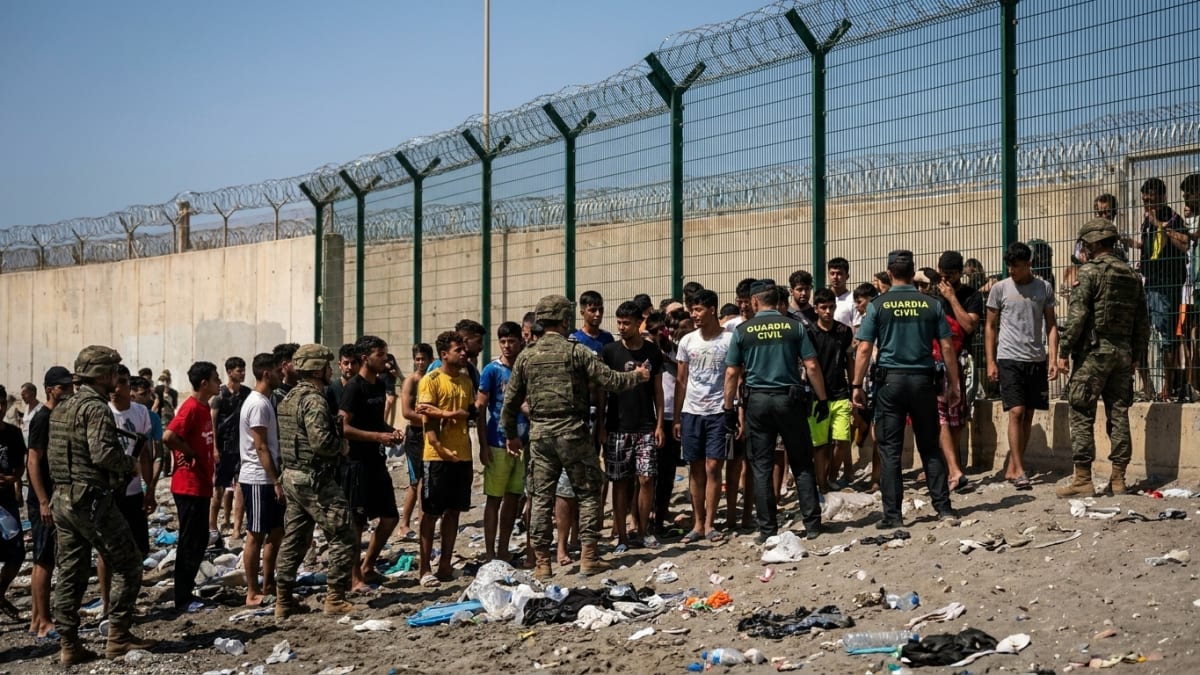
At least 57 people died as up to 60,000 crossed from Morocco into the Spanish enclave of Ceuta in a single day. Spain's Supreme Court had ruled on 29 June 2026 that migrants intercepted at sea near Ceuta could no longer be summarily returned, and Prime Minister Pedro Sanchez said trafficking networks exploited that ruling to trigger the surge. More than 48,300 people voluntarily returned to Morocco by Friday evening. Spain deployed extra police and soldiers and announced a temporary reception and expulsion centre. The Irish EU presidency convened a crisis meeting, and EU ambassadors were scheduled to meet Monday as some member states called for Spain's suspension from the Schengen zone.
KEY TAKEAWAYS
Scale of the crossing
At least 57 people died and an estimated 50,000 to 60,000 crossed from Morocco into the Spanish enclave of Ceuta in a single day, overwhelming a city of just 85,000 permanent residents. Spain's interior ministry put arrivals at more than 50,000; Ceuta's own president placed the figure closer to 60,000. Bodies were pulled from the water or found on rocky shorelines, making this one of the deadliest single-day events at any European border in recent memory.
Ceuta and Melilla are the only two Spanish territories on the African continent, sitting along Morocco's northern coast and enclosed by land-border fences, patrol roads and coastal barriers. Their geography makes them perennial focal points for irregular migration into the European Union. Between 1 January and 31 May 2026, terrestrial irregular arrivals to Ceuta alone totalled 2,281, a 224 per cent year-on-year increase.verifiedVerified Source: dsn.gob.es[1] That surge was already accelerating before the mass crossing; the events of late July represented a break from even that elevated baseline.
The court ruling that changed the legal landscape
Spain's sea-border enforcement lost its legal footing on 29 June 2026, when the Supreme Court's Fifth Section of the Contentious-Administrative Chamber handed down judgment in case No. 814/2026 (Rec. 3795/2025). The case concerned an Algerian national intercepted at sea on 14 November 2024 while attempting to swim into Ceuta.[2] One man's appeal became the instrument that stripped authorities of the power to turn boats and swimmers around on the spot.
The court ruled that the Additional Provision Tenth of Spain's Organic Law on Foreigners, the provision informally authorising so-called hot returns, does not apply to migrants intercepted at sea attempting to enter Ceuta or Melilla.verifiedVerified Source: iberley.es[2] Those intercepted in the water must instead go through the formal return procedure under Article 58.3 of the law, which requires a prior hearing, written reasons and the possibility of judicial review.[3]
The ruling did not open a legal right to remain in Spain. It did remove the mechanism by which coastguard vessels could push back swimmers and boats immediately, before any administrative process began.[3] Spain had relied on that provision since it was inserted into the Foreigners Law in 2014, extending its application over the years from land-border crossings to high-sea interceptions off both enclaves. The court's June 2026 judgment closed that extension definitively.[4]
Spain's response: deployments, buoys and expulsion centre
Pedro Sanchez described the mass crossing as a violation of Spain's territorial integrity, saying trafficking networks had spread word of the Supreme Court ruling through their channels and used it as a signal that the sea route into Ceuta was legally unguarded. Spain deployed additional national police and military personnel to the enclave, installed floating barrier buoys along sections of the coastline, and announced a temporary reception and expedited expulsion centre to process arrivals rapidly and return those without valid asylum claims.
The speed of voluntary departures was notable. More than 48,300 people had voluntarily returned to Morocco by 6pm Friday, according to Spain's interior ministry.verifiedVerified Source: dsn.gob.es That figure, if accurate, means the majority of those who crossed had turned back within hours, though it does not address the situation of those who remained, nor the 57 confirmed dead.
The rupture was stark against recent trends. In the first five months of 2026, overall irregular arrivals to Spain had actually fallen 35 per cent compared with the same period in 2025, totalling 10,224 people across all routes.[1] Terrestrial arrivals to Melilla in the same period numbered just 85, up 46 per cent year-on-year but still a marginal figure.[1] A single-day crossing of 50,000 to 60,000 was not a continuation of any trend.
EU reaction and the Schengen question
The Irish presidency of the European Union convened a crisis meeting as footage and casualty figures circulated across European capitals. Some member states called for Spain's suspension from the Schengen zone, a measure that would reimpose passport controls on Spain's internal EU borders. EU ambassadors were scheduled to meet Monday to discuss the situation formally.
The tension between a court ruling grounded in procedural rights and the political reality of a mass crossing concentrated minds in Brussels. How the EU responds to a judgment by a member state's own Supreme Court that constrains border enforcement will have direct implications for migration management across the Mediterranean.
Context: May 2021 and the longer pattern
The closest historical comparison is May 2021, when Morocco relaxed its border controls and roughly 10,000 people entered Ceuta over two days. That event prompted a Spanish political crisis and bilateral tensions with Rabat that took months to resolve. The July 2026 crossing, on figures at least five times larger in a single day, is a different order of magnitude.
Ceuta's structural position as the only land border between Africa and the EU's Schengen area makes it a permanent pressure point. Spain conducts Operation Paso del Estrecho each summer, managing more than 400,000 vehicles and 1.6 million passengers crossing the Strait of Gibraltar during peak months. The Supreme Court's June ruling did not create that pressure; it removed one of the legal instruments Spain had used to manage it.
SOURCES & CITATIONS
- Spain National Security Department, Migration Flows Update, June 2026
- Tribunal Supremo, Sala de lo Contencioso-Administrativo, Sección Quinta, Sentencia No. 814/2026
- El Faro de Ceuta, Supremo prohíbe devolver en caliente a inmigrantes que entran nadando
- Infolibre, Sentencia del Supremo confirma ilegalidad de devoluciones en caliente de migrantes llegados por mar
- At least 57 die as tens of thousands cross to Spanish enclave of Ceuta, The Guardian
- Tens of thousands of migrants voluntarily leave after crossing into Ceuta, AP News
- Spain's PM blames traffickers after 60,000 migrants reach Ceuta, BBC News
FREQUENTLY ASKED QUESTIONS
What did Spain's Supreme Court rule on sea pushbacks?
How does the July 2026 Ceuta crossing compare with May 2021?
How many people returned to Morocco after the crossing?
What is the Schengen zone and why is its suspension being discussed?
Nadia Petrova writes about geopolitics, defence and foreign affairs. She is interested in how decisions made far away arrive on Australian shores.