
TLDR
Thirty people are dead and at least 62 injured after a magnitude 7.1 earthquake struck Kumamoto Prefecture in southern Japan at 4:27 p.m. local time on Tuesday. Nearly 5,000 Self-Defence Force personnel are searching collapsed buildings in 35-degree heat, with a magnitude 5.8 aftershock overnight halting work and the critical 72-hour survival window closing fast. Aeon evacuated about 3,000 shoppers to a car park before a gas explosion tore through a separate part of the mall, and thousands more are sleeping in evacuation centres without power or water.
KEY TAKEAWAYS
The toll and the clock
Thirty people are dead. At least 62 others are injured, five of them seriously, after a magnitude 7.1 earthquake struck the Kumamoto region of Kumamoto Prefecture at approximately 4:27 p.m. Japan Standard Time on Tuesday, registering a maximum seismic intensity of 7 in Hikawa Town and Uki CityverifiedVerified Source: data.jma.go.jp.[1] The quake struck at a depth of about 10 kilometres, shallow enough to produce the violent surface shaking that pancakes reinforced concrete.
For rescue teams, the clock is as dangerous as the rubble. The 72-hour window after a major earthquake marks the outer boundary of realistic survival for people trapped beneath collapsed structures, with dehydration, injury and exposure cutting those chances sharply after that point.[5] Tuesday afternoon was consumed by the initial shock and damage assessment, so teams entered Wednesday morning knowing every hour counted.
Heat and aftershocks squeeze every hour
Conditions on the ground are close to the worst rescue planners could face. Temperatures in Kumamoto reached 35 degrees Celsius through the day, slowing the pace at which personnel can safely work and raising the risk of heat illness for survivors and searchers alike. Then, at about 7:22 p.m. JST on Tuesday, a magnitude 5.8 aftershock struck the same epicentral area, registering an estimated intensity of upper 3 and briefly halting rescue operations overnightverifiedVerified Source: data.jma.go.jp.[4]
Each halt, whether caused by tremors or heat, is time that people under the rubble do not have. Japan's meteorological and disaster management agencies maintain continuous monitoring and coordinate aftershock warnings with teams on the ground, but the physics of survival do not bend to organisational efficiency.
Aeon Mall and the paper mill
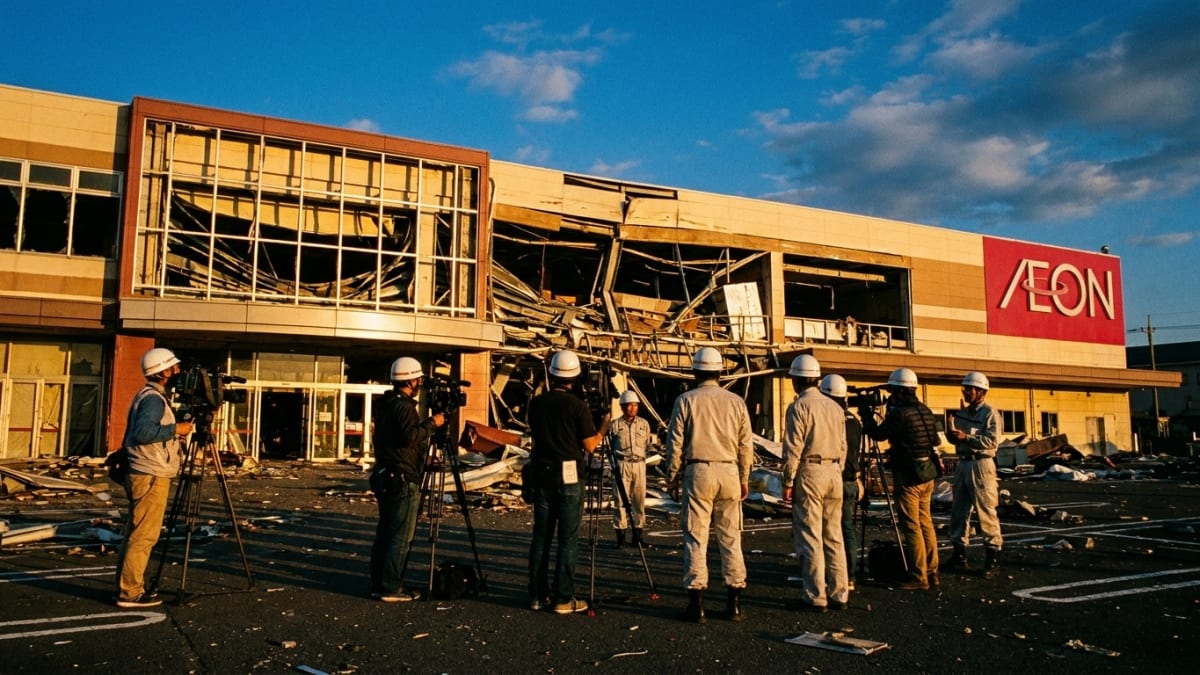
The most visible search site is Aeon Mall Kumamoto in the Kashima district, where part of the building collapsed during the initial tremor. Aeon said it evacuated about 3,000 customers to the mall's car park before a gas explosion occurred in a separate section of the building.[5] The combination of structural collapse and a subsequent gas explosion complicated both access and the safety envelope for search teams working inside.
The Ministry of Defence deployed approximately 3,600 personnel of the Ground Self-Defence Force's 8th Division, supported by Navy and Air Self-Defence Force aircraft, to conduct search, reconnaissance and rescue operations across Aeon Mall Kumamoto and surrounding collapsed homes.verifiedVerified Source: mod.go.jp[3] The total number of Self-Defence Force personnel involved in all related operations reached close to 5,000 when Navy and Air support units are counted alongside ground forces.
A nearby paper mill is also listed as a priority search site, with personnel moving between collapsed industrial buildings and residential streets. Defence Minister Yasuo Ishihara said the Self-Defence Forces deployed 20 aircraft for damage reconnaissance and commenced disaster operations at the mall and surrounding areas.[3]
Government response
Prime Minister Sanae Takaichi moved quickly after the initial shock. Takaichi said a tsunami advisory had been issued for the Ariake and Yatsushiro seas, with instructions to stay away from coastal areas, and she directed all ministries to assess damage as soon as possible and, under the principle of human life first, to spare no effort in saving lives and rescuing disaster victims.[2]
The Prime Minister's office instructed all relevant ministries and agencies to coordinate closely with local governments and prioritise emergency search and rescue above all other functions.[2] A tsunami advisory was issued for coastal stretches of the Ariake and Yatsushiro seas following the initial tremor, though the main destruction remained inland across the Kumamoto region.
Evacuation centres and infrastructure
Thousands of residents spent Tuesday night in evacuation centres after power and water supplies failed across parts of the affected area. Some communities remained without either service into Wednesday morning, raising concerns about sanitation and the health of elderly and infirm evacuees sheltering in school gymnasiums and community halls.
Kumamoto Castle, the sixteenth-century fortification that became a symbol of the city's resilience after the 2016 quakes, sustained further damage. A stone retaining wall within the castle precinct collapsed during Tuesday's tremor, adding to the historic site's list of earthquake injuries. The castle had only recently completed repairs from the 2016 sequence, a decade-long restoration effort that drew significant public and governmental attention.
Kumamoto's fault history
The prefecture sits near a complex fault system in central Kyushu. In April 2016, a sequence of temblors beginning with a magnitude 6.5 foreshock and culminating in a magnitude 7.3 main shock killed 49 people, injured more than 1,600 and left tens of thousands without homes for months.[5] That earlier disaster reshaped building codes and emergency response planning across the region, and much of the infrastructure that collapsed on Tuesday had been rebuilt or reinforced in the decade since.
That context sharpens the questions authorities will face once the immediate rescue phase concludes. Buildings that were supposed to be safer, in a city that had already learned the hard way about earthquake preparedness, have again failed their occupants. Japan's disaster-response framework, the coordination between the Japan Meteorological Agency, municipal governments, national ministries and Self-Defence Forces units, is functioning as designed.[2] Whether the built environment matched that preparedness is a question for the investigations that follow.
For now, the count stands at 30 dead, 62 injured, and an unknown number still beneath the rubble of Kashima and the surrounding towns. Rescuers are working against the heat, the aftershocks and the calendar. Wednesday is the day the 72-hour window closes.
SOURCES & CITATIONS
- Japan Meteorological Agency: Earthquake early warning reach-time data, 28 July 2026
- Prime Minister's Office of Japan: Chief Cabinet Secretary press conference, 28 July 2026
- Japan Ministry of Defence: Defence Minister press conference on disaster dispatch, 28 July 2026
- Japan Meteorological Agency: Aftershock forecast data, 28 July 2026
- Aeon Mall collapse and evacuation details, 28 July 2026
FREQUENTLY ASKED QUESTIONS
How strong was the Kumamoto earthquake on 28 July 2026?
Why is the 72-hour window important in earthquake rescues?
What happened at Aeon Mall Kumamoto?
Has Kumamoto experienced major earthquakes before?
Caleb Reed covers breaking news and sport. He works to the rhythm of a story as it unfolds, and he is happiest when the facts arrive faster than anyone can spin them.