

TLDR
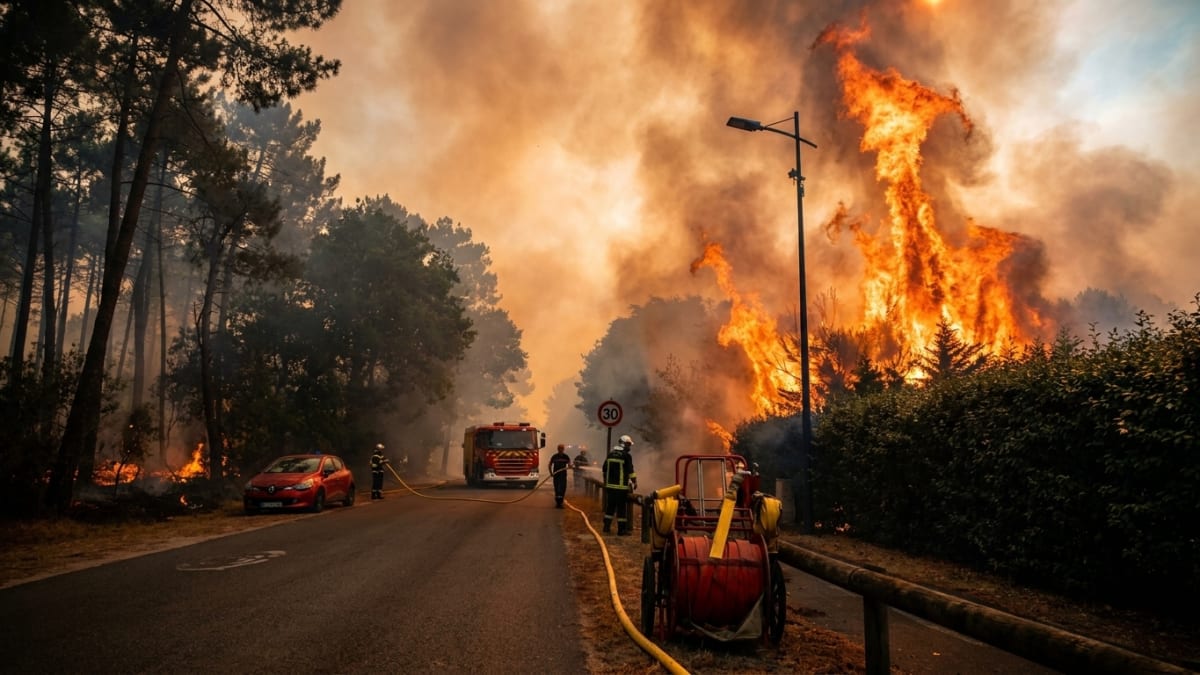
More than 300,000 people have been ordered from their homes in France and Spain as wildfires driven by record heat tear through southern Europe, in what French authorities describe as the largest civilian evacuation outside wartime. France alone has recorded 116,085 hectares burned this year, while Spain's 2026 season has already scorched five times more land than the same period in 2025. The EU has deployed 777 pre-positioned firefighters from 14 member states under its civil protection mechanism, though the system still requires formal national requests before aid can move. Officials are calling for structural reform, more funding and a shift from reaction to preparation before the fire front reaches Greece, Italy and central Europe in the weeks ahead.
KEY TAKEAWAYS
Moving 300,000 people in days
Wildfires burning across southwestern France and Spain have displaced more than 300,000 people, triggering one of Europe's largest ever evacuation operations.verifiedVerified Source: civil-protection-humanitarian-aid.ec.europa.eu[1] French Interior Minister Laurent Nuñez said the Gironde region alone had seen 220,000 residents ordered from their homes by 24 July 2026, and said they were the biggest fires of the season.[2]
Roughly 110,000 additional evacuees fled fires in Spain, bringing the combined total to approximately 330,000. Residents in both countries were told they could not return home until the fires were brought under control.[1]
Moving that many people demands rapid coordination between civil protection agencies, transport operators and local authorities, along with the quick establishment of shelter, medical care and basic services for populations that may be displaced for days or weeks. The scale is hard to absorb: 330,000 people is roughly the population of Canberra, relocated under fire threat in the space of days.
Why this fire season burns differently
France recorded 116,085 hectares burned since the start of 2026verifiedVerified Source: interieur.gouv.fr, with a third consecutive heatwave driving temperatures toward 42°C across the southwest.[2] Prolonged drought has left forests tinder-dry well beyond the traditional fire season, extending the window during which any ignition can turn catastrophic.
Spain's 2026 season had already burned more than 131,000 hectares by late July, five times the area destroyed by the same date in 2025.verifiedVerified Source: dsn.gob.es[3] Spanish Prime Minister Pedro Sánchez said climate denialism was the worst of fuels, linking the conditions directly to long-term warming trends.
Climate scientists have said for years that southern Europe faces a longer, hotter fire season as average temperatures climb. This summer's combination of record heat and entrenched drought has validated those projections in the most direct terms possible.
What the EU civil protection system can do
Europe did not face this season unprepared on paper. As early as June 2026, the EU activated its largest-ever pre-positioned wildfire response, placing 777 firefighters from 14 member states in high-risk areas across the continent.[4] Specialist aircraft and rescue teams were also pre-positioned under the EU's rescEU reserve, designed to give member states immediate cross-border reinforcement.
EU Commissioner for Preparedness and Crisis Management Hadja Lahbib said that when fires threaten communities, Europe responds as one.[4] The mechanism moves quickly once activated, but its structure still requires an affected country to formally request assistance before cross-border aid can flow.
That requirement introduces a lag. In fast-moving fire conditions, hours matter. Officials have pointed to the gap between risk forecasting and the moment national governments formally trigger a request as a structural weakness the current system has not resolved.
What officials want changed
Lahbib used the crisis to press a broader argument: Europe must prepare for risks before disasters strike, not simply absorb them afterwards. Lahbib called for more funding, better public education on fire risk, and renewed attention to forest management as a preventive tool.[1]
The civil protection mechanism, while expanded significantly in recent years, remains dependent on national political will and budget cycles. Pre-positioning 777 firefighters represents genuine progress, but officials warn that number will not stretch far if Greece, Italy and central Europe all enter acute fire conditions simultaneously in August, as current forecasts suggest they might.[1]
What Australian readers who know bushfire should take from this
Australians who lived through Black Summer in 2019 and 2020 will recognise the mechanics: consecutive heatwaves compressing humidity, a drought-primed landscape, fires that run faster than suppression lines and evacuations that outpace official instructions. What is different in Europe is institutional. Australia spent years after Black Summer rebuilding its national coordination frameworks and pre-positioning aerial assets. Europe is mid-reform, and this season is arriving before those reforms are complete.
The comparison also runs to scale. Black Summer burned roughly 18.6 million hectares across Australia. The fires now burning in France and Spain have collectively destroyed around 247,000 hectares across both countries so far in 2026, a fraction of that figure but occurring in densely populated landscapes with far less institutional fire-culture history.[2][3]
EU emergency officials have identified Greece, Italy and parts of central Europe as the next regions facing elevated fire risk in the weeks ahead, with the 2026 northern hemisphere summer showing no sign of easing.
SOURCES & CITATIONS
- EU sends planes and firefighters as wildfires ravage France and Spain
- Sur terre et dans les airs, combattre le feu sur tous les fronts, French Interior Ministry
- Incendios forestales 26 julio 2026, Dirección de Seguridad Nacional de España
- EU deploys largest ever wildfire response for 2026 summer, European Civil Protection
FREQUENTLY ASKED QUESTIONS
How many people have been evacuated due to the European wildfires in 2026?
How does the EU coordinate its wildfire response across member states?
How does Spain's 2026 wildfire season compare to previous years?
Which parts of Europe face the highest fire risk in the coming weeks?
Alex Mercer writes about technology, energy and infrastructure. He likes the physical end of the story: the plants, the grids and the machines that everything else depends on.