TLDR
The Reserve Bank's rise to 4.60 per cent leaves Australia with the second-highest cash rate among 41 advanced economies, behind only Iceland. Ten-year bond yields simultaneously hit 5.40 per cent, their highest since 2011, bearing down on the roughly 70 per cent of mortgage holders on variable terms.
Where Australia sits in the global rate landscape
The Reserve Bank of Australia Board raised the cash rate target by 25 basis points to 4.60 per cent at its meeting on 29 September 2026, placing Australia in uncomfortably thin company.[1] Among the 41 economies the IMF classifies as advanced, only Iceland sits higher, its Monetary Policy Committee having set the rate on seven-day term deposits at 8.00 per cent in August.[3] The distance between the two outliers is wide enough that the comparison says more about Iceland's circumstances than Australia's. The ranking still carries a practical consequence: every other peer economy is now cheaper to borrow in.
The yield curve tightens the vice
Australia's ten-year government bond yield reached around 5.40 per cent as at 24 September 2026, its highest point since 2011.[4] For the roughly 70 per cent of outstanding residential mortgages on variable-rate terms, the cash rate decision transmits almost immediately through lender standard variable rates. Fixed-rate borrowers face a benchmark that has not been this elevated in fifteen years when they come to refinance.
Rising long yields carry a secondary effect on the Australian dollar. Higher bond returns tend to attract foreign portfolio inflows, which support the currency, welcome for importers, less so for exporters already managing elevated domestic costs. The two pressures do not cancel neatly, and they do not resolve quickly.
Bullock's rationale, in her own words
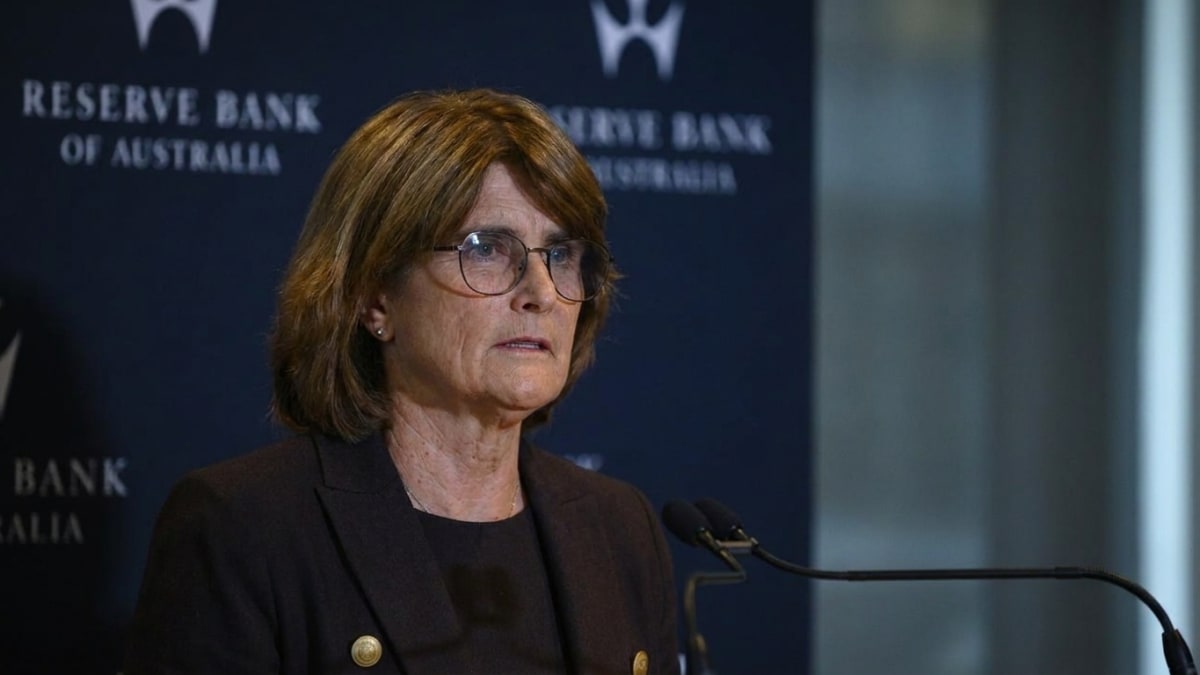
Governor Michele Bullock offered a blunt summary of the board's thinking on the day of the decision. Bullock said on 29 September 2026 that higher interest rates are needed to ensure inflation returns to target.[7] That sentence reads plainly enough, but it conceals a conditional: the board's willingness to tighten further depends on whether incoming data show inflation converging toward the target band, and the incoming data have not been cooperative.
The ABS monthly consumer price index showed headline inflation of 4.0 per cent in the 12 months to August 2026, up from 3.5 per cent in July, a reading the board had in hand before the September meeting.ABS: Consumer Price Index, Australia, August 2026 The monthly series gives the board a timelier read than the old quarterly cycle. When headline and underlying measures diverge, the direction of the gap tends to be informative even if the precise level differs.
Households absorbing cumulative weight
The Westpac, Melbourne Institute Consumer Sentiment Index fell 5.2 per cent in September 2026 to 84.4, down from 88.9 in August, a reading that sits well below the 100-point neutral mark separating pessimists from optimists.[6] Sentiment at this level reflects the cumulative weight of repeated tightening rather than any single decision. Households that have absorbed twelve months of elevated repayments do not reset their expectations from one meeting to the next.
The board's next scheduled meeting falls in November 2026, at which point updated quarterly CPI data will be available and the Melbourne Institute gauge will have printed at least one more reading. Whether those figures give the board room to pause, or reason to move again, will depend on whether services inflation, which has proven stickier than goods prices across the current cycle, shows any meaningful deceleration.
KEY TAKEAWAYS
SOURCES & CITATIONS
- RBA Media Release: Cash Rate Decision, 29 September 2026
- IMF World Economic Outlook Statistical Appendix, October 2024
- Central Bank of Iceland: Monetary Policy Committee Statement, 19 August 2026
- RBA Chart Pack, 30 September 2026
- Melbourne Institute Monthly Inflation Gauge, August 2026
- Westpac, Melbourne Institute Consumer Sentiment, September 2026
- Governor Bullock speech, 29 September 2026
FREQUENTLY ASKED QUESTIONS
Why does Australia have one of the highest interest rates among advanced economies?
How does the cash rate rise affect mortgage holders?
Which country has the highest interest rate among advanced economies?
Elias Thorne writes about interest rates, the bond market and the Reserve Bank. He is interested in what monetary policy actually does to household budgets, and in the long stretches of economic history that tend to repeat.