
TLDR
Fiji's Constitution Review Commission has recommended repealing the absolute immunity shielding participants in the 1987, 2000 and 2006 coups, a protection that covers Prime Minister Sitiveni Rabuka. The military backs the change, but Rabuka has declined to endorse it, pointing instead to a Supreme Court ruling that the clauses are entrenched.
The commission's recommendation
Fiji's Constitution Review Commission tabled its report in Parliament on 22 September 2026, recommending the repeal of Chapter 10 of the 2013 Constitution, the provisions that grant absolute and irrevocable immunity from criminal, civil and professional liability to participants in the coups of 1987, 2000 and 2006.[1] The report, exceeding 200 pages, followed nationwide consultations with civil society, traditional leaders and the military.
Prime Minister Sitiveni Rabuka, who led the 1987 coups, sits within the scope of Section 159. Removing that protection is precisely what the commission now recommends, placing the elected head of government in the unusual position of presiding over a constitutional reform that targets his own legal shelter.
Military backs it, Rabuka hedges
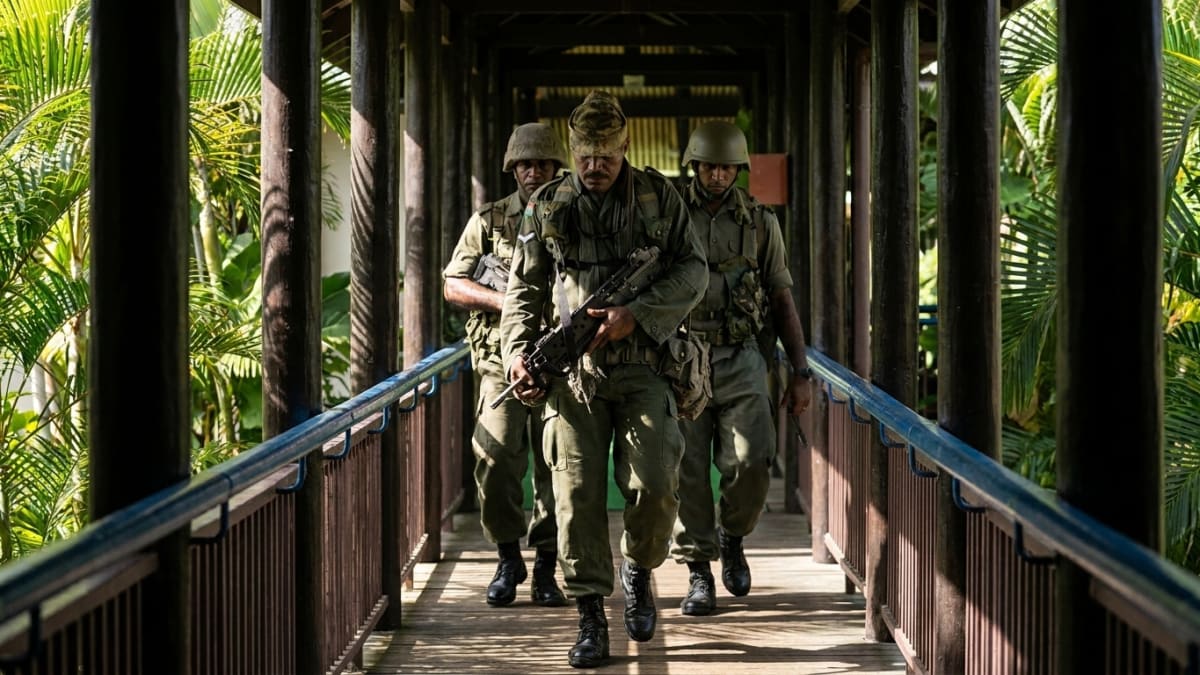
Major General Ro Jone Kalouniwai, Commander of the Republic of Fiji Military Forces, declared support for repeal on 2 July 2026, well before the report landed.[2] Kalouniwai said immunity clauses have created a two-tier legal system by shielding some individuals from legal action while ordinary citizens remain subject to the law.[2]
Rabuka stopped short of endorsing the repeal, deflecting to the judiciary rather than the commission's findings.[5] "Well, the Supreme Court has ruled on the position of the immunity in the constitution and we'll have to respect that decision," Rabuka said, adding that the commission's document remained a recommendation, not a draft law: "That's not the draft, that is the recommendation from the CRC."[5]
Kalouniwai's institution has formally stepped away from the immunity shield; the government has not, and that gap will shape whatever legislative path follows.
The legal mountain
The Supreme Court's August 2025 advisory opinion sits at the centre of this debate. The court ruled that the immunity provisions in Section 159 are entrenched and cannot be amended by ordinary constitutional amendment.[3] Rabuka's reference to that ruling was not incidental; it is the strongest procedural argument available to anyone who prefers the status quo.
Even setting the court opinion aside, the formal threshold for repeal is steep. A constitutional amendment bill must pass with support from at least three-quarters of all members of Parliament, with a mandatory 30-day interval between second and third readings, a committee report and presidential referral, after which a referendum must return approval from three-quarters of registered voters before presidential assent follows.[4] No government in Fiji has cleared that bar on a contested constitutional question.
What the report also proposes
The immunity question has drawn the most immediate attention, but the commission's structural proposals carry their own weight. The report recommends scrapping the current single-chamber Parliament and replacing it with a 41-member House of Representatives elected by first-past-the-post constituencies and a 19-member Senate.[1] That architecture would represent a significant departure from the proportional system embedded in the 2013 Constitution.
For Canberra, the report arrives at a moment when Australia's Pacific engagement turns heavily on governance credibility. Fiji remains a key partner in the Pacific Islands Forum, and a constitutional process that publicly exposes the distance between a military commander demanding legal equality and a prime minister sheltering behind a court ruling will register on Australian foreign-policy desks. The commission's report now sits in Parliament, and the government has not said when it will respond.
KEY TAKEAWAYS
SOURCES & CITATIONS
FREQUENTLY ASKED QUESTIONS
What is Section 159 of Fiji's constitution?
Does the commission's recommendation automatically change the law?
Why did the Supreme Court rule the provisions cannot be amended?
Simon Wu writes about Asia-Pacific markets and China's economy. He reads the Chinese-language financial press closely and looks for the stories that reach Australia before anyone here notices.