
TLDR
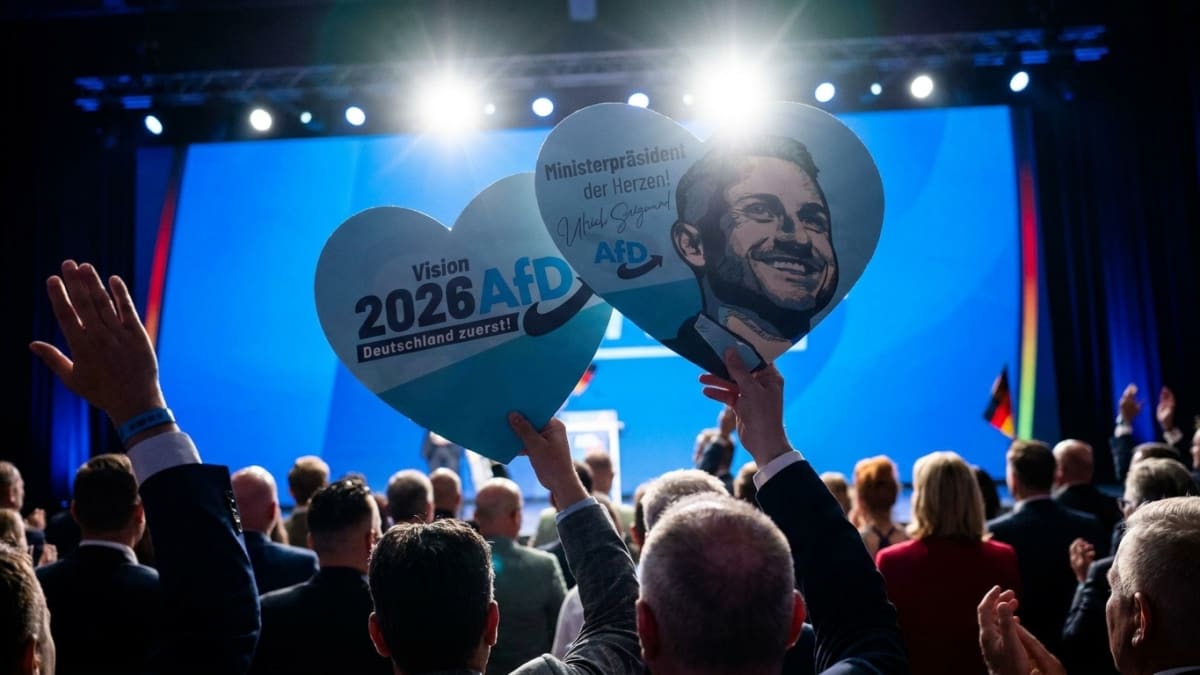
Germany's far-right Alternative for Germany party claimed 38.2 per cent in the Mecklenburg-Vorpommern state election, its highest ever result and second consecutive state victory in a fortnight. Chancellor Friedrich Merz's CDU collapsed to 4.9 per cent, losing all seats. Merz called it a disaster.
The arithmetic of alarm
There is something almost forensic about the moment a governing party falls below a parliamentary threshold. The percentage ceases to be merely low; it becomes annihilating, producing an outcome in which the party vanishes from the chamber entirely, and the number that caused it gets repeated until it acquires the texture of a verdict.
That is the condition of Friedrich Merz's Christian Democratic Union in Mecklenburg-Vorpommern after the state election held on 20 September 2026. The CDU received 4.9 per cent of the second vote, failing to clear the five per cent threshold and leaving the party without a single seat in the state parliament.[1] For a party that has governed Germany at the federal level for the better part of three decades, it is a figure that resists comfortable interpretation.
The numbers
The Alternative for Germany party took 38.2 per cent of the second vote, its highest result in any German state election to date.[1] The Social Democratic Party came second on 35.5 per cent, followed by the Left on 6.5 per cent and the Greens on 5.7 per cent.[1] Four parties cleared the threshold, and the AfD, despite topping the poll, will be invited to form or join nothing, given every other party's explicit refusal to govern alongside it.
That refusal, known in German political shorthand as the firewall, keeps the coalition arithmetic navigable, if uncomfortable. The SPD, the Left and the Greens together hold enough seats to govern without the AfD, though whether that arrangement holds in practice is a separate question from whether it holds in theory, and state-level coalition talks in Germany have a habit of taking months to answer it.
Merz delivers his own verdict
Chancellors rarely describe their own party's results in unsparing terms. Merz did. "The results in Mecklenburg-Western Pomerania cannot be sugarcoated; it is a disaster," he said.[3] The candour forecloses the usual retreat into qualified optimism; a chancellor who calls a result a disaster has surrendered the language of resilience, and language in politics is rarely surrendered accidentally.
Mecklenburg-Vorpommern follows a similar pattern two weeks earlier in Saxony-Anhalt, where the AfD also placed first. Two consecutive state defeats for the CDU in Germany's northeast, combined with Merz's own description of the outcome, focus attention on the federal coalition in Berlin, which he leads with SPD and Greens support. Regional ballots carry no direct constitutional weight in Berlin, but they compress the political space in which a federal government operates.
What it means for Australia
Political turbulence inside Germany carries practical weight for Australian trade. Germany is Australia's thirteenth largest trading partner, with two-way trade valued at approximately A$29 billion in 2024.[2] Germany is also the European Union's largest economy, meaning questions about the stability and direction of its federal government carry weight well beyond its own borders.[2]
Coalition instability in Berlin tends to slow policy decisions across trade, energy transition and defence procurement, all areas where Australian exporters and investors have active exposure. A federal government under sustained regional pressure from its own vanishing support base governs with less authority, and whether the CDU's regional collapse finds a floor will shape how much authority Merz retains heading into the next federal test.
KEY TAKEAWAYS
SOURCES & CITATIONS
FREQUENTLY ASKED QUESTIONS
What is the five per cent threshold in German elections?
What is the firewall and does it hold legally?
Does this result affect the federal government in Berlin?
Margaret Hale writes about politics, policy and the culture of business. She is drawn to the people behind decisions and to the moments when a political story turns out to be a human one.