
TLDR
SpaceX recovered its Starship upper stage at the Texas launch tower on 14 November, the first time an orbital Starship has been caught by the tower's mechanical arms. The Super Heavy booster failed to return and exploded in the Gulf of Mexico. Full reusability of both stages remains unproven.
Upper stage caught, booster lost
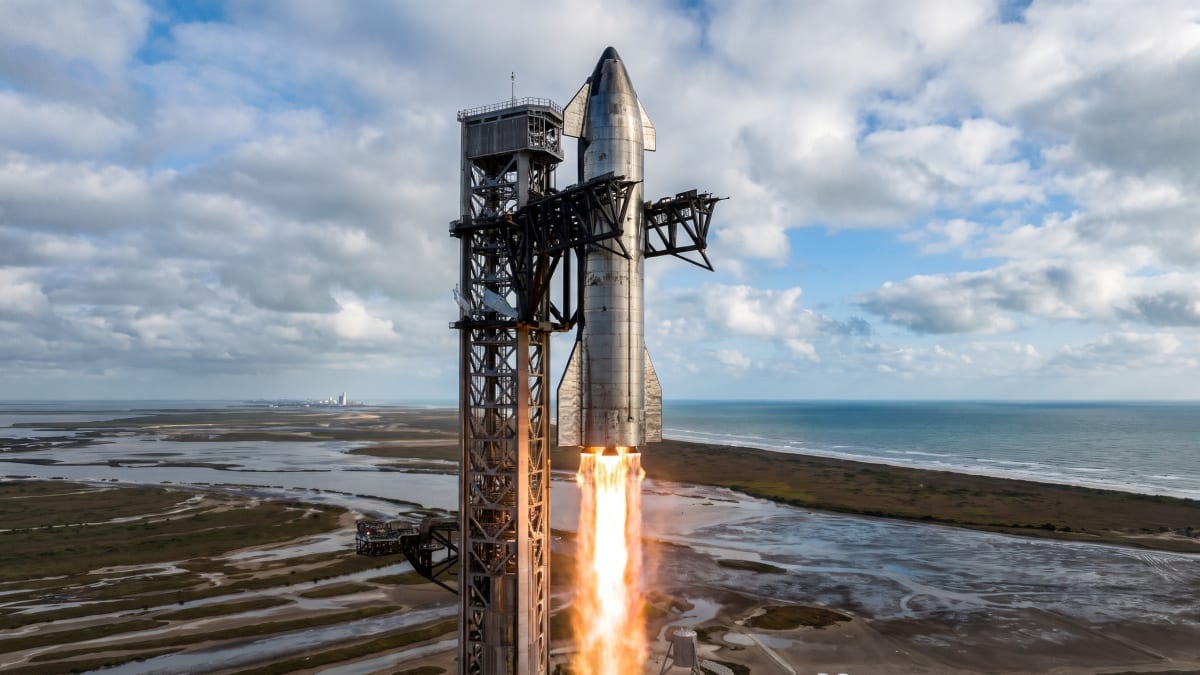
SpaceX recovered its Starship upper stage at the Starbase launch tower in Texas on 14 November, using the tower's mechanical arms to catch the vehicle after a roughly 22-hour orbital mission. The upper stage completed 14 orbits and deployed 26 Starlink satellites before descending into the tower arms, marking the first recovery of a Starship upper stage following an orbital flight.[6]
The Super Heavy booster did not return. SpaceX communications manager Dan Huot said the booster's automated guidance, navigation and control system recognised it was out of position for a tower catch. SpaceX presenter Kate Tice said the booster's engines stopped firing prematurely during descent, and the vehicle was diverted away from the launch site before exploding in the Gulf of Mexico.[6][7]
Fuel shortfall cited
Elon Musk said the booster had been slightly low on fuel.[7] The upper-stage catch confirmed that Starship can survive orbital operations, atmospheric re-entry and the final precision approach to a tower recovery, though the booster failure leaves full two-stage reusability undemonstrated.
Starship's business case depends on recovering both the Super Heavy first stage and the upper stage after every launch. Reusing only the upper stage still requires a replacement booster for each flight, limiting the flight-rate and cost reductions SpaceX has promised operators and NASA.
What the result means for NASA Artemis
NASA is funding SpaceX to develop a Starship-based Human Landing System to carry astronauts from lunar orbit to the Moon's surface and back.[1] The agency's upgraded Version 3 Starship and Super Heavy system underpins that work for Artemis III and a later crewed lunar landing.[2]
Under NASA's revised Artemis architecture, the Starship lander is to rendezvous and dock with the Orion spacecraft in Earth orbit before performing the trans-lunar injection burn for a future lunar mission.[3] Artemis III itself has been redefined as an Earth-orbit demonstration: Orion will dock with test articles from both SpaceX and Blue Origin to validate spacecraft control, communications, software and docking operations before astronauts are committed to lunar flight.[4]
NASA Administrator Jared Isaacman said the agency was executing a national space policy to return American astronauts to the lunar surface in 2028 and establish a Moon base.[3] NASA Artemis program manager Jeremy Parsons said every piece of the Earth-orbit mission was designed to reduce risk before astronauts were put back on the Moon.[4]
NASA says both SpaceX and Blue Origin must complete uncrewed demonstrations of their crewed landers, and NASA must certify the systems, before near-term Artemis crewed lunar missions proceed.[3] NASA's Office of Inspector General found earlier this year that human landing system development challenges had delayed planned Artemis launch dates, while the agency continued oversight and risk-mitigation work with its lander providers.[5]
SpaceX's remaining milestones before the lander can be cleared for astronauts include uncrewed demonstration flights, in-space propellant aggregation and NASA certification of the full system.
KEY TAKEAWAYS
SOURCES & CITATIONS
- NASA Human Landing System
- NASA and SpaceX advance wind tunnel tests for Starship rocket
- NASA partners accelerate lander development for 2028 Moon missions
- NASA Artemis III mission to test future Moon lander operations
- NASA OIG: Management of the Human Landing System contracts
- AP via NPR: SpaceX successfully catches Starship and makes history
- Guardian: SpaceX's Starship returns to launch pad from orbit
FREQUENTLY ASKED QUESTIONS