
TLDR
A flood across Nepal and Tibet has killed more than 1,003 people, with police seeking DNA samples from relatives to identify victims. Scientists have mapped 47 potentially dangerous glacial lakes in the region, and the hazard grows as warming expands them.
KEY TAKEAWAYS
The risk runs beyond this flood
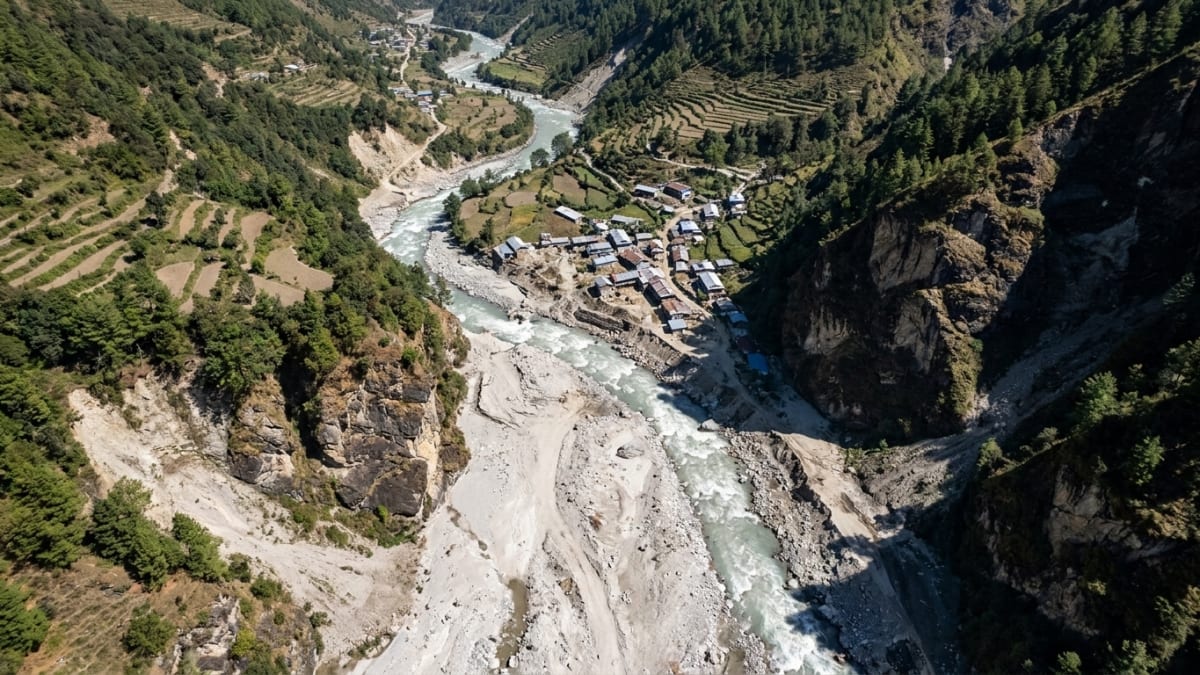
Below the glaciers of the Hindu Kush Himalaya sit thousands of lakes held back by walls of ice and rock debris. When those walls give way, entire valleys can flood in minutes. ICIMOD's glacial lake inventory, released on 11 November 2020, mapped 3,624 glacial lakes of at least 0.003 km² across Nepal, the Tibet Autonomous Region of China and India. It ranked 47 of them as potentially dangerous.[5] That is about 1.3 per cent of all mapped lakes carrying a rated hazard, a small share spread across a vast, densely settled arc of mountains.
The flood that swept through Nepal and Tibet is the latest and deadliest reminder of that hazard. The death toll reached 1,003 and at least 11,884 people were rescued, according to an NDRRMA report carried by NepalNews on 1 September 2026.[1] Nepal Police published a notice on the Nepal Government Portal on 31 August 2026. It asked one first-degree relative of each missing person to provide a fresh blood sample and two passport photos for DNA identification.[2]
What a glacial lake outburst flood is
A glacial lake outburst flood, or GLOF, begins when a lake formed at or near a glacier loses its dam. ICIMOD's 2018 research report on GLOFs and early warning systems describes the failure as sudden: avalanches of ice or rock, heavy rain or internal weakness in the moraine can all trigger a release.[4] The water moves fast and carries debris far downstream, well beyond the mountain valleys where the lake sat.
Warming accelerates the process. Glaciers retreat, meltwater pools behind moraine dams, and those dams can become unstable as the ice within them thaws. Lakes grow larger and hold more water against barriers that are, in some cases, getting weaker.
The 2019 Hindu Kush Himalaya Assessment, published by ICIMOD, found that about 915 million people live in mountainous regions worldwide, with fewer than 150 million above 2,500 metres.[3] Millions more live in the valleys downstream, below lakes they may never see.
Sudan Bikash Maharjan, a cryosphere specialist at ICIMOD, said at the release of the 2020 inventory that up-to-date information on glacial lake distribution was necessary for understanding the dynamics of their changes. He said the information was also necessary for identifying potential hazards and risk reduction. Maharjan also said the report would be useful for those studying water resource management and related hazards and risk reduction.[5]
What scientists can say, and what they cannot
The science supports urgency but not certainty about cause. S. Harrison and co-authors wrote in The Cryosphere in 2018 that "Attribution of climate change impacts is an emerging research field and no attribution studies on GLOFs are available so far."[6] This flood cannot be assigned solely to warming. It may have been triggered by heavy rain, a slope failure or internal dam weakness, factors that exist regardless of the longer-term trend.
What warming does is shift the baseline: more lakes, larger lakes, weakened dams. The probability of outburst rises even if no single event can be labelled a climate disaster.
Early warning systems exist in parts of the region but coverage is uneven. The 47 potentially dangerous lakes ICIMOD identified in its November 2020 inventory span three countries and some of the world's most difficult terrain. Identification of victims in Nepal is still under way, with police waiting on DNA results from relatives who provided samples last week.
SOURCES & CITATIONS
- Rasuwa flood death toll reaches 1003, at least 11884 rescued (NepalNews / NDRRMA, 1 September 2026)
- बेपत्ता आफन्तको खोजीमा डीएनए परीक्षण, Nepal Government Portal, Office of the Prime Minister and Council of Ministers, 31 August 2026
- Chapter 1 Brief, Introduction to the Hindu Kush Himalaya Assessment, ICIMOD, 2019
- Glacial Lake Outburst Floods, ICIMOD research report 2018/1
- New glacial lake inventory report released, 47 potentially dangerous glacial lakes ranked, ICIMOD, 11 November 2020
- Harrison S. et al., The Cryosphere 12:1195-1209, 2018
FREQUENTLY ASKED QUESTIONS
What is a glacial lake outburst flood?
How many dangerous glacial lakes are there in the Himalayas?
Can this flood be blamed on climate change?
Simon Wu writes about Asia-Pacific markets and China's economy. He reads the Chinese-language financial press closely and looks for the stories that reach Australia before anyone here notices.