
TLDR
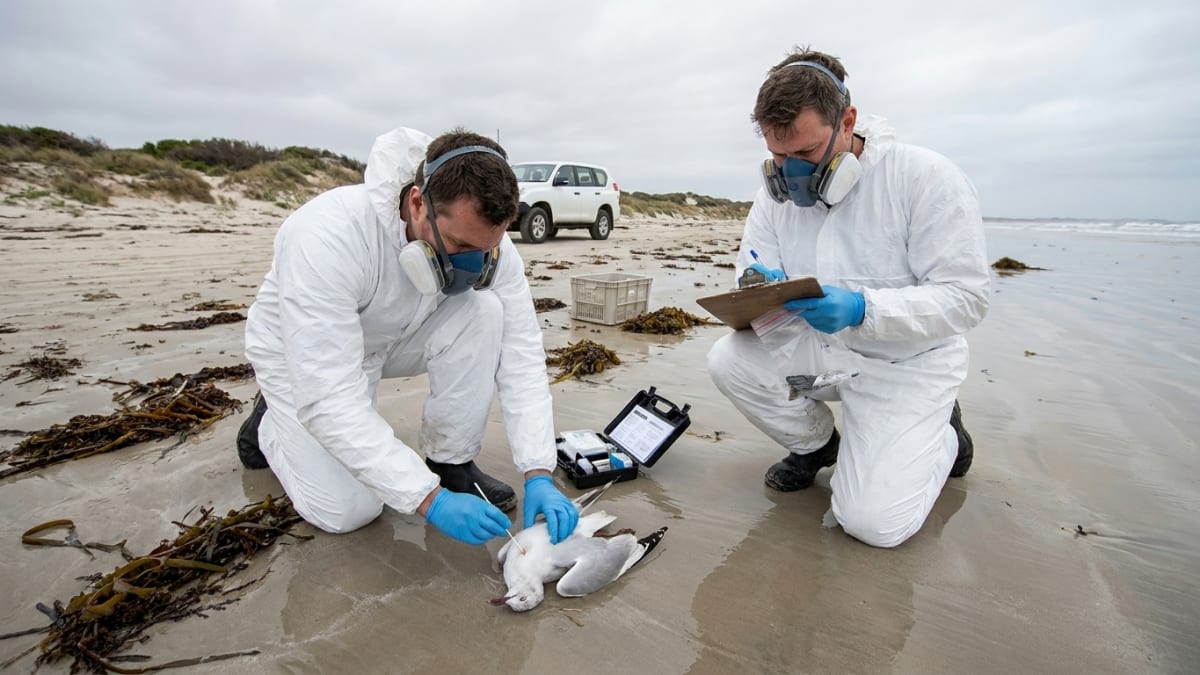
Australia's confirmed or presumed positive H5 bird flu detections reached 53 after CSIRO's Australian Centre for Disease Preparedness confirmed the virus in a silver gull found at Robe in South Australia on 1 August 2026. The silver gull is the first of its species in Australia to test positive, which matters because it is the country's most common coastal gull, moving freely across beaches, wetlands, farmland and urban areas. Burnet Institute chief health officer Suman Majumdar said further coastal spread and mass mortality events in seabird colonies should be expected. No H5 detections have been recorded in poultry or the agricultural production system.
KEY TAKEAWAYS
A new species in the count
Testing at CSIRO's Australian Centre for Disease Preparedness confirmed H5 bird flu in a silver gull found at Robe in South Australia on 1 August 2026, the first detection in that species in Australia.verifiedVerified Source: agriculture.gov.au[1] The result pushed the national tally of confirmed or presumed positive detections to 53.[1]
Prior detections had concentrated in migratory seabirds: brown skuas, giant petrels, greater crested terns and petrels moving along Australia's coast.[2] Silver gulls are a different proposition. They are resident, ubiquitous and deeply embedded in human-modified landscapes across the country.
Why the silver gull changes the picture
The silver gull (Chroicocephalus novaehollandiae) is the most common gull in Australia, found on every beach, jetty, rubbish tip, sporting oval and fish-and-chip carpark in the country. Its movements are not bounded by a coastal flyway; it links marine environments with wetlands, agricultural land and dense urban areas within a single day's foraging range.
Burnet Institute chief health officer Suman Majumdar said gulls' movement across beaches, wetlands, farmland and urban areas could carry the virus into a far wider range of environments than the migratory seabirds that dominated earlier detections. Majumdar said further coastal spread and mass mortality events in seabird colonies should be expected, based on the trajectory overseas experience has consistently produced.
Highly pathogenic avian influenza A(H5N1) clade 2.3.4.4b has caused a global wave of outbreaks since 2021, infecting more than 500 wild bird species and spilling into some mammals. Australia recorded no H5 detections prior to June 2026, but the first cases arrived quickly: a brown skua and a giant petrel in Western Australia tested positive on 20 June 2026, and detections in migratory species across multiple states followed in short succession.[2]
Where the outbreak stands
As of 31 July 2026, Australia had 33 confirmed detections in wild seabirds across five states: 19 in South Australia, 10 in Western Australia, 2 in New South Wales, 1 in Queensland and 1 in Victoria.verifiedVerified Source: agriculture.gov.au[2] The Robe silver gull result then carried the broader tally, which includes presumed positives alongside confirmed cases, to 53 by 1 August.[1]
South Australia has recorded the highest concentration of confirmed cases, with 19 of the 33 confirmed wild bird detections. Robe sits on the Limestone Coast roughly 340 kilometres south-east of Adelaide, on a stretch of coastline with significant seabird activity that made it an active surveillance area before this result.
There remain no detections of H5 bird flu in poultry or in the agricultural production system.verifiedVerified Source: agriculture.gov.au[1] That absence has held across all 53 detections to date, and it remains the line authorities are most focused on maintaining. Poultry industries in South Australia and Western Australia represent billions of dollars in production value and are the primary economic concern driving the government's preparedness investment.
What the government said
Australian Chief Veterinary Officer Dr Beth Cookson said the detection is being taken seriously and that Australia has been preparing for this scenario for several years. Cookson said Australia is well prepared to respond to H5 bird flu and will react quickly to protect poultry production and reduce impacts on wildlife and communities.[3]
Agriculture Minister Julie Collins said national leaders met on Friday and vowed to do everything they can to protect wildlife, agricultural industries and the economy. The government invested over $113 million in preparedness before the first detection, including expanding laboratory capacity at CSIRO's Australian Centre for Disease Preparedness and running national simulation exercises.[2]
CSIRO's laboratory is processing surveillance samples drawn from a growing geographic spread, and the turnaround capacity built into the system before June 2026 allowed the Robe result to be confirmed and published within a day of collection.[3]
What happens from here
Epidemiologists tracking the global clade 2.3.4.4b wave regard further spread as near-certain given the species involved and the contact patterns the silver gull's behaviour creates. The central question is whether the virus finds a path into the agricultural system before surveillance detects and contains it.
The government has not elevated its formal alert level in response to the Robe detection, and officials have framed the current picture as contained within wild bird populations. Cookson said the system is calibrated, the laboratories are running and the response framework built across several years of preparation is in place.[3]
Members of the public who find dead or sick seabirds are asked not to handle them and to report them through state and territory wildlife authorities, who are coordinating surveillance under the national response framework.[2]
SOURCES & CITATIONS
- H5 bird flu updates, Department of Agriculture, Fisheries and Forestry
- Bird flu, Department of Agriculture, Fisheries and Forestry
- Media release: Confirmed H5 bird flu in Australia, Dr Beth Cookson, Australian Chief Veterinary Officer
- Bird flu cases grow to 53 as first gull tests positive, AAP via The Standard
FREQUENTLY ASKED QUESTIONS
What is H5 bird flu and why does it matter in Australia?
Why is a silver gull detection more significant than earlier cases?
Has H5 bird flu been found in chickens or other farmed poultry in Australia?
What should I do if I find a dead or sick seabird?
Caleb Reed covers breaking news and sport. He works to the rhythm of a story as it unfolds, and he is happiest when the facts arrive faster than anyone can spin them.