
TLDR
Turkish President Erdoğan is in Riyadh as bilateral trade between Turkey and Saudi Arabia recovers to US$7.22 billion, following years of boycott-era lows after the 2018 Khashoggi killing. Defence, renewable energy and investment are the live files, with five bilateral accords already signed in February 2026 setting the foundation.
What both governments say this visit is for
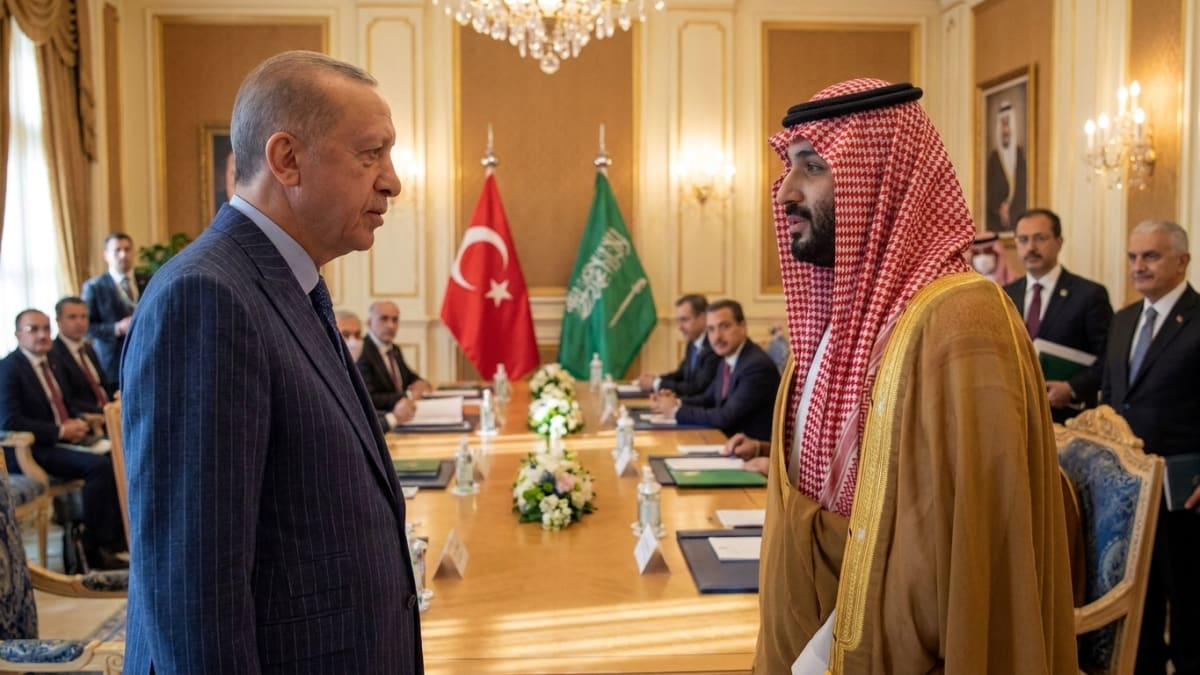
President Recep Tayyip Erdoğan arrived in Riyadh for talks with Crown Prince Mohammed bin Salman, and the official tone was warm from the outset. Erdoğan "expressed his pleasure at the visit and at meeting HRH the Crown Prince," according to the Saudi Press Agency.[6] That kind of language is diplomatic boilerplate, but the substance sitting beneath it is not.
The Saudi Press Agency framed the agenda around strengthening bilateral relations and coordinating on regional issues.[6] On the Turkish side, the presidency pointed to defence, energy and investment as the substantive files. Both governments have been careful to describe this visit as a continuation of a relationship rebuilt over the past three years, not a fresh start.
The numbers behind the relationship
Turkey's exports to Saudi Arabia reached US$3.81 billion in 2025 and imports US$3.41 billion, giving a bilateral trade total of US$7.22 billion for the year.[1] That recovery follows the informal Saudi boycott on Turkish goods that began after Jamal Khashoggi was killed inside the Saudi consulate in Istanbul in October 2018. Riyadh's consumer and business community quietly steered spending away from Turkish products for years, and the hit to exporters was real.
Rapprochement began in 2022 with reciprocal high-level visits, accelerated through Erdoğan's December 2023 trip to Riyadh, and picked up pace with joint investment forums. Saudi Arabia accounted for nine cross-border mergers and acquisitions in Türkiye in 2025, representing 7.3 per cent of total inbound deals, according to the 2025 Türkiye FDI Projects Report.[2] That puts Riyadh among the more active acquirers in the Turkish market, a positioning that would have been unthinkable five years ago.
The defence file
The most consequential single transaction in the relationship to date happened on 18 July 2023, when Baykar and the Saudi Defence Ministry signed an agreement for the Akinci combat drone.[4] Baykar described it as the largest defence export deal in Turkish history, a claim that has not been publicly challenged. The Akinci is Baykar's high-altitude, long-endurance platform, a step up in capability from the Bayraktar TB2 that made the company globally known.
The deal carried a localisation dimension from the start, with pacts linking Baykar to Saudi Arabian Military Industries aimed at joint production and technology transfer. That framing matters to Riyadh: Vision 2030 sets a target of sourcing 50 per cent of Saudi defence spending domestically, and partnering with foreign manufacturers who agree to build capability inside the Kingdom is how that goal gets pursued. How far the localisation has progressed in practice, and what further contracts could follow Erdoğan's current visit, has not been publicly confirmed by either government.
The February 2026 Riyadh meeting produced five bilateral accords, one of which covered defence industries and research and development.[5] Two further contracts with Baykar Technology were also signed at that session, though their specific terms have not been disclosed.[5] The current presidential visit sets up the question of whether those February commitments can be converted into binding production or transfer agreements.
Energy, construction and Vision 2030
On 3 February 2026, Saudi Minister of Energy Prince Abdulaziz bin Salman and Turkish Minister of Energy Alparslan Bayraktar signed an intergovernmental agreement on renewable energy power plant projects in Riyadh.[3] That agreement is the most concrete expression yet of the energy dimension in the relationship. Saudi Arabia is building out solar and wind capacity at scale under Vision 2030, and Turkish contractors and engineering firms have an established track record in large infrastructure builds.
Turkish construction companies have been present in the Gulf for decades, and the Saudi infrastructure pipeline under Vision 2030 is one of the largest public investment programmes in the world. Bilateral renewable energy cooperation formalised in February creates a framework for Turkish firms to compete for contracts already being tendered. The current visit, with heads of government in the room, is the kind of political signal that procurement officers on both sides read carefully.
The February 2026 accords also covered direct investment and logistics cooperation, rounding out a package that touches most of the major commercial sectors where Turkish and Saudi interests intersect.[5] Whether Erdoğan's Riyadh visit produces new announcements on railway or port cooperation, which has been flagged in earlier bilateral forums, has not been confirmed ahead of the meeting.
The diplomatic agenda: Syria, Gaza and Red Sea shipping
Beyond the commercial files, the two governments share a set of regional problems that neither can resolve bilaterally. Syria is the most structurally significant: Türkiye has troops inside Syrian territory and has been a principal backer of factions that now hold governing authority in Damascus. Saudi Arabia is working out its own posture toward the new Syrian administration and has interests in reconstruction financing. How the two countries coordinate, or fail to, shapes the options available to both.
Gaza is the more immediate political pressure point. Both Ankara and Riyadh have been publicly critical of the conduct of Israeli military operations, though their responses have differed in instrument. Erdoğan's government suspended trade with Israel and has pushed for international legal accountability. Saudi Arabia, in the middle of a normalisation process with Israel that was disrupted by the October 2023 attacks, has faced different pressures. Whether the two governments can develop a shared position that moves beyond public statements is one of the harder tests of this visit.
On Red Sea security, Foreign Minister Hakan Fidan has discussed multilateral initiatives with Saudi Arabia, Egypt and Pakistan to promote peace and stability in the region and ensure free navigation, though no formal mechanism has yet been announced.[7] That framing, a multilateral initiative anchored by Turkey and involving Saudi Arabia, is more ambitious than anything the two countries have yet formalised.
The diplomatic files are harder to close than the commercial ones. Trade figures and signed accords are measurable; a common position on Syria, a joint initiative on Red Sea shipping, or a coordinated stance on Gaza requires the two governments to manage differences that are real, not just presentational. What the Riyadh visit can do is keep those conversations alive at the highest level, which carries its own weight given where the relationship stood in 2019.
KEY TAKEAWAYS
SOURCES & CITATIONS
- Turkey Exports to Saudi Arabia, Trading Economics
- 2025 Türkiye FDI Projects Report, Invest in Türkiye
- Saudi-Turkish renewable energy agreement signing, Saudi Press Agency
- Baykar signs Akinci export deal with Saudi Arabia, Baykar Tech
- Five bilateral accords signed between Saudi Arabia and Türkiye, Saudi Press Agency
- Erdoğan meets Crown Prince Mohammed bin Salman, Saudi Press Agency
- Foreign Minister Fidan press conference, fifth Antalya Diplomacy Forum, Turkish MFA
FREQUENTLY ASKED QUESTIONS
Why did Saudi Arabia boycott Turkish goods after 2018?
What is the Akinci drone and why does the Saudi deal matter?
What was agreed at the February 2026 Riyadh meeting?
What is Türkiye's position on Red Sea security?
Claire Bennett writes about work and workplace culture. She is interested in the gap between how organisations describe themselves and what it feels like to work inside them.