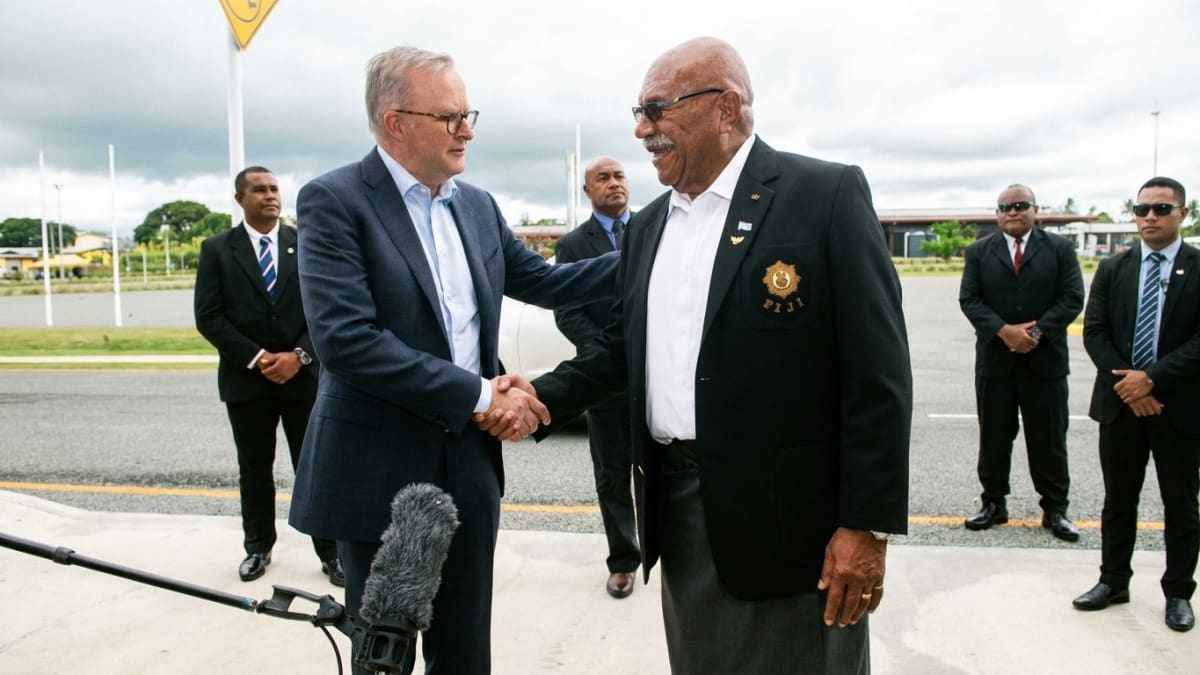

The New York Times says Canberra pushed and Beijing pushed back harder, and the receipts are real: an ASIO warning, a Vanuatu security pact and the Darwin port fight on one side, and a 55 per cent beef tariff wall plus an ambassador's broadside on the other.
TLDR
The New York Times argued on 4 July that Australia's recent security moves have drawn a harder shove back from Beijing, even as both sides protect the trade relationship . Within a fortnight, ASIO chief Mike Burgess warned espionage and foreign interference sit at extreme levels, Canberra signed the Nakamal Agreement blocking foreign military bases in Vanuatu, and China's ambassador accused Australia of paranoia in a newspaper op-ed . China's out-of-quota 55 per cent beef tariff took effect on 20 June after Australia's 205,000 tonne quota filled 37 days faster than last year, with industry estimating more than A$1 billion in trade at risk . Canberra is holding its line rather than retaliating: Trade Minister Don Farrell says Australia expects its free trade agreement status to be respected, and exports to China still ran to A$196 billion in 2025 .
What the Times actually said
The New York Times published its assessment on 4 July 2026, arguing that Prime Minister Anthony Albanese's balancing act of repairing trade ties while building Pacific security partnerships has collided with a newly assertive Beijing.verifiedVerified Sourced from Australia Tried to Push Back on China. China Pushed Harder. (New York Times, 4 July 2026, syndicated copy). The paper noted Chinese diplomats have accused Canberra of stoking paranoia and unfairly targeting China over an intelligence assessment and Pacific deal-making.verifiedVerified Sourced from Australia Tried to Push Back on China. China Pushed Harder. (New York Times, 4 July 2026, syndicated copy).
The stakes are not abstract: China takes almost one-third of Australian exports.verifiedVerified Sourced from Australia Tried to Push Back on China. China Pushed Harder. (New York Times, 4 July 2026, syndicated copy). The state-run Global Times warned that recent events 'inevitably recall the unpleasant period in China-Australia relations', a reference to the trade punishment years of 2020 to 2022.
A fortnight of Australian pushback
ASIO Director-General Mike Burgess delivered his Annual Threat Assessment on 24 June 2026, warning that espionage and foreign interference are running at extreme levels and that at least three or four countries are interfering in Australian diaspora communities. The NYT reported the assessment included a video showing Chinese nationals arrested in Canberra for allegedly collecting information on a Buddhist group.
Five days later, on 29 June, Albanese and Vanuatu Prime Minister Jotham Napat signed the Nakamal Agreement in Canberra. The pact bars foreign military bases or infrastructure in Vanuatu, requires Vanuatu to consult Australia on third-party investment in critical infrastructure, and confirms Australia as its primary policing partner. Albanese was blunt about the point of it: 'What this does do is to provide certainty for Australia that there will be no foreign military base'.
Beijing's answer came in print and at the podium
China's ambassador Xiao Qian responded on 1 July with an op-ed in the Sydney Morning Herald and The Age titled 'When will the China-threat paranoia stop?', which China's Ministry of Foreign Affairs then republished. He wrote that China 'has no intention of, nor has it ever engaged in, so-called interference in Australia' and accused Australia of 'using national security as a pretext to portray China as a hypothetical enemy'.
On the Vanuatu pact, Chinese foreign ministry spokesman Guo Jiakun said Pacific cooperation 'should not target any third party, still less be used as an excuse for geopolitical contest', as the NYT reported. The ambassador's op-ed also took direct aim at the video shown at ASIO's threat assessment, arguing it cast China as the villain in cases still before the courts.
The beef wall: 55 per cent for the rest of 2026
The sharpest economic pain point predates the July row. China's commerce ministry announced a beef safeguard measure on 31 December 2025 following a year-long investigation, applying a 55 per cent tariff to out-of-quota beef from 1 January 2026 for three years and superseding Australia's zero-tariff access under ChAFTA. Australia's 205,000 tonne quota filled by 18 June 2026, 37 days earlier than last year, and the 55 per cent rate has applied since 20 June for the remainder of the year. Industry bodies estimate the restrictions could cut beef exports to China by about one-third, trade they value at more than A$1 billion.
Canberra's response has been firm but deliberately unheated. 'We are disappointed by this decision', Trade Minister Don Farrell said, adding that Australia has 'made it clear to China that Australian beef is not a risk to their beef sector, and that we expect our status as a valued free trade agreement partner to be respected'. One caution on framing: the safeguard applies to all exporting countries and followed a Chinese trade-remedy investigation into domestic oversupply, so reading it purely as retaliation against Australia is contested by trade analysts. Both readings deserve a run.
Where that leaves the relationship
The economic ballast is enormous. Two-way goods and services trade reached A$326 billion in 2025, a quarter of Australia's total trade, and Australian exports to China hit A$196 billion, or 29 per cent of everything Australia sells to the world. Running underneath it all is the unresolved Port of Darwin fight, where Albanese's pledge to return the Landbridge-leased port to Australian control has met Chinese warnings that Beijing would 'take measures' to protect its companies' interests.
Australian public opinion has swung with the thaw: the NYT reported, citing Lowy Institute polling, that more than 60 per cent of Australians now see China more as an economic partner than a security threat, roughly the reverse of four years ago. Analysts quoted by the Times see a relationship that absorbs shocks rather than resolves them: the Australia-China Relations Institute's James Laurenceson described a pattern where 'Canberra and Beijing agree to disagree, neither side overreacts, and the relationship kind of moves on'.
KEY TAKEAWAYS
SOURCES & CITATIONS
- Australia Tried to Push Back on China. China Pushed Harder. (New York Times, 4 July 2026, syndicated copy)
- Director-General's Annual Threat Assessment 2026 (ASIO, 24 June 2026)
- Chinese Ambassador Xiao Qian: 'When will the China-threat paranoia stop?' (Chinese Ministry of Foreign Affairs)
- Australia and Vanuatu sign deal to block foreign military bases (Al Jazeera, 29 June 2026)
- China officially flags Australia's 2026 beef quota as filled (Beef Central, June 2026)
- Government 'disappointed' with China's new beef import tariffs (SBS News, 1 January 2026)
- China country brief, trade statistics for 2025 (DFAT)
- China warns Australia against taking back control of key port in Darwin (Al Jazeera, 29 January 2026)
FREQUENTLY ASKED QUESTIONS