

TLDR
Volodymyr Zelensky reported that Russia launched approximately 1,900 attack drones, nearly 1,600 guided aerial bombs and 144 missiles across Ukraine in a single week, striking 16 regions and damaging more than 1,500 sites. Zelensky urged Western allies to speed up deliveries of Patriot air defence systems.
On 2 August, President Volodymyr Zelensky published a weekly strike summary through his official channels. The figures were itemised with the flat precision of a military ledger, and they confirmed what many had suspected but not yet had to hold in full.
The week's arithmetic
Over the course of a single week, Russia launched approximately 1,900 attack drones against Ukraine, alongside nearly 1,600 guided aerial bombs and 144 missiles of various types, including ballistic missiles.[1] Three categories of strike, pressed across the length of the country in fewer than 168 hours.
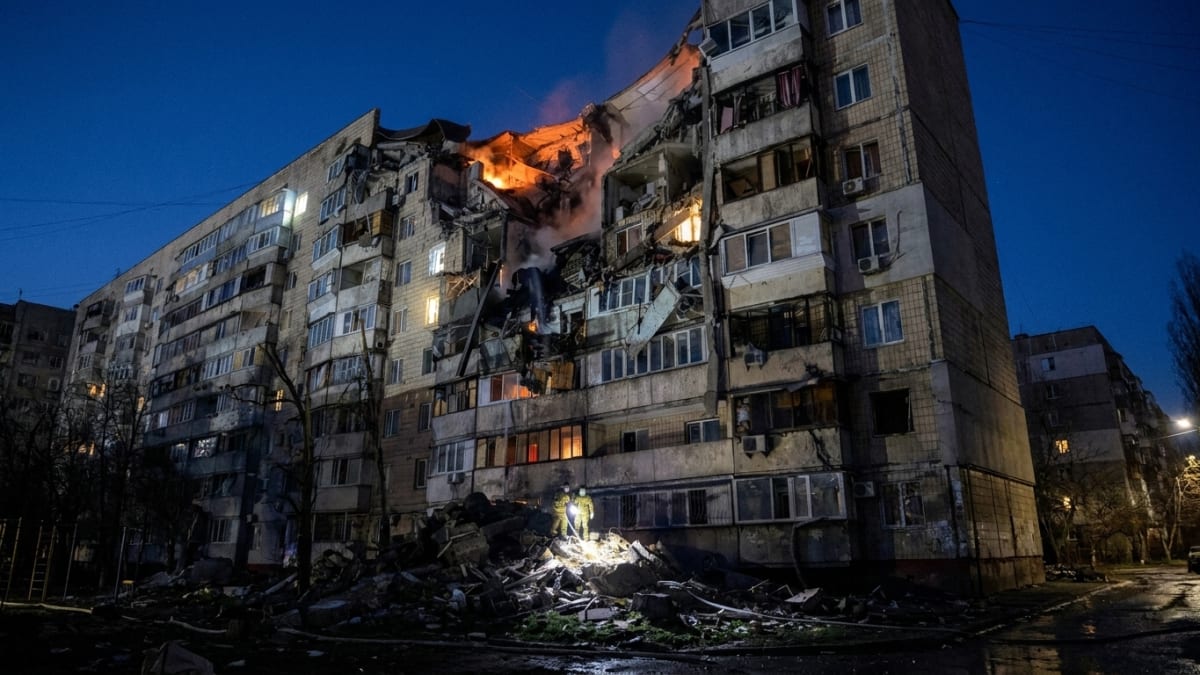
Sixteen regions of Ukraine were struck during that period, with more than 1,500 sites damaged, among them hundreds of residential buildings.[1] Kharkiv, Odesa, Zaporizhzhia, Dnipro and Sumy were among the hardest-hit oblasts. A drone strike on Brovary, close enough to Kyiv that its fires are visible from the capital's suburbs, killed one person and injured six.
A record month for guided bombs
July recorded more than 8,300 guided aerial bombs deployed, the highest monthly total of the war.[4] Ukraine's defence ministry also recorded 7,922 combat engagements along the front lines during the same month, giving some measure of how simultaneously the ground and air wars are being prosecuted.
The guided aerial bomb, known in Russian military parlance as the KAB series, has become one of Moscow's primary instruments for striking targets just beyond the front lines, where Ukrainian ground-based air defences are thinner. Russian aircraft launch them from within Russian or occupied airspace, keeping the delivery platform out of reach, and the bombs glide unpowered to their targets, making radar-guided interception harder. Since February 2022, Russia has steadily shifted away from cruise missiles toward drones and glide bombs, which can be manufactured at scale and deployed in coordinated waves designed to exhaust interceptor stocks.
Air defence: the interceptor gap
Zelensky paired the weekly totals with a renewed push on air defence. On 3 August he voiced frustration with Western allies over delays in delivering urgently needed Patriot air defence systems and other military aid, as Russia and Ukraine exchanged another wave of overnight drone strikes on logistics, energy and civilian infrastructure.[3]
Ukraine's air defences have been bolstered by Western-supplied Patriot and IRIS-T systems, along with domestic counter-drone capabilities developed under wartime pressure. Those systems consume interceptor missiles faster than supply chains have managed to replace them, which is why delivery speed, not just delivery volume, keeps surfacing in Kyiv's requests.[2]
At the volume Russia is sustaining, even a high interception rate leaves a meaningful number of strike vehicles reaching their targets. More than 1,500 damaged sites in a single week is what that arithmetic looks like on the ground.[1]
The pattern behind the week
Since mid-2023, Russia has progressively scaled its drone production and deployment, moving from dozens of Shahed-series aircraft per night to the saturation campaigns Zelensky's weekly totals now describe. The trend line, examined over months rather than days, points consistently upward.
July's guided-bomb count of more than 8,300 reflects both Russia's production capacity and its tactical preference for weapons that expose its aircraft to minimal risk.[2] For Ukrainian civilians across 16 regions, and for defenders managing interceptor stocks consumed faster than they arrive, the week of nearly 1,900 drones is the baseline against which the next one will be measured.
KEY TAKEAWAYS
SOURCES & CITATIONS
- Volodymyr Zelensky official Telegram channel, 2 August 2026
- CGTN: Zelensky reports 1,900 drones, 1,600 bombs in one week, 2 August 2026
- RFE/RL: Zelenskyy urges faster Patriot deliveries, 3 August 2026 (via GlobalSecurity)
- Interfax-Ukraine: over 8,300 guided bombs and 7,922 combat engagements in July 2026
- Kyiv Post: Russia uses 1,900 drones, 1,600 bombs against Ukraine in a week
FREQUENTLY ASKED QUESTIONS
How many drones did Russia launch at Ukraine in the week reported by Zelensky?
What has Zelensky asked of Western allies?
Why are guided aerial bombs particularly difficult for Ukraine to intercept?
What was notable about Russia's guided-bomb use in July?
Margaret Hale writes about politics, policy and the culture of business. She is drawn to the people behind decisions and to the moments when a political story turns out to be a human one.