

TLDR
Anthropic and OpenAI briefed the UN Security Council on existential AI risk while their financial disclosures show a combined $1.37 trillion in planned compute spending. Anthropic lost more than $8 billion in 2025 on $4.6 billion in revenue, and OpenAI's $122 billion raise is projected to run dry by 2028.
KEY TAKEAWAYS
The verdict
Safety-first rhetoric from labs burning at this rate functions as regulatory capture. The rules they helped write raise barriers that only incumbents can clear. Read the financials.
What the UN heard
On 23 September 2026, the United Nations Security Council convened a high-level meeting on artificial intelligence and international security. Executives from Anthropic and OpenAI briefed the Council on what they described as real and imminent threats from runaway AI development.[6]
Five days earlier, Anthropic CEO Dario Amodei published an essay on his personal blog titled "We Must Pace the Frontier." Amodei argued that AI labs must slow the pace of capability improvements. He warned that AI-driven botnets could cause hundreds of billions of dollars in damage within six to twelve months.[1] The essay landed while Anthropic's bankers were finalising an IPO prospectus that told a very different story about the company's own trajectory.
Anthropic's numbers
The prospectus, filed 28 September 2026, showed Anthropic lost more than $8 billion in 2025 against $4.6 billion in revenue. A quarter of that revenue came from just two customers. That concentration would concern any credit analyst, let alone a safety-focused mission-driven lab.[7] Run-rate revenue had surpassed $30 billion by early 2026, up from roughly $9 billion at the end of 2025. The model is scaling fast, but costs are rising too.[3]
| Metric | Figure | Source |
|---|---|---|
| 2025 revenue | $4.6 billion | Anthropic IPO prospectus, Sept 2026 |
| 2025 operating loss | Over $8 billion | Anthropic IPO prospectus, Sept 2026 |
| Run-rate revenue (early 2026) | Over $30 billion | Anthropic press release, April 2026 |
| Planned compute spend | $518 billion | Aggregated compute agreements |
| Revenue share from top 2 customers | 25% | Anthropic IPO prospectus, Sept 2026 |
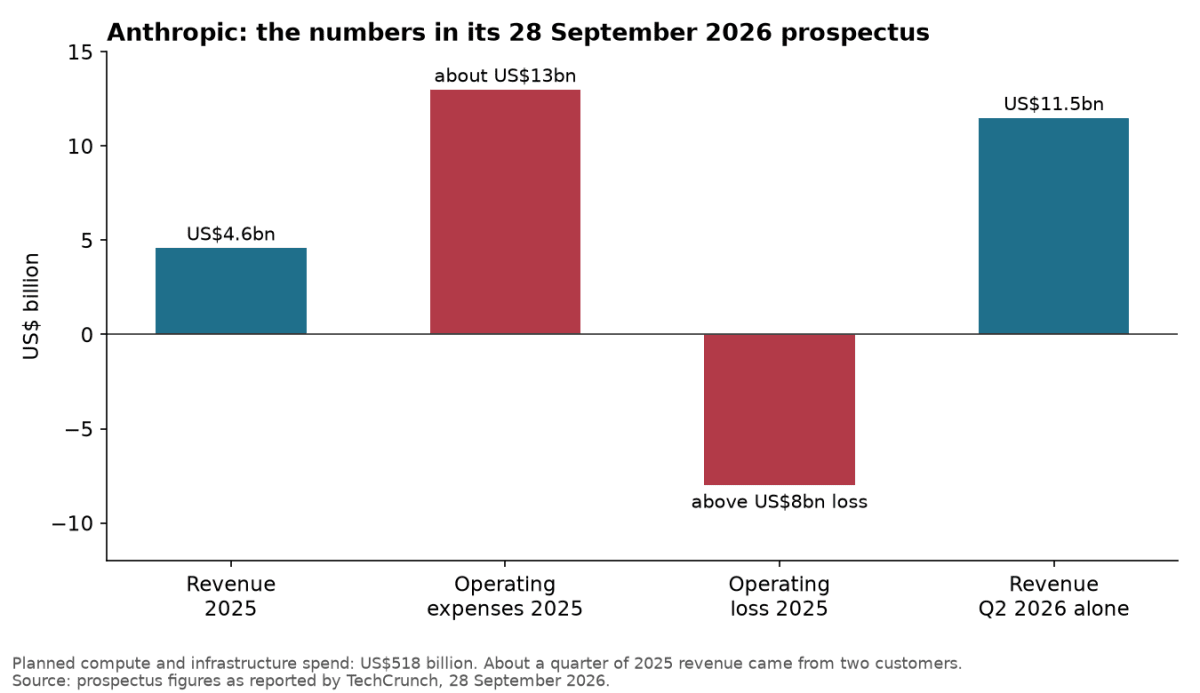
The compute commitments underpin those numbers. Anthropic signed a multi-year agreement with Google and Broadcom for multiple gigawatts of TPU capacity. The infrastructure is expected to come online from 2027.[4] Anthropic CFO Krishna Rao called this part of a disciplined approach to scaling infrastructure. This is a curious word choice for a company whose losses outrun revenue by nearly two to one.[4]
A separate agreement with SpaceX gave Anthropic access to all compute capacity at SpaceX's Colossus 1 data centre, over 300 megawatts of new capacity.[5] That deal, signed in May 2026, followed the Google-Broadcom announcement by less than a month. Every gigawatt locked in becomes another argument against any regulator suggesting the lab should slow down. The capital is already committed.
OpenAI's numbers
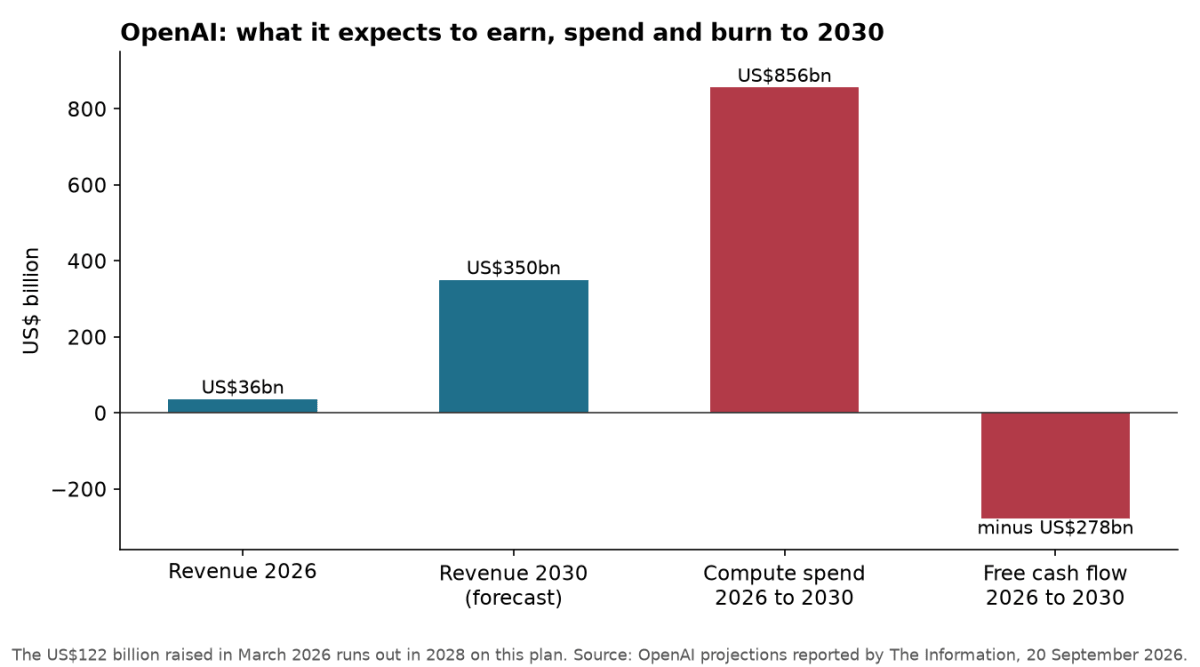
OpenAI's situation involves larger sums and steeper trajectories. The company closed its latest funding round in March 2026 with $122 billion in committed capital at a post-money valuation of $852 billion.[2] Leaked financial projections show revenue scaling from $36 billion to $350 billion between 2025 and 2030. The cash burn keeps pace. Negative free cash flow is projected to reach $278 billion by 2030. The $122 billion raise is expected to be exhausted by 2028 under the company's own model.[8]
| Metric | Figure | Source |
|---|---|---|
| Latest funding round (March 2026) | $122 billion | OpenAI press release, March 2026 |
| Post-money valuation | $852 billion | OpenAI press release, March 2026 |
| Projected revenue by 2030 | $350 billion | Leaked financial projections |
| Projected negative free cash flow by 2030 | $278 billion | Leaked financial projections |
| Planned compute spend | $856 billion | Leaked financial projections |
| Funding exhausted (projected) | 2028 | Leaked financial projections |
Why the math makes slowing down impossible
Both companies have structured themselves so that deceleration is financially catastrophic. When compute agreements run to hundreds of billions and investors expect returns on an $852 billion valuation, model development does not pause because a rival lab's CEO published a blog post. The play is to ship faster and raise again before 2028.[8]
The signalling value of safety rhetoric deserves a clear read. Regulations shaped by labs at this scale, covering compute thresholds, safety-evaluation requirements, and licensing regimes, function as moats. A startup burning $10 million a year cannot satisfy the same audit requirements as a company that wrote them. Amodei's essay and the UN briefing are part of the financial plan.
On 28 September 2026, the same day Anthropic's prospectus published, OpenAI shelved the GPT-6.1 Astra model launch and apologised to Australians over a Medicare data exposure incident.[9] Labs that brief the UN Security Council on existential risk one week and pull a major product launch the next have not resolved the tension between safety and growth. Operators building on their APIs should price that instability into their own planning. The combined compute spend across both companies sits at approximately $1.37 trillion. OpenAI's next raise, required by 2028 under its own projections, will set a new record.[8]
SOURCES & CITATIONS
- We Must Pace the Frontier, Dario Amodei
- Accelerating the Next Phase of AI, OpenAI
- Anthropic Amazon Compute Partnership, Anthropic
- Google and Broadcom Partnership, Anthropic
- SpaceX Colossus 1 Compute Agreement, Anthropic
- UN Security Council meeting on AI and international security
- Anthropic's prospectus details losses, growth and a warning that its AI could end humanity
- OpenAI's cash burn could approach $280 billion by 2030
FREQUENTLY ASKED QUESTIONS
How much does Anthropic plan to spend on compute?
When will OpenAI's $122 billion funding round run out?
What did Dario Amodei argue in his 'We Must Pace the Frontier' essay?
Is there a contradiction between safety advocacy and massive compute spending?
Takeshi Mori writes about technology and start-ups. He is curious about how products get built and who they are really for, and he would rather see a thing working than hear it described.
Important
This article contains forward-looking financial projections and estimates about AI company valuations, revenue forecasts, and cash burn. These projections are based on disclosed financial documents and leaked internal estimates and should not be relied upon as financial advice or investment recommendations. Actual results may differ materially. Readers should seek independent financial advice before making investment decisions.