TLDR
Australia has agreed to let Japan test hypersonic missiles at Australian defence ranges, including the Woomera Range Complex in South Australia, under the bilateral Reciprocal Access Agreement. On the same day, a jointly developed high-energy laser called Boobook completed field trials, with Mitsubishi Electric committing A$70 million to manufacture it in NSW.
What was agreed
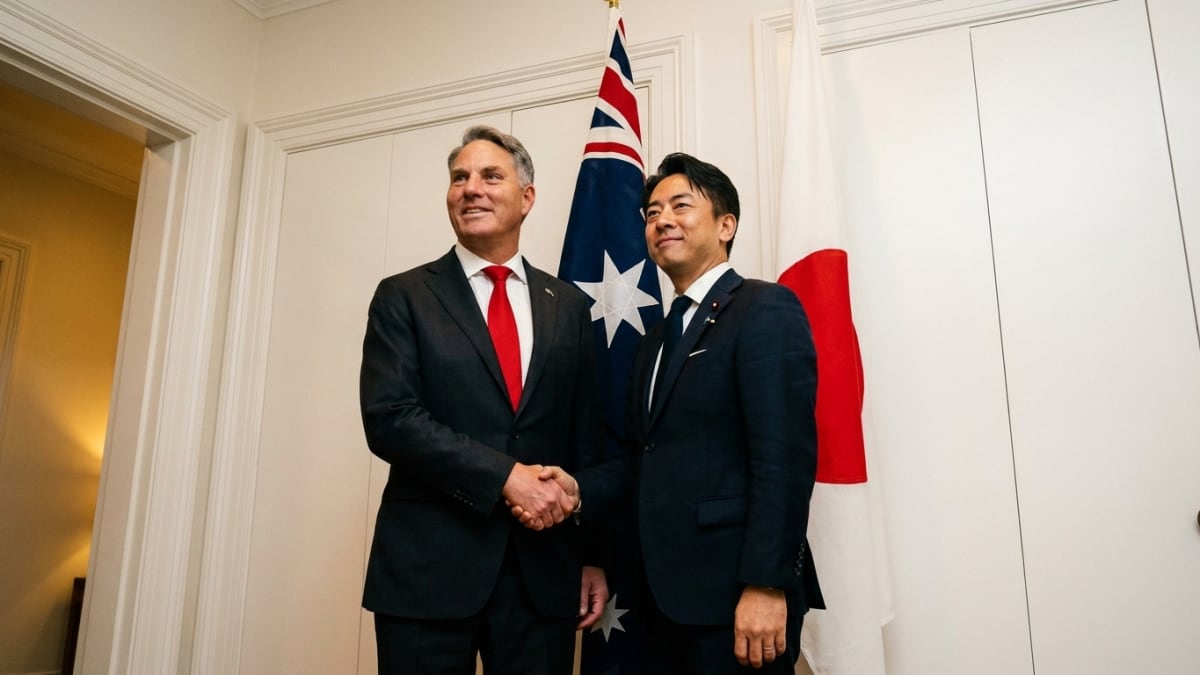
Japan has secured the right to test hypersonic missiles on Australian soil, with the Woomera Range Complex in South Australia confirmed as a primary site. The arrangement, announced jointly by Deputy Prime Minister and Defence Minister Richard Marles and his Japanese counterpart Shinjiro Koizumi, draws its legal authority from the Reciprocal Access Agreement that entered force on 28 August 2024.[2] That agreement unlocked mutual use of training areas and test ranges across both countries, and this announcement is among the first concrete exercises of that provision.
Marles was direct about the relationship's strategic weight. "Our relationship with Japan continues to go from strength to strength, underpinned by deep strategic alignment, trust and shared ambition," he said.[6] The announcement came alongside two linked developments: the first successful field trial of the jointly developed Boobook high-energy laser, and a A$70 million manufacturing commitment from Mitsubishi Electric Australia to produce it at Rydalmere in western Sydney.[3]
Why Japan needs Woomera
Tokyo's requirement for overseas range access is structural, not incidental. Since 2022, Japan has pursued a counterstrike missile programme that includes hyper-velocity gliding projectiles, weapons that travel in the hypersonic regime and require flight corridors far longer and more isolated than anything available inside the Japanese archipelago.[5] Domestic range constraints have made overseas agreements a necessity.
The United States Defense Security Cooperation Agency notified Congress on 7 May 2026 of a proposed Foreign Military Sale to Japan covering Hyper Velocity Gliding Projectile capability support, explicitly including range support, test utility services, range surveillance, range safety, radio frequency assignments and test plan generation to enable hypersonic weapon tests on allied ranges.[1] That notification put on the public record that Washington and Tokyo were actively scoping live-fire and flight-test campaigns beyond Japan's borders. Australia's announcement follows directly from that.
Woomera is the logical host. The range complex encompasses the Woomera Prohibited Area and supporting air weapons ranges, demolition ranges, live-firing ranges and target areas designed for advanced capability development, with airspace corridors and instrumentation suited to exactly this class of trial.[4] Few comparable facilities exist in the democratic world, and none as geographically close to Japan's operating theatre.
The Boobook laser milestone
The Boobook programme, described as the first co-development between Australian and Japanese defence industries, completed field trials of its prototype high-energy laser at Cultana Training Area and DSTG Edinburgh on 18 August 2026.[3] Cultana, near Port Augusta, provides open terrain for live-fire instrumented trials; DSTG Edinburgh on Adelaide's northern fringe is the Defence Science and Technology Group's principal test and evaluation facility. Running trials across both sites in the same period indicates the programme has moved well beyond laboratory proof-of-concept.
Minister for Defence Industry Pat Conroy pointed to the project as evidence of what the bilateral relationship can now produce. "This project demonstrates close collaboration with Japan, to develop cutting-edge technologies that address real capability needs for the Australian Defence Force," Conroy said.[3] Directed-energy weapons are widely regarded in defence planning as a cost-effective counter to the saturation drone and missile tactics seen in recent conflicts.
Mitsubishi Electric Australia will invest A$70 million to establish a new defence manufacturing facility at Rydalmere, NSW, dedicated to large-scale production of the Boobook laser system.[3] Rydalmere, in Sydney's western industrial belt, has a long history in precision manufacturing. The investment signals that both governments intend to move Boobook from prototype to production scale, with Australian sovereign manufacturing built into the programme from the outset.
Strategic context
The legal architecture enabling all of this has been assembled quickly by the standards of treaty-making. The Reciprocal Access Agreement entered force in August 2024, following the 2022 Joint Declaration on Security Cooperation between Canberra and Tokyo.[2] A Framework for Strategic Defence Coordination was added in December 2025, covering land, sea, air, cyber and space domains. That sequence, from declaration to access agreement to coordination framework across three years, is notably compressed.
Both governments have been explicit about the driver. Chinese military modernisation across the Indo-Pacific figures in every joint statement from Canberra and Tokyo, and the decision to open Woomera to Japanese hypersonic trials is inseparable from that assessment. Japan's counterstrike posture, which would have been constitutionally and politically inconceivable a decade ago, now rests on the ability to hold potential adversaries at risk from Japanese territory and, with range-access deals like this one, from allied territory as well.
For Australia, the calculus runs in two directions. Hosting Japanese missile tests at Woomera extends the deterrence web across the southern Indo-Pacific and binds Tokyo more deeply into the alliance architecture that includes AUKUS. It also carries real implications for Woomera's scheduling and infrastructure, given that the range complex already supports Australian and American test programmes and adding a Japanese hypersonic campaign will require coordination of airspace, range time and safety corridors at a complexity previous bilateral arrangements have not demanded.[4]
What it means for Australian industry
The Rydalmere factory investment is the clearest signal that the Australia-Japan defence relationship is shifting from interoperability to co-production. Previous bilateral arrangements between Canberra and Tokyo concentrated on exercises and information-sharing; co-developing a directed-energy weapon and manufacturing it in NSW is a qualitatively different proposition. It embeds Japanese industrial capital in Australian sovereign defence production and gives both governments a shared stake in the programme's long-term success.
Range hosting is also a form of industrial activity. Providing test support, instrumentation, safety services and logistics for Japanese hypersonic trials at Woomera will require Australian personnel and Australian infrastructure. The US Congressional notification explicitly listed range support and test utility services as components of the Japan FMS package, meaning some portion of that support will flow through Australian providers operating on Australian soil.[1] The dollar value of that activity has not been publicly disclosed, but range hosting at Woomera for major foreign programmes has historically generated sustained work for South Australian defence contractors.
Taken together, the missile-range deal and the Boobook investment represent the most substantive materialisation yet of the Australia-Japan defence partnership that Tokyo and Canberra began building in earnest after 2022. The hypersonic tests have not yet been publicly scheduled, but the legal basis, the site and the direction of travel are now settled.
KEY TAKEAWAYS
SOURCES & CITATIONS
- US DSCA Congressional Notification: Japan Hyper Velocity Gliding Projectiles FMS
- Australian Department of Defence Annual Report 2024-25
- Successful trial of high-energy laser marks deepening Australia-Japan defence collaboration
- Independent Review of the Woomera Prohibited Area Coexistence Framework
- US DSCA Press Release: Japan 24-128 CN
- Richard Marles: Travel to Japan
FREQUENTLY ASKED QUESTIONS
Which Australian range will Japan use to test hypersonic missiles?
What is the Reciprocal Access Agreement and when did it start?
What is the Boobook laser and who is building it?
Why does Japan need to test missiles overseas?
What role does the United States play in this arrangement?
Simon Wu writes about Asia-Pacific markets and China's economy. He reads the Chinese-language financial press closely and looks for the stories that reach Australia before anyone here notices.