
TLDR
Finnish infants sleeping outside in winter prams average 92 minutes more daytime sleep than those kept indoors, research from Oulu shows. That finding sits inside a wide global patchwork of infant sleep customs, from Japan's riverside co-sleeping to Dutch schedules that add nearly two hours of daily rest.
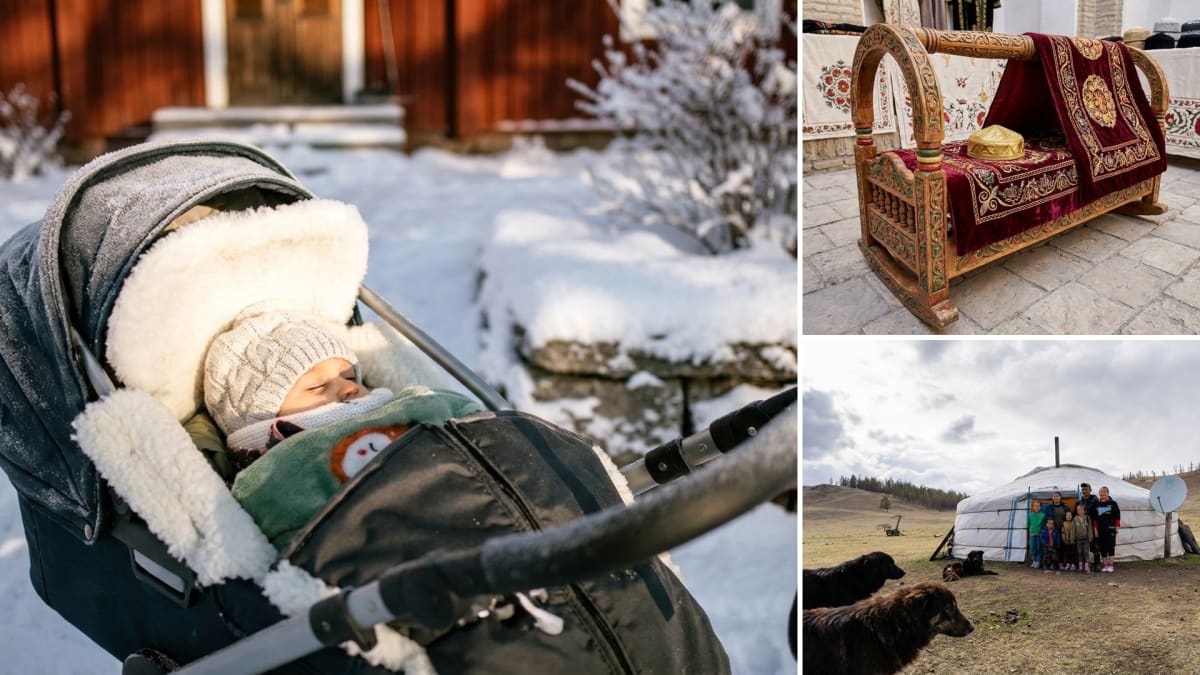
There is something quietly radical about the Nordic pram parked outside a cafe in a snowstorm, its occupant asleep and apparently unbothered. To an outside eye, it reads as neglect dressed up as tradition. To researchers at the University of Oulu, it reads as data.
Nordic outdoor naps
In a cross-over observational study of three-month-old infants in Oulu, daytime sleep outdoors in winter ran on average 92 minutes longer than sleep taken indoors.[1] The study did not establish why the gap exists, though temperature, light and ambient sound all differ substantially between a centrally heated apartment and a sub-zero street.
A 2011 University of Oulu dissertation traces the outdoor nap recommendation to Finnish paediatrician Arvo Ylppö, who promoted it in the 1920s as part of a broader public-health push for fresh air.[2] A century later, the habit endures. A 2008 cross-sectional questionnaire study in Oulu found Finnish babies began daily outdoor naps around two weeks of age, with recorded temperatures ranging from minus 27 degrees Celsius to plus 5.[3] Ylppö's campaign has proved remarkably durable.
Asia and the Pacific
Japan's approach to infant sleep rests less on fresh air than on proximity. A 1998 paper in JAMA Pediatrics describes the kawa no ji arrangement, in which the infant sleeps between both parents on a shared futon, the configuration evoking the kanji character for river. The study authors said: "The custom of the child sleeping between the parents is referred to as kawa. Kawa is the Japanese character for a river flowing between two banks and is therefore used to refer to the child sleeping between the protective support of the two parents."[4]
The Pacific offers a striking contrast in how infant contact with the earth itself is managed. Balinese Hindu custom forbids an infant's feet from touching the ground for the first 105 days after birth, a period that culminates in the nyabutan ceremony.[5] The newborn occupies a liminal status, not yet fully of this world, and the ground represents the mundane realm into which the child will eventually descend.
Maori communities in Aotearoa New Zealand have developed the wahakura, a woven flax bassinet designed to keep an infant safely alongside parents during sleep, though the research bundle does not supply actigraphy figures for this practice.
Africa and the Arctic
Across much of sub-Saharan Africa, where a baby sleeps is inseparable from how a baby travels. A 2017 Nigerian peer-reviewed study found that back carrying using a cloth wrapper is the predominant infant-care method among nursing mothers.[6] The wrapper keeps the infant in near-constant physical contact with the caregiver, regulating temperature and movement throughout the day. An academic survey of rural African caregiving practices identifies specific regional variants: the Mozambican capulana and the East African kanga both serve this function, worn across the back and tied at the chest.[7]
At the other climatic extreme, the Inuit amauti achieves something structurally similar by entirely different means. Pauktuutit Inuit Women of Canada describes the amauti as the traditional Inuk woman's parka, distinguished by a built-in back pouch sized specifically for an infant.[8] The child rides against the caregiver's back beneath the outer garment, sharing body warmth in an environment where exposure is a physical rather than a philosophical concern. The design is old and, in Arctic conditions, sensible.
Europe's contrasts
The Dutch have given the question of infant sleep a characteristically systematic treatment. Super and Harkness identified what they termed the Three R's of Dutch child-rearing, rust (rest), regelmaat (regularity) and reinheid (cleanliness), as a cultural model underpinning sleep routines.[9] The measurable outcome is substantial. An actigraphy study of eight-month-olds found Dutch infants averaged 13.65 hours of sleep per 24 hours, 1.67 hours more than their American counterparts.[10] A framework of regularity, it turns out, produces regularity.
Southern Europe operates on different assumptions entirely. In Spain and Italy, infants and young children typically join the family at the dinner table and remain awake into the evening, sleep arriving when the household settles rather than on a schedule imposed for the child's benefit. The social logic is coherent, the child belongs to the family's rhythms rather than the reverse, though it produces sleep patterns that would make a Dutch parent wince.
Traditional tight swaddling does not always survive clinical scrutiny intact. A 2021 randomised controlled trial in Mongolia found that the traditional method, with legs extended and hips adducted, increases the risk of developmental dysplasia of the hip.[11] The practice carries cultural weight and aesthetic logic alongside a measurable orthopaedic cost. Longevity and safety are credentials that do not automatically travel together.
A note on safe sleep
Every practice described here is cultural observation, not clinical advice. Global safe-sleep guidance is consistent across jurisdictions: infants placed supine, on a firm flat surface, without soft bedding, and never in temperatures that risk overheating or hypothermia. The Finnish outdoor nap studies were conducted in conditions that include parental monitoring and appropriate bundling; the gap between the observed practice and a general recommendation for pram naps in the cold is wide and matters. What the research documents is the diversity of arrangements that humans have developed to help small people sleep. The actigraphy study showing Dutch infants averaging 13.65 hours of daily sleep was published in the journal Infant Behavior and Development in 2021.[10]
KEY TAKEAWAYS
SOURCES & CITATIONS
- Outdoor sleeping in Finnish infants (Acta Paediatrica, 2010)
- Outdoor nap habits in Oulu questionnaire study (International Journal of Circumpolar Health, 2008)
- University of Oulu dissertation on outdoor sleeping, 2011
- Co-sleeping and bed sharing among infants in Japan (JAMA Pediatrics, 1998)
- Swaddling and developmental dysplasia of the hip in Mongolia (BMC Pediatrics, 2021)
- Balinese birth customs, US Government information (GovInfo)
- Back carrying among Nigerian nursing mothers (Journal of Obstetrics and Gynaecology, 2017)
- Cloth wrapper carrying in rural Africa (Linguistica, 2022)
FREQUENTLY ASKED QUESTIONS
Why do Finnish babies sleep longer outdoors in winter?
What is kawa no ji co-sleeping?
Do Dutch babies really sleep significantly more than American babies?
Is traditional Mongolian swaddling safe?
Margaret Hale writes about politics, policy and the culture of business. She is drawn to the people behind decisions and to the moments when a political story turns out to be a human one.