
TLDR
Germany has agreed to supply Ukraine with 600 PAC-2 Patriot interceptor missiles across 2027 and 2028, nearly double what Kyiv initially sought. President Zelensky disclosed the deal at Independence Day press briefings, alongside a $27 billion defence budget shortfall and a separate 6.1 billion euro European Commission procurement approval.
Twice what Kyiv asked for, barely two years of cover
The Patriot system works as a layered filter: a radar tracks the incoming ballistic missile, a fire-control computer calculates an intercept solution, and a PAC-2 interceptor is launched to detonate near or inside the threat. Each incoming ballistic missile can require more than one Patriot interceptor, with doctrine often calling for multiple interceptors per target, and a battery burns through rounds faster than a raw count suggests.[6] That arithmetic is precisely why the number 600 matters more than it first appears.
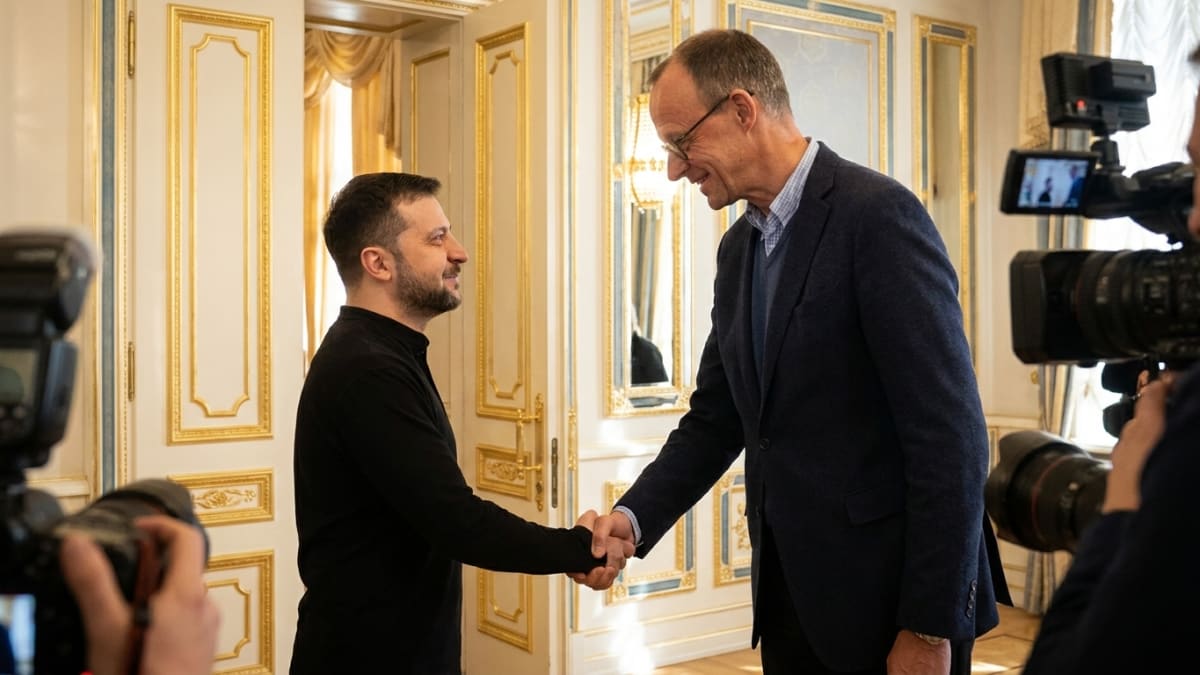
Ukraine and Germany, under Chancellor Friedrich Merz, agreed on the delivery of 600 PAC-2 interceptor missiles for Kyiv's Patriot air defence systems, to be supplied across 2027 and 2028.[1] President Volodymyr Zelensky disclosed the agreement at Independence Day press briefings on 23 August 2026. The volume is striking: Zelensky had originally sought 300 interceptors as part of a winter protection package, making Germany's commitment almost double the opening ask.[2]
Ukraine's own air force calculates it needs 360 interceptors every year just to sustain operations at the current pace of Russian attacks.[2] Six hundred missiles spread across two delivery years produces a ceiling close to that annual figure, assuming Russia does not intensify its ballistic missile campaign. Any escalation in Russian salvo size could compress that buffer significantly faster, given the multiple-interceptors-per-target logic baked into the system's operating doctrine.
Why stocks are critically low
Zelensky had been signalling the interceptor shortage openly since early July. His office published a statement on 4 July 2026 saying Ukraine critically needs Patriot interceptors, a rare public admission of operational scarcity.[3] The statement followed a particularly devastating night: Russia carried out a massive ballistic missile attack on the night into 2 July that killed 30 people, demonstrating in the starkest terms what happens when interceptor magazines run thin.[3]
Germany has been a consistent supplier of Patriot hardware since Russia's full-scale invasion. The system was developed by Raytheon and has formed the backbone of NATO-aligned air defence since the Gulf War, where allied forces routinely fired multiple interceptors at each incoming Scud to ensure a kill. Ukraine is now operating that same doctrine under sustained pressure, with batteries protecting cities and power infrastructure simultaneously.
The budget gap and European funding
The interceptor deal did not arrive in isolation. At the same Independence Day briefings, Zelensky disclosed the scale of Ukraine's fiscal strain: according to his statement, Ukraine faces a budget deficit in the Ministry of Defence of $27 billion.[1] Weapons delivered in kind reduce the cash outlay Kyiv must find from an already strained treasury.
The European Commission approved 6.1 billion euros in defence procurement funding for Ukraine on 24 August 2026, the day after Zelensky's Independence Day disclosures.[5] The Commission's approval provides a procurement mechanism that European member states can draw on to co-ordinate arms purchases for Kyiv, potentially accelerating delivery pipelines beyond what bilateral deals alone can achieve. The two announcements landing within 24 hours reflects a broader push by European institutions to institutionalise defence support as the conflict extends past its fourth year.
The longer game: making interceptors at home
Behind the German deal sits a more ambitious objective. Ukraine is working to obtain licences to produce Patriot interceptors domestically, a goal Zelensky's office outlined in late July 2026.[4] Domestic manufacture would remove the dependency on allied political decisions and export approvals that has constrained Ukrainian air defence throughout the war, and would allow Kyiv to scale production in line with operational demand rather than donor schedules.
For now, the 600-missile commitment from Germany provides a defined runway. Spread across two delivery years at Ukraine's said annual requirement of 360, the consignment covers roughly 20 months of sustained operations at current tempo, assuming one interceptor fired per threat. Under real-world doctrine, where salvos trigger multiple launches per target, that figure shrinks. How quickly the broader European procurement mechanism converts approved funding into delivered rounds will shape how much buffer Ukraine actually holds when the 2027 deliveries begin.
KEY TAKEAWAYS
SOURCES & CITATIONS
- Zelensky discloses German Patriot deal and $27 billion defence budget shortfall
- Zelensky on 300 vs 360 interceptors and annual air force requirement
- Ukraine critically needs Patriot interceptors, Zelensky's office
- Zelensky on domestic Patriot production licences
- European Commission approves 6.1 billion euros in defence procurement for Ukraine
- MIM-104 Patriot system overview
FREQUENTLY ASKED QUESTIONS


