
TLDR
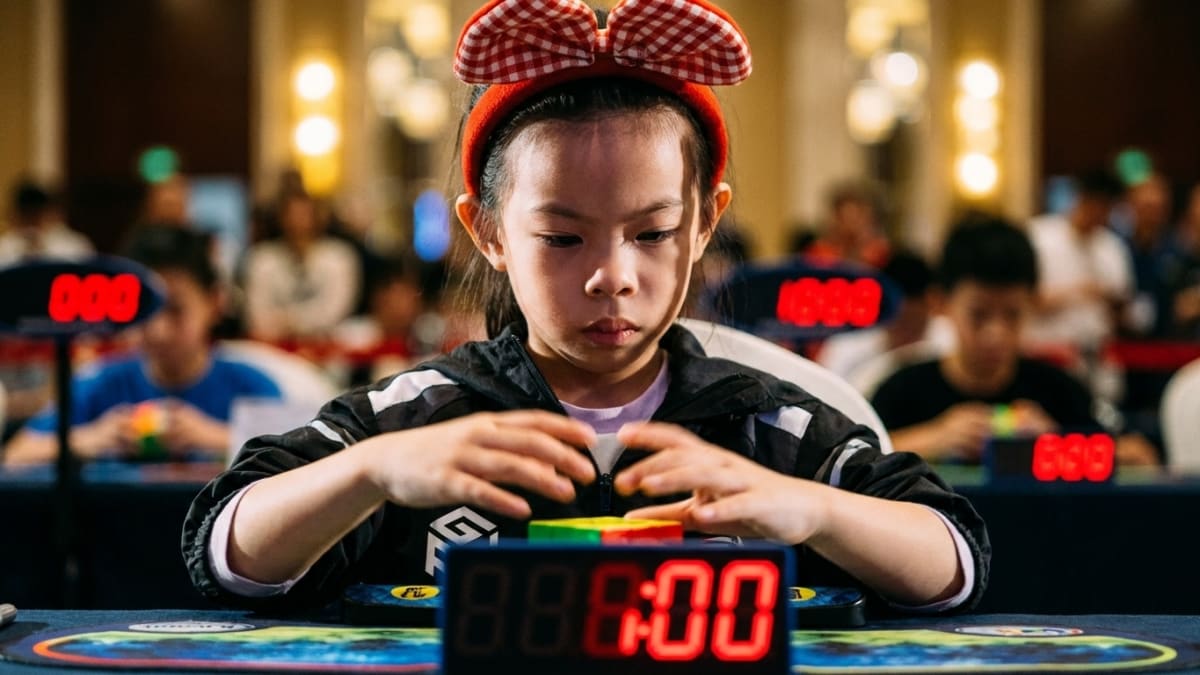
Lian Yunzhi, a six-year-old from China, set the women's 3x3 Rubik's Cube average world record at 4.27 seconds in Guangzhou on 16 September 2026, three days after breaking it for the first time in Wuhan. She is now the only female competitor to average under 4.5 seconds.
A six-year-old and 1,300 algorithms
There is a particular kind of record that unsettles because of the age attached to it rather than the number itself. Four point two seven seconds is already an abstraction, faster than most people can register that a puzzle exists, let alone touch it. Attach it to a six-year-old and the abstraction becomes something closer to a provocation.
On 16 September 2026, Lian Yunzhi won the 3x3x3 Cube final at the Guangzhou GraDUAL 3x3 IV 2026 competition with a World Cube Association-ratified average of 4.27 seconds, the fastest women's 3x3 average in the history of competitive speedcubing.[1] The record had already been broken once that week: three days earlier in Wuhan, Lian posted a 4.52-second average to claim the title for the first time.[2]
Chinese state broadcaster 央视新闻 reported that she is the world's only female competitor to average under 4.5 seconds, a distinction she consolidated in Guangzhou with more than a quarter-second to spare.[6] Lian first solved a cube at age four and now carries more than 1,300 algorithms in memory, training two to three hours daily.
How a WCA average is calculated
The figure of 4.27 seconds warrants a word about method, because WCA averages are constructed to resist outliers. Under WCA Regulations 9f8 and 9f13, the "Average of 5" format gives each competitor five consecutive solves, then discards the single fastest and the single slowest time, with the ranking derived from the arithmetic mean of the three solves that remain.[3] A fluke solve in either direction cannot carry a result; what survives is a genuine central tendency.
Both single-solve times and average-of-five results qualify as independent world records under WCA Regulation 9i1, meaning a competitor can hold one without the other.[4] The single-solve benchmark belongs to a different performer entirely: Poland's Teodor Zajder holds the outright single-solve world record at 2.76 seconds, set at the GLS Big Cubes Gdańsk 2026 competition in February 2026.[5]
Where the sport has come from
The WCA has sanctioned competitive speedcubing since 2004, and the arc of improvement across those two decades is difficult to reconcile with the apparent limits of human motor function. Australia's Feliks Zemdegs dominated much of the 2010s, setting dozens of records and becoming the first competitor to average under five seconds, a barrier that now reads like a warm-up benchmark.
China has since emerged as the sport's leading nation, hosting dozens of WCA events annually and producing competitors at the top of both the men's and women's rankings. The men's average-of-five record fell below four seconds in 2026, which places Lian's 4.27-second women's average inside a broader compression of times that shows no obvious floor. Her next ratified competition result will be watched closely by the WCA community.
KEY TAKEAWAYS
SOURCES & CITATIONS
FREQUENTLY ASKED QUESTIONS
How does the WCA calculate a speedcubing average?
What is the current single-solve world record for the 3x3 Rubik's Cube?
Who was the first speedcuber to average under five seconds?
Margaret Hale writes about politics, policy and the culture of business. She is drawn to the people behind decisions and to the moments when a political story turns out to be a human one.