
TLDR
One in three Australian households experienced food insecurity in the past year, according to Foodbank Australia's 2025 Hunger Report, as real wages and disposable incomes collapsed to levels unseen among comparable OECD nations. The crisis has reached into the agricultural sector itself, with self-employed Australians including farmers making up 11 per cent of food-insecure households. Headline inflation is forecast to peak at 4.8 per cent in the June quarter 2026, compounding a 2.6 per cent fall in real hourly wages recorded over nearly four years to September 2025. For a nation built on agricultural exports, hunger at that scale points to a sustained policy failure rather than a passing anomaly.
KEY TAKEAWAYS
The queue that should not exist
A farmer who works soil and seasons to produce food for export markets now stands in a queue at a food bank, a scene that sits badly with the story Australia tells about itself. One in three Australian households, an estimated 3.5 million, experienced food insecurity in the past 12 monthsverifiedVerified Source: reports.foodbank.org.au, according to Foodbank Australia's 2025 Hunger Report.[1] A number that size describes the structure of the economy rather than its margins.
Kylea Tink, Foodbank Australia's CEO, said the scale demands a political response. "This is not a fringe issue. Appallingly, hunger is mainstream in Australia right now. Our federal government must act," Tink said.[2] Tink has been making that case in public, year after year, while government deliberates.
The economics of hunger
The route a high-income country takes to this point runs straight through four years of wage data. Real hourly wages in Australia fell by 2.6 per cent over the 3¾ years to September 2025, one of the largest declines recorded among OECD economiesverifiedVerified Source: oecd.org.[3] A fall of that size, sustained across nearly four years, ground steadily through household budgets and purchasing power.
Real disposable household income per capita remained pinned at its 2019 level and stayed well below the pandemic-era peak throughout the period from early 2022 to late 2024, according to the OECD's January 2026 Economic Survey of Australia.[3] Australians, on average, have been living on less real money than they had before the pandemic, even as housing, groceries and energy costs climbed. Flat incomes meeting rising costs is the arithmetic that fills food bank queues.
Headline inflation is expected to peak at 4.8 per cent in the June quarter 2026, according to the Reserve Bank of Australia's May 2026 Statement on Monetary Policy.[4] That peak, assuming it arrives as projected, offers eventual relief, though for households already rationing meals the timing of a future peak matters far less than the grocery bill in front of them.
Work is no longer enough
The response that government and commentators reach for first is almost always the labour market. Unemployment is low, the argument goes, people are working, and work protects people, yet the numbers beneath that tidy argument leave it incomplete. The seasonally adjusted unemployment rate fell to 4.4 per cent in May 2026.[5] The trend underemployment rate sat at 6.1 per cent in the same month.[6]
Read together, those two numbers describe the labour market more honestly than either does alone. A person employed for twelve hours a week is counted as employed; they are not, in any meaningful sense, protected from food stress. Underemployment captures that precarity: the work that exists but does not stretch to rent, food and utilities simultaneously. With six per cent of the workforce in that position, the economy has quietly reclassified vulnerability as participation.
Tink put the human dimension plainly. Foodbank Australia's CEO said food insecurity does not discriminate, and Australians are doing everything right by working, budgeting and seeking help, yet still going hungry.[2] Most of the people in these queues have done nothing more unusual than work in an economy that fails to pay them enough.
When the farmer needs the food bank
One line in Foodbank Australia's 2025 Hunger Report says more about the shape of the crisis than the headline figure. Eleven per cent of food-insecure households in 2025 were self-employedverifiedVerified Source: reports.foodbank.org.au, a category that includes farmers and small agricultural operators.[1] Australia exports beef, wheat, barley, wool, wine and dozens of other agricultural commodities to markets across Asia and beyond. The people who grow that food are showing up at relief services to feed their own families.
Self-employed agricultural producers have no access to employee entitlements: no paid sick leave, no redundancy, no employer superannuation contributions beyond their own. Their income is volatile by definition, shaped by rainfall, commodity prices, interest rates on farm debt and input costs. When several of those variables turn hostile simultaneously, as they have in recent years, the only buffer left is the food bank.
What distinguishes the current crisis from cyclical hardship is where it sits: it has moved beyond the traditionally vulnerable into the working population, the self-employed, and the people who grow Australian food for global markets. The distribution of hunger has changed even if the political conversation has not caught up.
Charity as infrastructure
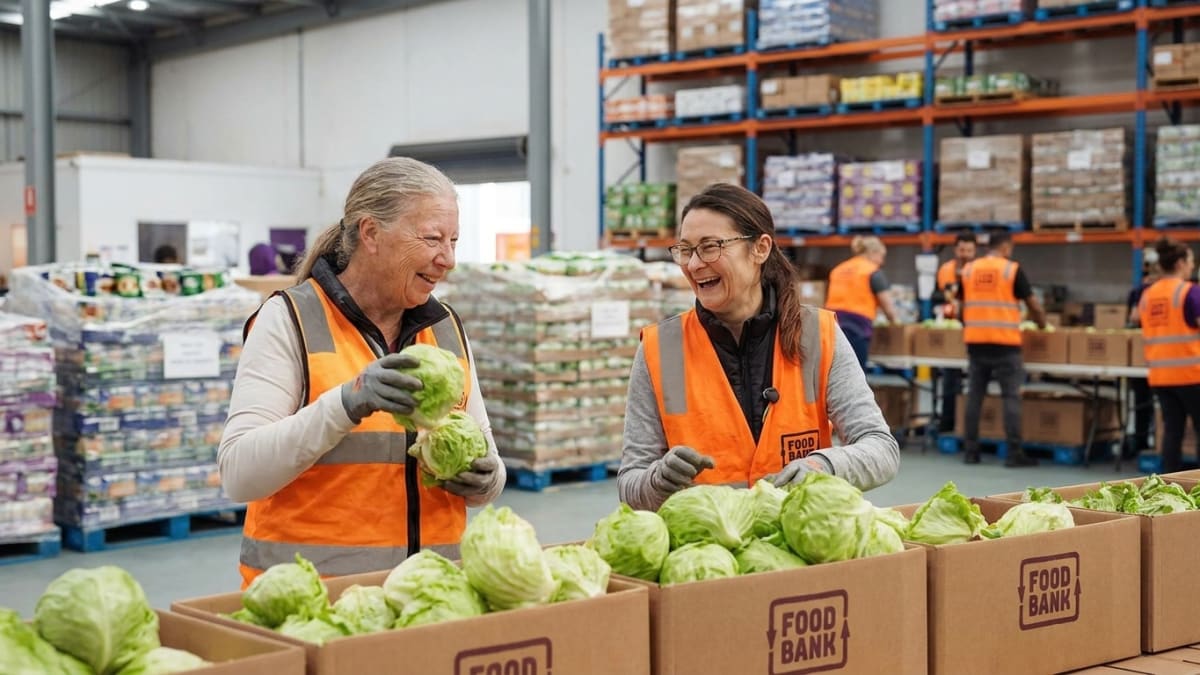
Foodbank Australia and its network of member organisations are doing extraordinary work. That work has also, quietly and without a formal policy decision, become load-bearing, filling a gap that income support, wages policy and housing affordability were supposed to prevent from opening.
When charity becomes infrastructure, when 3.5 million households depend in some measure on food relief as a routine feature of their year, the state has outsourced a problem it was supposed to solve, and outsourced problems surface in the Hunger Report rather than in the budget papers.
The OECD identified real wage decline as one of the most serious structural problems in the Australian economy in its January 2026 survey, and the RBA's own inflation projections confirm that cost-of-living pressure will not ease quickly.[3][4] Foodbank Australia served food-insecure households across all employment categories, all age groups and all states in the 12 months to October 2025.[1] A government can choose to act on those conditions or allow food relief networks to quietly absorb the consequences of inaction.
SOURCES & CITATIONS
- Foodbank Hunger Report 2025, Foodbank Australia / Ipsos
- Foodbank Hunger Report 2025 Media Release, Foodbank Australia
- OECD Economic Surveys: Australia 2026, OECD
- Statement on Monetary Policy, May 2026: Outlook, Reserve Bank of Australia
- Unemployment Rate Falls to 4.4%, May 2026, ABS
- Labour Force, Australia, Latest Release, ABS
FREQUENTLY ASKED QUESTIONS
How many Australian households experienced food insecurity in 2025?
Why are real wages falling in Australia?
Are employed Australians also affected by food insecurity?
What does farmer food insecurity reveal about Australia's economy?
Margaret Hale writes about politics, policy and the culture of business. She is drawn to the people behind decisions and to the moments when a political story turns out to be a human one.