
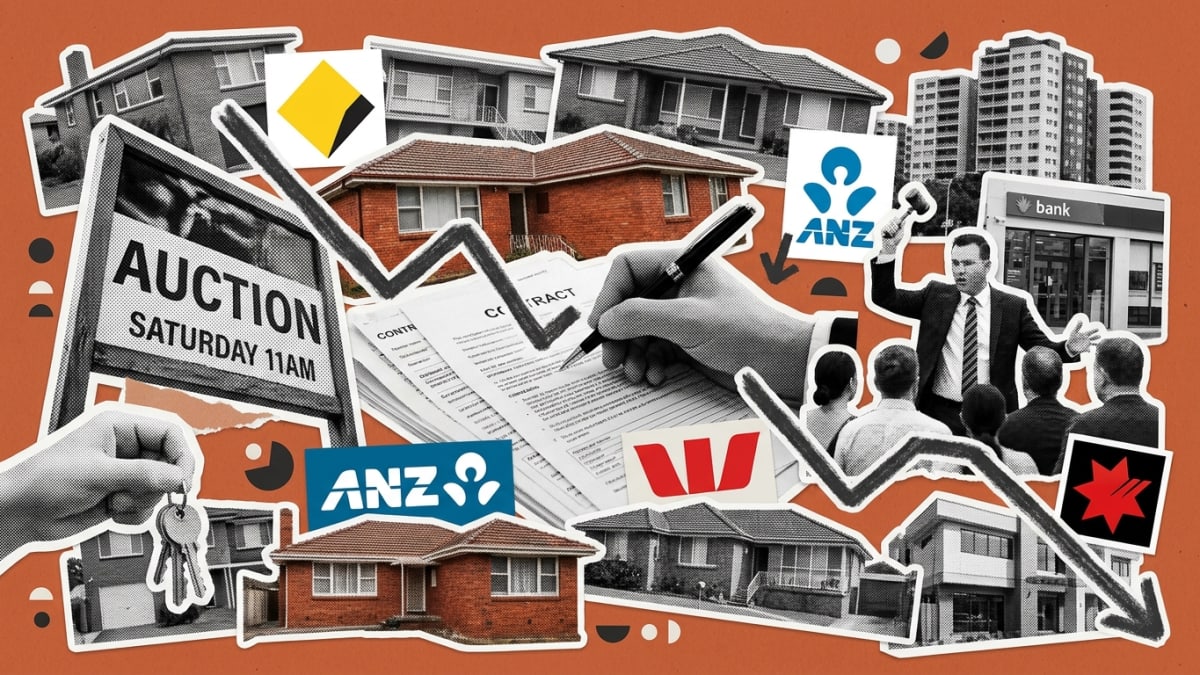

TLDR
Australia's four major banks have each flagged a sharp pullback in home loan demand since the May budget, with CBA posting a $10.9 billion full-year profit even as applications fell 15 per cent. Westpac's ASX disclosure puts its own slide at 18 per cent, and national dwelling prices fell 0.4 per cent in June.
Profit up, pipeline down
Commonwealth Bank booked a net profit after tax of $10.866 billion for the full year ended 30 June 2026[1], the largest annual result in the bank's history. The headline number looks solid, but the operating commentary buried inside the same result briefing told a different story about where the mortgage book is heading.
Chief Executive Matt Comyn said on 12 August that home loan application volumes had slid 15 per cent since May, with investor applications down 28 per cent since the budget was unveiled on 12 May.[2] Comyn's written statement offered a careful read: "Housing activity has softened from a high base. Application volumes appear to have stabilised in recent weeks."[6] Stabilised, not recovered.
Westpac's numbers are more precise
Westpac's ASX disclosure put average monthly mortgage applications at a pace of 27,000 a month since the May budget, down from 33,000 the prior quarter, a fall of roughly 18 per cent.[3] Where CBA offered a percentage, Westpac gave the raw volumes, which makes its figure easier to interrogate. At average loan sizes around $600,000 to $650,000, the move from 33,000 to 27,000 applications a month represents several billion dollars of origination capacity leaving Westpac's pipeline every month.
The May budget introduced changes to property-related tax settings that appear to have knocked sentiment before the RBA even moved. The Reserve Bank held the cash rate at 4.35 per cent on 11 August, marking the end of its tightening cycle that began in early 2022.[6]
What the price forecasts actually say
ANZ's property research unit has gone further than the other major banks in laying out a specific price trajectory. ANZ Associate Director for Property Daniel Gradwell said "Sydney and Melbourne housing prices are likely to fall about 8% this year".[4] ANZ's Q3 commercial property update, published 27 July, also flagged a worst-case scenario of a 14.5 per cent Sydney decline, which would be the sharpest correction in that market since the post-pandemic unwind.
NAB cut its national dwelling price forecast to minus 5 per cent this week, reversing the 5 per cent rise it had published in its first-quarter housing sentiment release.[5] Its application volumes tell the same story as its peers, with the bank flagging a 15 per cent fall.
The market data underneath the bank forecasts
Cotality's Home Value Index recorded sequential monthly falls of 0.1 per cent in April, 0.3 per cent in May and 0.4 per cent in June 2026, the largest monthly national price decline since December 2022. Three consecutive months of accelerating falls shifts the burden of proof onto the bulls.
Brisbane's residential auction clearance rate slid to 23.8 per cent in the first week of August. KPMG Economics is projecting a 1.1 per cent national price decline across 2026 before a 3.4 per cent recovery in 2027.
What to watch next
Three variables will determine whether the application slowdown is a temporary budget shock or the start of a genuine credit contraction. The spring selling season beginning in September typically lifts listing volumes and buyer activity, so a weak clearance rate through October would confirm that sentiment, not just supply, is the constraint. Any shift in RBA language toward rate cuts would immediately reprice fixed-rate expectations and likely pull forward demand that is currently sitting on the sideline.
ANZ's Q3 paper flagged investor activity was expected to fall 34 per cent, a contraction large enough to reshape pricing dynamics in inner-city unit markets that had only recently recovered. The record profit season and the falling application volumes are two readings from different points on the same timeline, and the gap between them is closing.
KEY TAKEAWAYS
SOURCES & CITATIONS
- CBA 2026 Full-Year Results Profit Announcement
- CBA 2026 Full-Year Results ASX Announcement
- Westpac ASX Disclosure June 2026
- ANZ Commercial Property Update Q3 2026
- NAB Housing Sentiment Q1 2026
- Commonwealth Bank home loan applications fall 15pc since May - ABC News - abc.net.au
FREQUENTLY ASKED QUESTIONS
Why did CBA report a record profit if mortgage applications are falling?
Is the 18 per cent Westpac figure the same as the 15 to 20 per cent range cited elsewhere?
What is ANZ's worst-case forecast for Sydney house prices?
When will KPMG's projected price recovery occur?
Vikram Singh writes about banking. He follows where money actually moves, from the strategy set in head office to what changes on a customer's phone.