
TLDR
China fired a submarine-launched intercontinental ballistic missile into the South Pacific on 6 July 2026 without giving the 48-hour advance notice that international norms require. Prime Minister Anthony Albanese, speaking from Honiara, called it a provocative act that destabilises the region. Foreign Minister Penny Wong echoed that warning from Suva. Beijing said the launch was routine annual training that complied with international law. The test landed in the middle of Albanese's Pacific diplomacy tour, sharpening friction at an already sensitive moment.
A missile in the middle of a peace tour
On 6 July 2026, while Prime Minister Anthony Albanese was in Suva signing the Vuvale Union and Ocean of Peace Alliance with Fiji, China test-fired what analysts assessed to be a JL-2 or JL-3 submarine-launched intercontinental ballistic missile from the South China Sea, the warhead travelling approximately 7,300 kilometres before splashing down in the South Pacific Nuclear Free ZoneverifiedVerified Source: csis.org.[2] The timing was, to put it plainly, pointed.
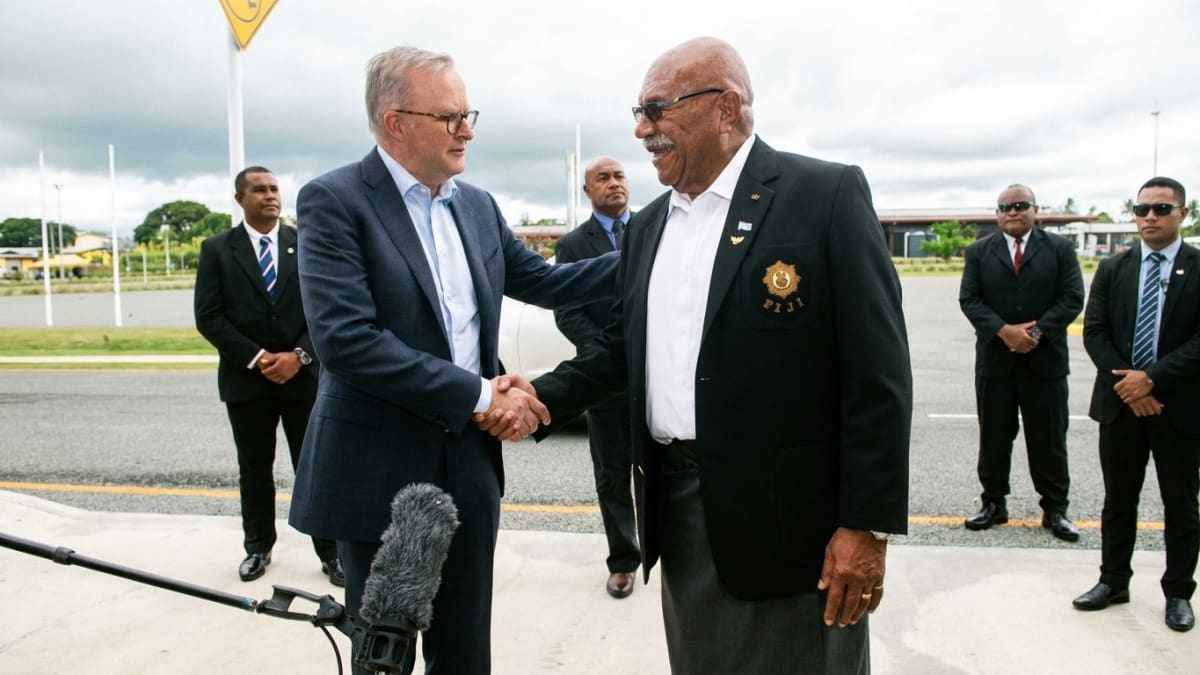
Albanese moved on to Honiara the following day to mark Solomon Islands Independence Day. The press conference he gave there was not the one his office had planned.
What China fired, and why it matters
The missile was unarmed, launched from a nuclear-powered submarine, and its flight path crossed international waters.[1] A submarine-launched ICBM test in the open ocean demonstrates a sea-based second-strike nuclear capability, the ability to absorb a first strike and still retaliate from beneath the waves.[2] It also marked Beijing's first publicly acknowledged SLBM test in international waters and its first strategic nuclear strike demonstration from a nuclear submarine in the Indo-Pacific.
Such launches reduce the predictability of missile flight paths and complicate regional missile-defence planning in ways that no diplomatic communiqué can easily paper over.[2] The destination, the South Pacific Nuclear Free Zone, added its own layer of symbolic weight to an already fraught event.
The missing 48 hours
Under the Hague Code of Conduct Against Ballistic Missile Proliferation and the customary practice embedded in major arms-control arrangements, states are expected to give at least 48 hours' prior notification of ballistic missile flight tests, including the missile type, trajectory, impact area, and timing. China gave no such notice on this occasion.verifiedVerified Source: pm.gov.au Albanese said the omission was not a procedural oversight; it was the act itself.
"It is standard procedure for tests such as this for there to be given 48 hours notice. This was not done on this occasion."[3] Defence Minister Pat Conroy separately said the test was not consistent with these norms, which exist precisely to reduce the risk of misinterpretation and escalation.[3]
Albanese and Wong speak plainly
Albanese did not reach for diplomatic softening. "There is no doubt that this is a provocative act by China which does destabilise the region," he said from Honiara.[3] Australia has spent several years managing a careful recalibration of its relationship with Beijing, and a prime minister choosing the word "provocative" in public is not doing so carelessly.
Wong, speaking from Suva, was equally direct. "Australia has been clear with China that we regard this as destabilising to the region," she said.[4] Wong said the test lacked "the transparency and reassurance as to intent, that the region expects," and that it was inconsistent with Pacific Islands Forum leaders' vision of an Ocean of Peace, the very framework Albanese had been in Fiji to advance.[4]
Washington adds its voice
The United States monitored the launch and moved quickly to characterise it in stark terms. Tommy Pigott, spokesperson for the US State Department, said Beijing's rapid and opaque nuclear weapons buildup is of great concern to the region and the worldverifiedVerified Source: ebs.publicnow.com.[5] Pigott urged China to "engage in meaningful arms control discussions and commit to a regularised notification arrangement for all intercontinental-range ballistic missile and space launches."[5]
Washington's call for a regularised notification arrangement signals that the absence of such a framework is seen not as an oversight but as a structural problem requiring a negotiated remedy, one Beijing has so far shown little appetite for.
Beijing's position
China's Foreign Ministry Spokesperson Mao Ning said the launch was a routine part of annual military training, complied with international law and practice, and that relevant countries had been notified in advance.[1] Mao told reporters that critics should not overinterpret the exercise. Which countries constitute "relevant" parties to advance notice, and whether 48-hour public notification falls within that definition, remained the central point of contention.
The test came as Albanese's Pacific tour was intended to reinforce Australia's commitment to a Pacific-led security architecture, a vision now competing for regional attention with a missile that flew 7,300 kilometres and landed on 6 July 2026.
KEY TAKEAWAYS
SOURCES & CITATIONS
- Chinese Foreign Ministry spokesperson Mao Ning on the SLBM launch
- CSIS analysis: China's SLBM test underscores importance of ballistic missile launch notification agreement
- PM Albanese press conference, Honiara, Solomon Islands, 7 July 2026
- Foreign Minister Penny Wong doorstop, Suva, Fiji
- US State Department spokesperson Tommy Pigott on China's SLBM test
FREQUENTLY ASKED QUESTIONS