
TLDR
Australia's housing downturn turned near-universal in August, with 93 per cent of capital city suburbs recording falling values and the national index dropping 0.9 per cent for the month. Sydney led all markets lower, now 7.1 per cent off its February peak, while auction clearance rates collapsed to the low 40 per cent range.
Downturn goes near-universal
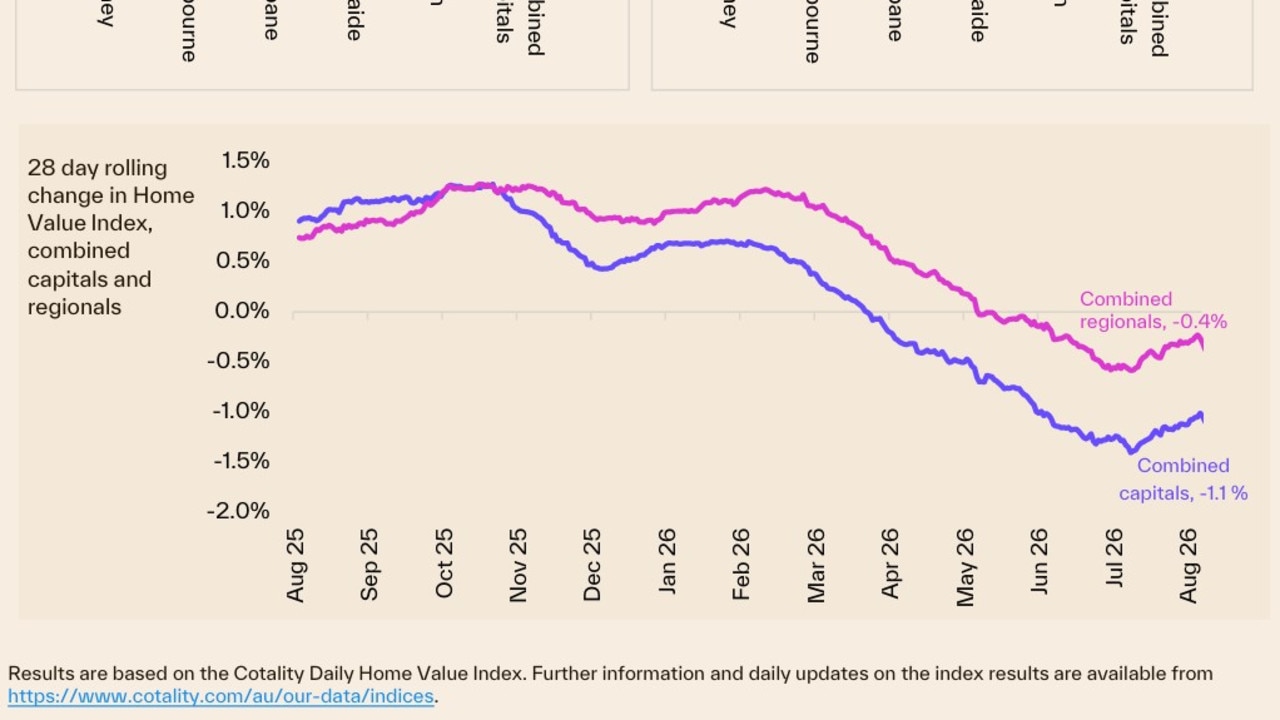
Cotality's national Home Value Index fell 0.9 per cent in August 2026, a fifth consecutive monthly decline and an acceleration from July's 0.7 per cent fall.[1] July's drop had itself been the largest single-month fall since December 2022.[1] Over the three winter months the falls added up to about $40,000 off the value of the average house in the capital cities, on Cotality figures reported by The Age.[5]
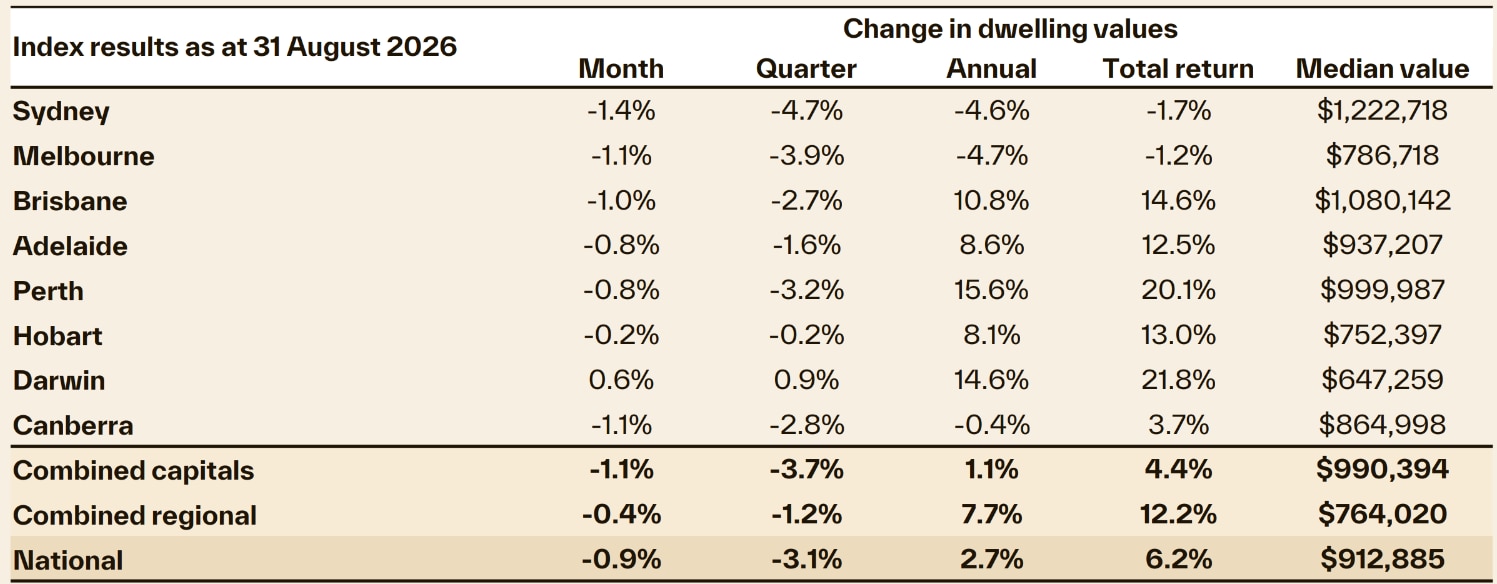
The national median value of $912,885 now sits 3.6 per cent below the record set in March, and news.com.au reported Sydney is falling at a pace not seen in four decades.[6]
The share of capital city suburbs recording a value fall more than doubled through winter, from 45.8 per cent in autumn to 93 per cent by August.[1] Cotality Research Director Tim Lawless said the breadth of the decline marked a shift in character. "What started as a more concentrated easing across higher-value segments has now become a much more generalised softening, with the vast majority of capital city suburbs recording some level of decline," Lawless said.[1]
Sydney leads, Darwin the lone exception
Sydney home values dropped 1.4 per cent in August and now sit 7.1 per cent below their February 2026 peak.[1] Lawless said elevated advertised stock was compounding the city's pressure. "Sydney continues to lead the downturn. The combination of a sharp drop in demand and higher than average advertised stock levels is weighing more heavily on Australia's largest housing market," he said.[1]
Melbourne and Canberra both fell 1.1 per cent, Brisbane dropped 1.0 per cent, and Adelaide and Perth each declined 0.8 per cent over the month.[1] Every capital city except Darwin recorded a value decline over the three months through August.[1] Australia's total housing stock carried a value of $12,772.6 billion across 11,495,200 dwellings as of the March quarter 2026, according to Australian Bureau of Statistics data.[4]
Auctions stall, stock builds
The share of homes selling at auction fell from around 66 per cent in February 2026 to the low 40 per cent range by the end of July, as buyer hesitancy prompted many vendors to withdraw listings or sell privately.[2] Quarterly sales volumes tracked 15.5 per cent lower year-on-year and 11.5 per cent below the five-year average.[1] Cotality's listings count puts 84,961 properties on the market across the combined capitals over the four weeks to late August, 21,678 of them newly listed, a stock overhang that helps explain why clearance rates keep sliding.[6]
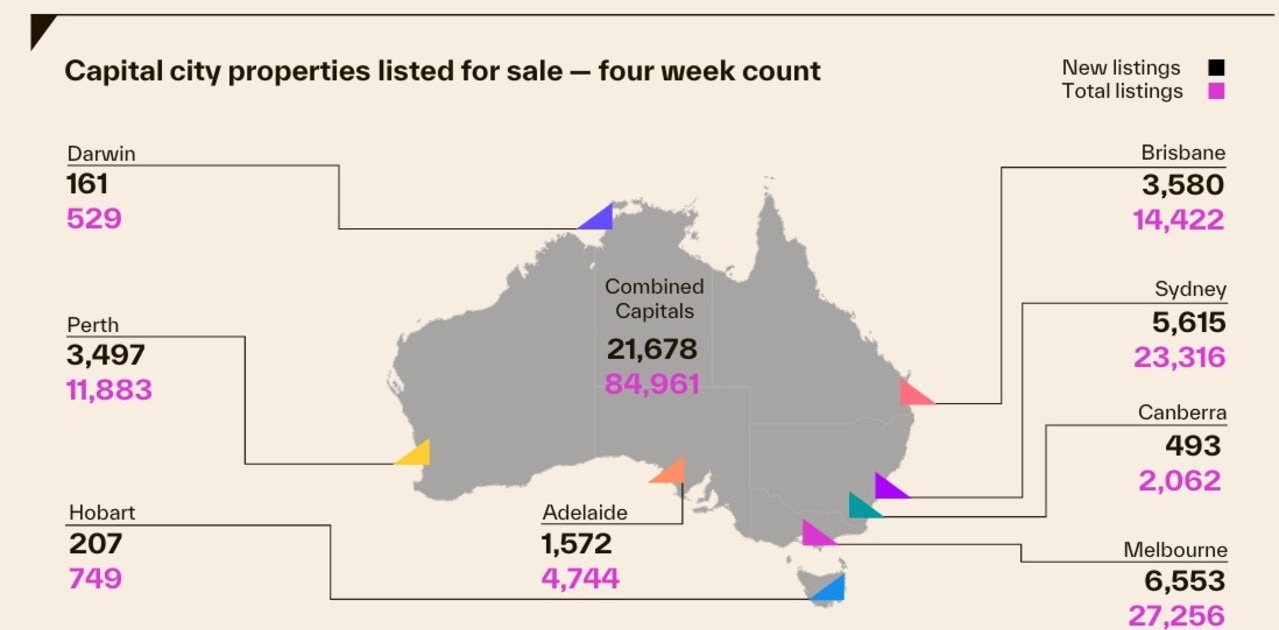
Total advertised listings across the four weeks ending 30 August ran 24 per cent higher year-on-year and 8 per cent above the five-year average.[1] New listings flowing to market over the same period fell 6 per cent year-on-year and sat 8 per cent below the five-year average, pointing to vendors holding back rather than testing a soft market.[1] Annual rental growth held at 5.9 per cent in July, with gross rental yields rising to 3.7 per cent, adding a further barrier for prospective buyers already facing tight borrowing conditions.
RBA decision looms over spring
Spring typically brings a lift in new listings, and buyers and sellers enter the season with the RBA's next rate decision still unresolved. The Monetary Policy Board meets on 28 to 29 September 2026 to set the cash rate.[3] A cut could revive buyer confidence; a hold or rise would extend the pressure on a market already recording its broadest price falls in years.
KEY TAKEAWAYS
SOURCES & CITATIONS
- Housing downturn spreads as 93 per cent of capital city suburbs record winter value falls, Cotality
- Monthly Housing Chart Pack August 2026, Cotality
- Board Meeting Schedules, Reserve Bank of Australia
- Total Value of Dwellings, March Quarter 2026, Australian Bureau of Statistics
- $40,000 wiped off the value of the average house over winter, The Age
- Fresh housing data lands showing prices fell for the fifth consecutive month, news.com.au
FREQUENTLY ASKED QUESTIONS


