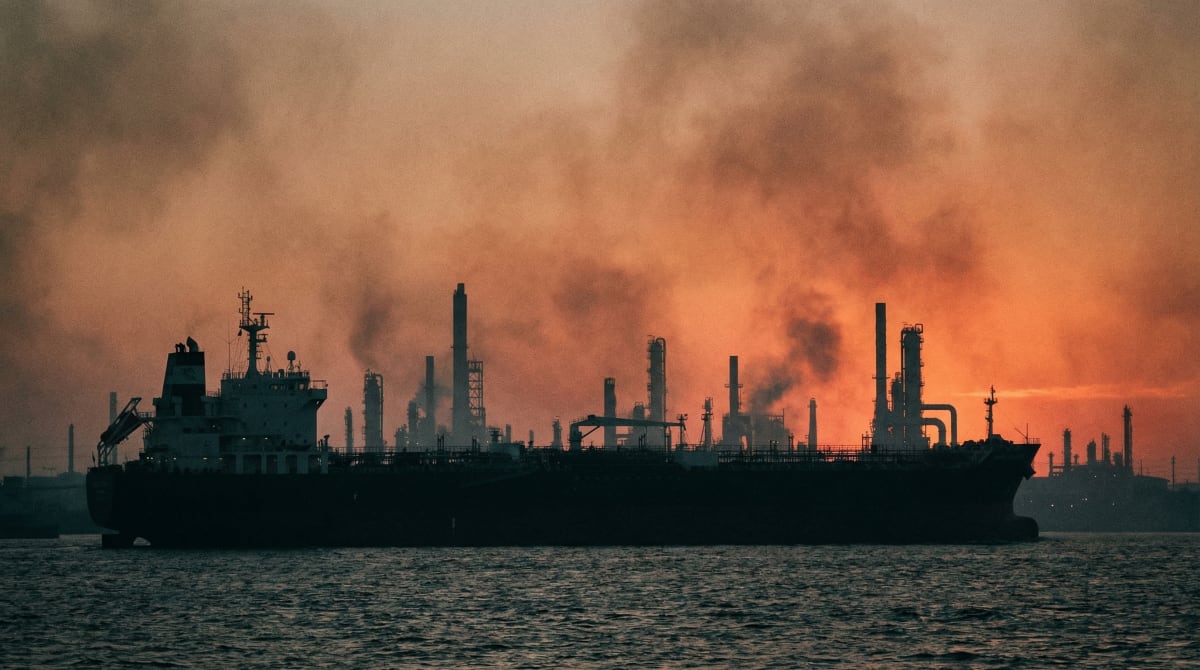
The last tanker to transit the Strait of Hormuz before the blockade took hold was the Eagle Vellore, carrying 2 million barrels of crude. When it departed, that cargo was worth $130 million. By the time it reached Asian waters, the same oil was valued at $220 million. The ship had become a floating demonstration of what happens when the world's most important oil chokepoint closes.
KEY TAKEAWAYS
That was three weeks ago. Since then, the dominoes have started falling across Southeast Asia, and Australia is watching the collapse from the end of a very long supply chain.
The supply chain breaks
Asian refineries source between 60 and 70 percent of their crude from Middle Eastern producers, almost all of it transiting the Strait of Hormuz. When that waterway became impassable, the mathematics became brutal. Saudi Aramco, the region's largest supplier, cut deliveries to Asia from 7.1 million barrels per day in February to 4.3 million in March. That is a 40 percent reduction in crude supply to a region that runs on refining.
The response has been predictable and swift. Singapore Refining has reduced output. Malaysia's Pengerang Refinery, one of the largest in the region, has followed. Across the region, refineries are burning through feedstock faster than it can be replaced.
Countries have started hoarding. South Korea imposed an export cap at 2025 levels this week. China, Vietnam, and Thailand have banned exports of refined products entirely. Each export ban makes sense for the country imposing it. Collectively, they are strangling regional fuel availability.
The reserves problem
The strategic petroleum reserves across Southeast Asia were never built for this scenario. Cambodia, Indonesia, and Vietnam each hold between 20 and 23 days of fuel supplies. Myanmar has roughly 40 days. Thailand sits at around 60 days, comparatively comfortable but still measuring time in weeks rather than months.
Vietnam has already moved to demand reduction. The government is encouraging work-from-home arrangements to cut fuel consumption. Petrol prices have risen roughly 30 percent since the war began. Diesel is up 40 percent. These are not price spikes that resolve when the news cycle moves on. They reflect a physical shortage of refined fuel.
Cambodia is negotiating emergency supply agreements with Singapore and Malaysia. But Singapore and Malaysia are dealing with their own constraints. The entire region is competing for the same shrinking pool of refined products.
The Russian pivot
One pressure valve has opened. After the United States eased sanctions to manage global supply stress, Asia is expected to import record volumes of Russian fuel oil in March. This will provide some relief. But Russian supply cannot replace Middle Eastern volumes at scale, and the logistics of rerouting tanker traffic take time the region does not have.
The fundamental problem remains. A region built its entire energy infrastructure on the assumption that Hormuz would always be open. That assumption has proven wrong, and there is no quick fix.
Australia's exposure
Australia imports roughly 90 percent of its refined fuel, most of it from refineries in Singapore, South Korea, and Japan. When those refineries cut output or redirect product to domestic markets, Australian supply contracts.
"We're approaching crunch time. Australia is vulnerable at the end of the supply chain." — Saul Kavonic, energy analyst, MST Marquee
Pauline Tang at S&P Global offered a blunt assessment of the pricing outlook. Even if Asian refiners continue operating normally, she said, their customers including Australia will pay significantly more. The competition for finite supply has changed the market structure.
Australian policymakers have talked about fuel security for years. The closure of local refineries at Kurnell, Clyde, Bulwer Island, and Caltex Lytton reduced domestic refining capacity to two facilities: Geelong and Brisbane. Those discussions always assumed adequate supply from regional partners. That assumption is now being tested.
What comes next
The war in Iran shows no signs of rapid resolution. The Strait of Hormuz remains contested. Every week the blockade continues, pressure on Asian energy markets intensifies.
Australia cannot build new refineries in weeks or months. It cannot source crude from suppliers that do not exist. What it can do is watch the scramble unfold and prepare for the price increases that are coming regardless of military outcomes.
The strategic miscalculation was not unique to Australia. An entire region built its energy security on a single maritime chokepoint controlled by actors with every incentive to threaten it. That vulnerability has been theoretical for decades. It is now operational.
Vietnam is telling workers to stay home to save fuel. South Korea is capping exports. Thailand is measuring reserves in weeks. Australia is at the end of this supply chain, dependent on partners who are now looking after themselves first.
The dominoes are falling. The question is how far down the line Australia sits.
TLDR
The Strait of Hormuz blockade has triggered a cascading energy crisis across Southeast Asia. Countries are banning fuel exports, refineries are cutting output, and Australia sits at the end of a supply chain that is breaking down in real time.
SOURCES & CITATIONS
FREQUENTLY ASKED QUESTIONS