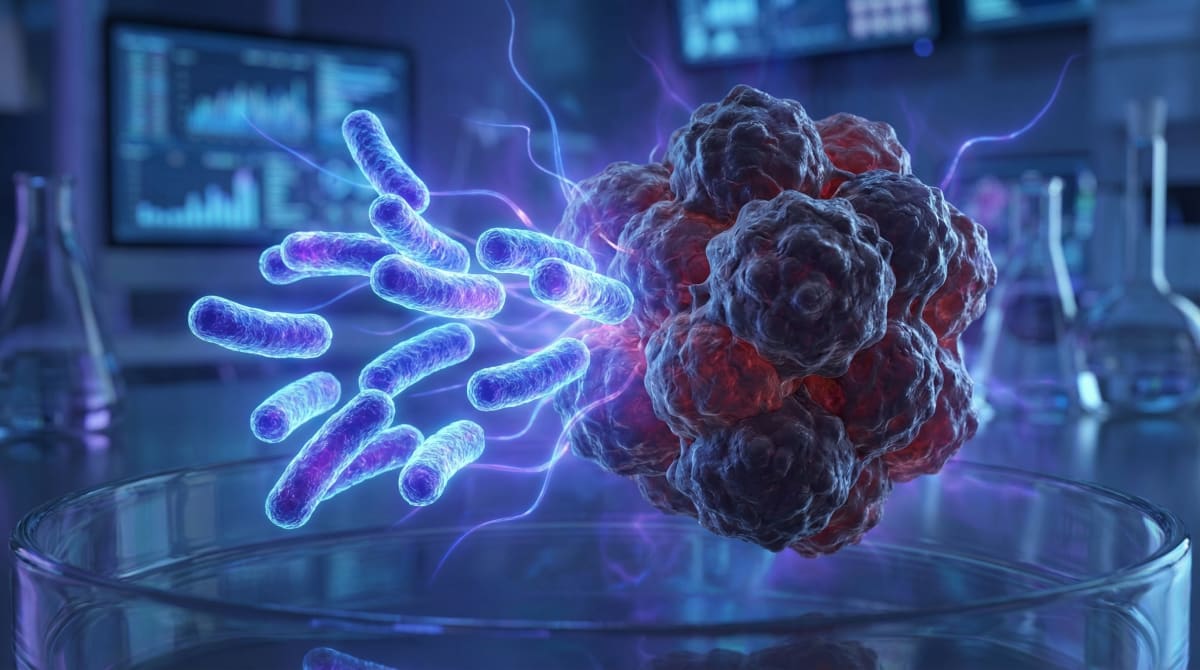
Researchers in China have engineered a common probiotic bacterium to function as a microscopic drug factory, infiltrating tumours and producing a cancer-fighting medication directly at the disease site. The findings, published in the open-access journal PLOS Biology, represent an early but promising step toward a new class of cancer treatments.
TLDR
Researchers in China have engineered E. coli Nissle 1917, a probiotic strain used safely for over a century, to produce the FDA-approved cancer drug Romidepsin inside tumours. In mouse trials, the bacteria successfully colonised tumours and released the medication on site, offering a potential path to targeted cancer therapy with fewer side effects.
KEY TAKEAWAYS
The team at Shandong University in Qingdao, led by Tianyu Jiang, modified Escherichia coli Nissle 1917, a probiotic strain that has been safely used in humans for over a century to treat intestinal conditions. Through genetic engineering, they equipped the bacteria with the ability to synthesise Romidepsin, an FDA-approved drug used to treat certain types of lymphoma.
How the system works
The approach exploits a peculiar characteristic of many bacteria: they tend to accumulate in tumour environments. Tumours create conditions that certain bacterial strains find hospitable, including low oxygen levels and an abundance of nutrients from rapidly dividing cells.
Once the engineered E. coli Nissle 1917 colonises a tumour, it begins producing Romidepsin inside the mass. This targeted delivery could potentially reduce the systemic side effects associated with conventional chemotherapy, where drugs circulate throughout the body and affect healthy cells along with cancerous ones.
By leveraging engineered EcN, we can design a bacteria-assisted, tumour-targeted therapy for the biosynthesis and targeted delivery of small-molecule anticancer agents. Our mouse-model study establishes a solid foundation for engineering bacteria which are capable of producing small-molecule anticancer drugs.
— Tianyu Jiang and colleagues, PLOS Biology
The team tested the modified bacteria in mice with breast cancer tumours. They found that the bacteria successfully accumulated inside the tumours and released Romidepsin in both laboratory and live animal settings across various conditions.
Why Romidepsin
Romidepsin belongs to a class of drugs called histone deacetylase inhibitors. These medications work by affecting how genes are expressed in cancer cells, ultimately triggering cell death. The drug received FDA approval in 2009 for treating cutaneous T-cell lymphoma and was later approved for peripheral T-cell lymphoma.
Using a medication that already has regulatory approval simplifies the path toward human trials. Researchers do not need to prove the drug itself is safe; they need to demonstrate that the bacterial delivery mechanism works and does not introduce new risks.
The choice of E. coli Nissle 1917 as the delivery vehicle is similarly strategic. The strain has been used in Europe since 1917 to treat gastrointestinal conditions and has a well-established safety profile. Doctors have prescribed it for inflammatory bowel disease and to prevent colonisation by harmful bacteria.
A dual-action approach
The researchers describe their system as a dual-action cancer therapy. The first action comes from the bacteria's natural ability to colonise tumours and potentially stimulate an immune response. The second action comes from the Romidepsin the bacteria produce.
Escherichia coli Nissle 1917's tumour colonisation synergises with Romidepsin's anticancer activity to form a dual-action cancer therapy.
— Research team, PLOS Biology
This combination could prove more effective than either approach alone. Some previous research has shown that certain bacteria can trigger the immune system to recognise tumours more effectively. Adding a potent anticancer drug to that immune activation creates multiple mechanisms working against the cancer simultaneously.
Significant limitations remain
Despite the promising results, the research is at an early stage. The approach has not been tested in humans, and mouse models often fail to predict how treatments will perform in people.
The researchers acknowledged that future studies will need to examine potential side effects of the engineered bacteria. While E. coli Nissle 1917 is generally considered safe, adding new genetic material introduces unknown variables. The bacteria's behaviour in different tumour types and in patients with compromised immune systems requires investigation.
Another open question involves how to safely remove the bacteria after treatment concludes. Engineered microorganisms designed to persist in the body raise regulatory and safety concerns that do not apply to conventional drugs, which are metabolised and excreted.
Context in cancer research
The work joins a growing field of research into bacteria-based cancer therapies. Scientists have long observed that certain bacterial infections occasionally cause tumours to shrink, a phenomenon first documented more than a century ago. Modern biotechnology now allows researchers to harness this effect systematically.
Other research groups have engineered bacteria to deliver various therapeutic payloads to tumours, including proteins that stimulate the immune system and enzymes that convert inactive drugs into active forms. The field remains experimental, but early results have attracted significant investment from pharmaceutical companies and venture capitalists.
Cancer killed nearly 10 million people worldwide in 2023, according to the World Health Organisation, making it the second leading cause of death globally. Treatments that can target tumours more precisely while causing fewer side effects would represent a substantial advance.
What comes next
The Shandong University team has demonstrated proof of concept. The bacteria can colonise tumours in mice and produce an anticancer drug on site. The next steps involve understanding the approach's limitations and moving toward human testing.
Such progression typically takes years. Researchers will need to conduct extensive safety studies, optimise the bacterial engineering to maximise drug production while minimising risks, and eventually design and execute clinical trials.
The regulatory pathway for a living therapeutic agent differs from that for conventional drugs. The FDA has approved a small number of genetically modified organisms for therapeutic use, but the category remains relatively new, and approval processes are still evolving.
Still, the research adds to evidence that engineered microorganisms could become a meaningful component of cancer treatment. The ability to produce medication directly inside a tumour, rather than flooding the entire body with toxic drugs, addresses one of oncology's fundamental challenges.
The full study was published in PLOS Biology on 17 March 2026.
SOURCES & CITATIONS
FREQUENTLY ASKED QUESTIONS