
TLDR
Nvidia's second-quarter revenue hit $96.2 billion, doubling year on year, driven by data centre sales up 117 per cent to $89 billion. AWS committed to deploying 2 million Nvidia GPUs under a deal that locks in demand well into 2028.
The number that resets expectations
Nvidia posted revenue of $96.2 billion for the second quarter ended 26 July 2026, up 106 per cent year on year and 18 per cent on the prior quarter.[1] Consensus estimates sat near $92 billion. Nvidia cleared them by roughly $4 billion.
Wall Street had already priced in extraordinary growth. Nvidia delivered something beyond that, and the composition of those earnings tells you exactly where the money is going.
Data centres now carry the whole business
Data centre revenue reached $89 billion for the quarter, up 117 per cent from the same period a year earlier, representing more than 92 per cent of Nvidia's total sales.[1] Gaming, professional visualisation and automotive combined for the remainder, and none of them move the needle at this scale.
Gross margins held at 75 per cent on both a GAAP and non-GAAP basis, and GAAP diluted earnings per share came in at $2.46.[1] At $96 billion in quarterly revenue, a 75 per cent gross margin tells you supply is still running well short of what buyers want.
Huang frames it as an inflection, not a cycle
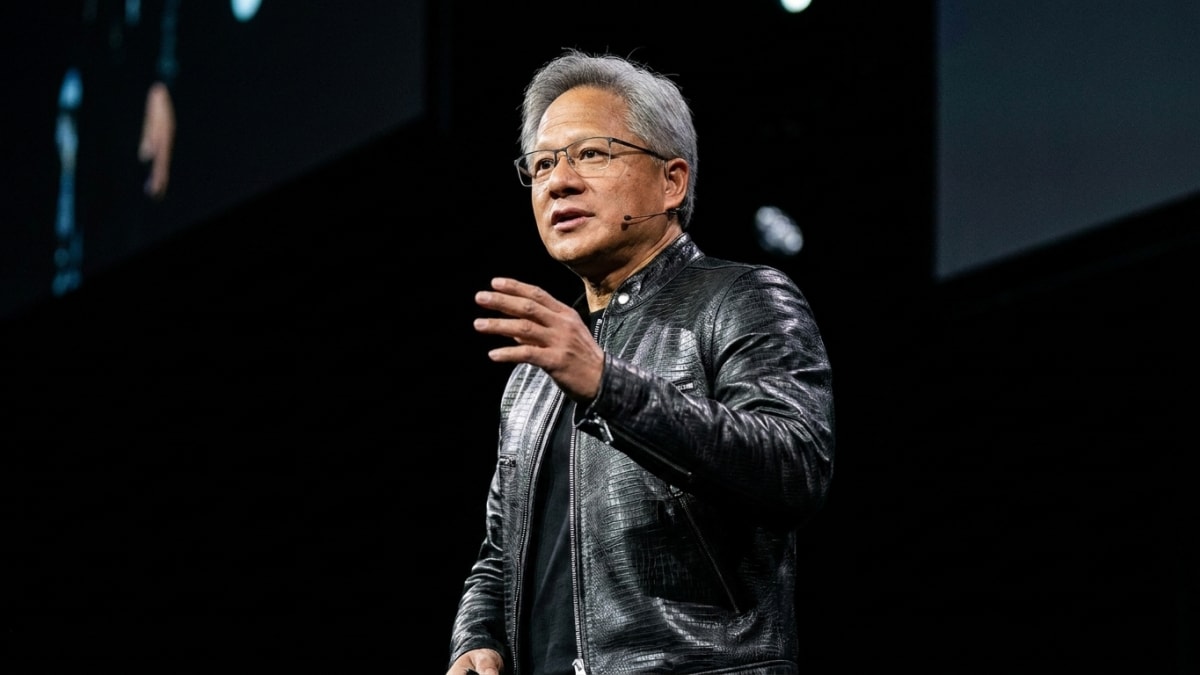
Nvidia founder and CEO Jensen Huang drew a direct line between AI's practical utility and the company's revenue trajectory. "AI has reached its inflection point. It's doing useful work. Its tokens are productive and profitable. Now, compute is revenue," Huang said.[1]
Huang positioned the current buildout as structural rather than speculative, pointing to the Vera Rubin platform as the supply-side answer to that demand. "The AI infrastructure buildout is at full steam. Vera Rubin, now in full production, was built to power exactly this moment," he said.[1]
The AWS deal and what 2 million GPUs signals
AWS and Nvidia announced plans to deploy 2 million additional GPUs, integrating Vera CPUs with the Rubin platform, across AWS global infrastructure through 2027 and 2028.[2] A single cloud provider committing at that scale tells you two things: Nvidia's platform lock-in is deepening, and supply chains for silicon are being reserved years in advance.
The Rubin architecture sits at the centre of Nvidia's forward product roadmap. AWS locking in volume at this stage removes meaningful demand uncertainty for at least the next two fiscal years.
Hyperscaler capex and the valuation question
CFO Colette Kress put the scale of cloud spending plainly. "Capital spending by the top five hyperscalers is expected to reach nearly $800 billion this year and $1.3 trillion in 2027," Kress said.[3] That trajectory underpins Huang's forecast of approximately 70 per cent revenue growth for fiscal 2028, well above what analysts had modelled.
Australian investors exposed to the AI trade on the ASX have tracked sentiment from Nvidia's results seasons, and local technology equities moved accordingly. The harder question analysts are now asking is whether $1.3 trillion in annual cloud capital expenditure reflects genuine workload demand or the kind of overinvestment that historically precedes a correction. Nvidia's margins and the AWS commitment suggest supply is still the binding constraint. Whether that holds through 2027 is the bet embedded in current valuations.
KEY TAKEAWAYS
This article reports company disclosures and market data for general information only and is not financial advice. Consider your own circumstances before making investment decisions.
SOURCES & CITATIONS
FREQUENTLY ASKED QUESTIONS