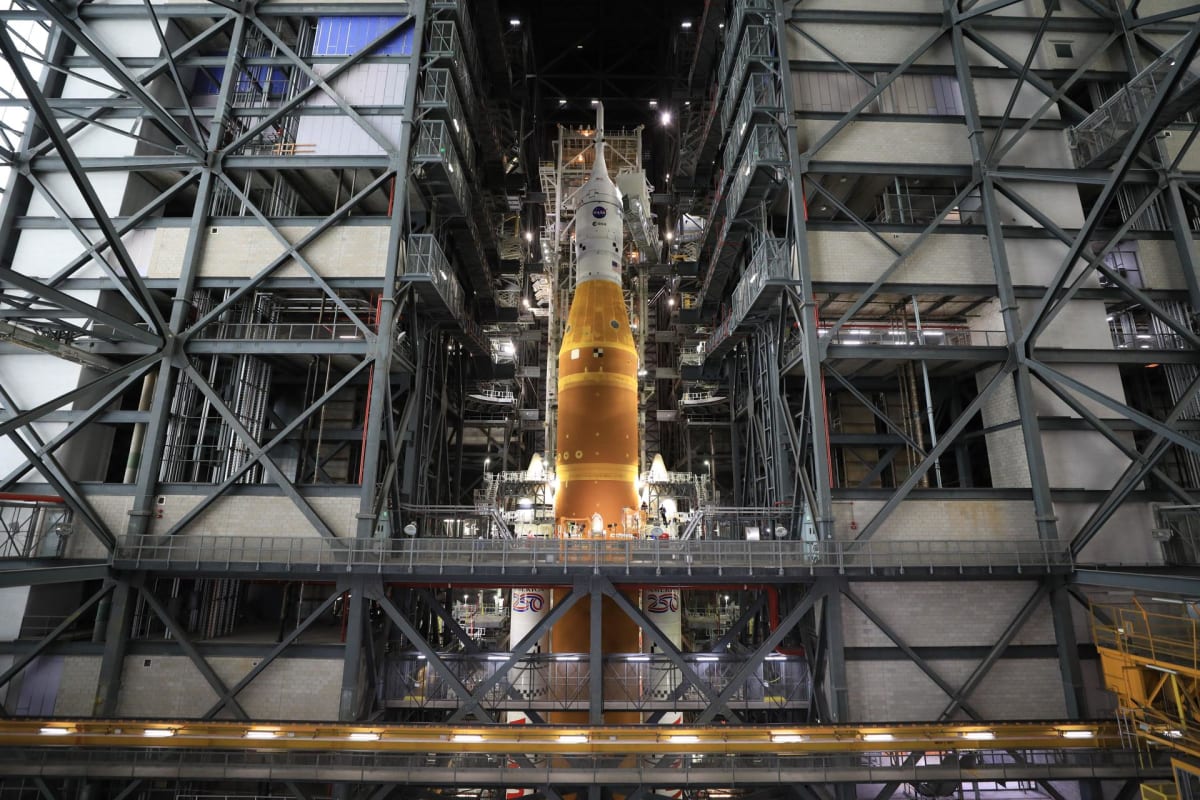
For the second time this year, NASA's 5,000-tonne Artemis II rocket began its slow crawl from the Vehicle Assembly Building to Launch Pad 39B at Kennedy Space Center on Thursday night, a 12-hour journey that carries considerably higher stakes than the first attempt.
TLDR
NASA has rolled its Artemis II rocket back to Launch Pad 39B at Kennedy Space Center, targeting an April 1 launch for the first crewed lunar mission since 1972. After hydrogen fuel leaks and a helium flow issue forced the rocket back to the hangar for repairs in late February, engineers completed fixes and began the 12-hour rollout on March 19. The four-person crew is now in quarantine ahead of their 10-day journey around the Moon.
KEY TAKEAWAYS
If things go according to plan, four astronauts will strap into the Orion capsule sitting atop the Space Launch System rocket on April 1 and head for the Moon. They will loop around the far side without landing, get closer to the lunar surface than any human in 54 years, and return home after a 10-day voyage. Given the mission's troubled history of fuel leaks and mechanical issues, the April launch window represents NASA's final chance to meet its own deadline.
A rocky path to the pad
Artemis II has had a difficult few months. The rocket first rolled out to the launch pad in January, and everything looked good for a February launch until engineers found hydrogen fuel leaks during testing. They fixed those at the pad, but then discovered a helium flow issue in the rocket's upper stage that required a return to the hangar.
In late February, NASA made the call to roll the entire stack back to the Vehicle Assembly Building. The 5,000-tonne rocket, Orion capsule, and mobile launcher made the slow journey in reverse. Engineers spent three weeks tracing the helium problem, replacing components, and running tests.
On March 12, NASA held a flight readiness review and gave the all-clear after confirming the helium issue was resolved. Originally scheduled for March 20, the rollout was moved up to March 19 after teams completed their work ahead of schedule.
While I am comfortable and the agency is comfortable with targeting April 1st as our first opportunity, just keep in mind we still have work to go. There are still things that need to be done within the VAB and out at the pad.
— Dr. Lori Glaze, NASA Moon to Mars Program Manager
What happens on April 1
The launch window opens at 18:24 Eastern Daylight Time on April 1, which is 08:24 AEST on April 2 for Australians. If weather or technical issues scrub that attempt, NASA has backup windows on April 2, 3, 4, 5, 6, and April 30.
Once launched, the crew will spend three days travelling to the Moon. They'll spend about a day in lunar vicinity, passing within 10,300 kilometres of the surface and observing parts of the far side that no human has ever seen up close. Then they'll swing around and head back to Earth for a Pacific Ocean splashdown around April 10.
The crew has been in quarantine since March 18 at Johnson Space Center in Houston. About five days before launch, they'll fly to Florida to continue preparations at Kennedy Space Center.

NASA's cinematic trailer for the Artemis II mission (3:12)
The crew flying around the Moon
Four astronauts will make the journey, led by Commander Reid Wiseman, a Navy test pilot who flew on the International Space Station in 2014 and served as NASA's Chief Astronaut before being assigned to Artemis II.
Victor Glover pilots the spacecraft, having previously flown on SpaceX's Crew Dragon to the ISS in 2020, and will become the first Black astronaut to travel beyond low Earth orbit.
Christina Koch and Jeremy Hansen serve as mission specialists. Koch set the record for the longest single spaceflight by a woman at 328 days and participated in the first all-female spacewalk. Hansen, from the Canadian Space Agency, will become the first non-American to travel around the Moon. Canada contributed the solar array wings on the European Service Module in exchange for this crew seat.
Why this mission matters
Artemis II is a test flight designed to verify that the life support systems, navigation, and communication equipment all work properly with humans aboard before NASA attempts a lunar landing. The uncrewed Artemis I flew the same trajectory in 2022 and worked mostly as expected, though the upcoming mission will test systems that matter only when living people are inside the capsule.
The last time humans travelled beyond low Earth orbit was December 1972, when Apollo 17 astronauts Gene Cernan and Harrison Schmitt walked on the Moon. That 54-year gap between human deep space exploration missions is now longer than the entire history of powered flight when the first Moon landing happened in 1969.
If Artemis II succeeds, NASA plans to land astronauts on the lunar surface with Artemis III, currently targeting 2028. The long-term goal is establishing a permanent human presence on the Moon and eventually sending crews to Mars.
The cost of getting back to the Moon
The Artemis program has been expensive, with NASA spending roughly $93 billion since 2012 according to the Office of Inspector General, and each Space Launch System rocket costing approximately $2.2 billion with current infrastructure only capable of producing one per year.
Critics argue SpaceX's Starship could accomplish similar missions at a fraction of the cost since it is larger, fully reusable, and designed to launch frequently. However, Starship hasn't flown humans yet and its orbital refuelling technology remains unproven.
NASA's position is essentially that SLS exists and works, so they're going to use it. Whether that logic holds up against rapidly improving commercial alternatives is a question for the 2030s.
What to watch for
Over the next two weeks, teams at Kennedy Space Center will complete final checkouts on the pad while monitoring Florida's unpredictable early April weather, since a lightning strike on the pad or high winds at altitude could push the launch to a backup date.
The crew will fly to Florida about five days before launch to participate in final simulations and suit-up rehearsals. If all goes well, they'll board Orion on launch day and wait for the countdown.
NASA will livestream the launch. Given that it's the first crewed mission to the Moon in most people's lifetimes, expect significant public interest. The agency opened a website for people to submit their names to fly symbolically on an SD card inside Orion. That signup period closed in January.
With April 1 now 12 days away, the rocket back on the pad, and the crew in quarantine, NASA is as close as it has ever been to sending humans back to the Moon after years of delays and billions of dollars in spending.
SOURCES & CITATIONS
FREQUENTLY ASKED QUESTIONS