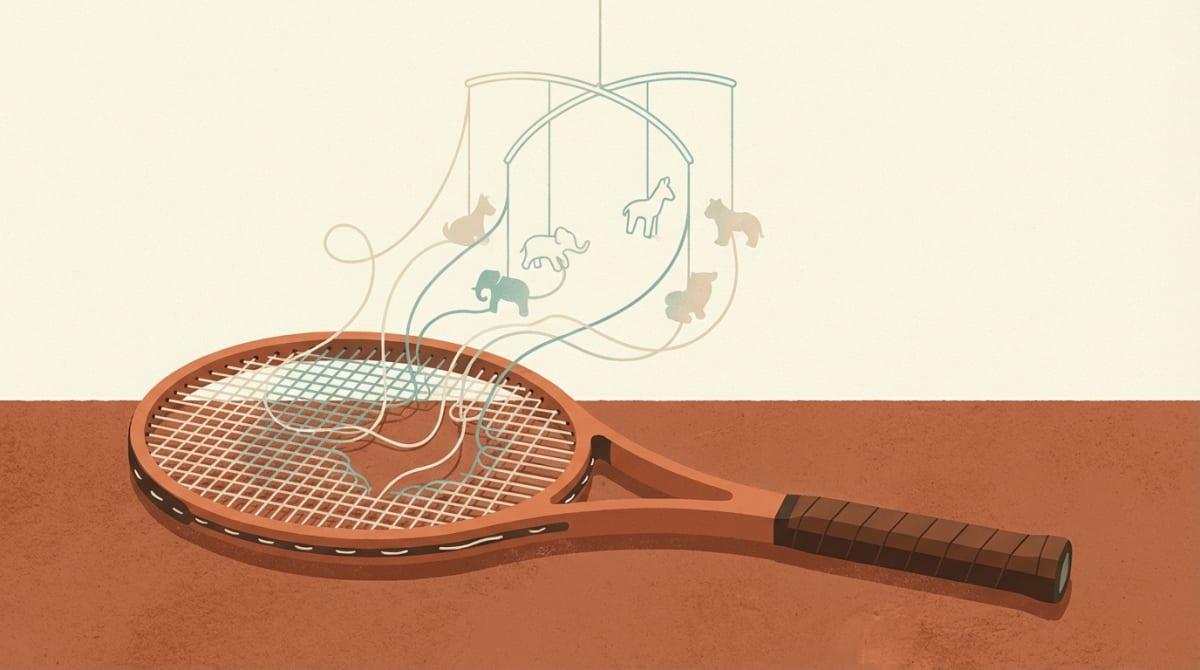
In Nora Ephron's essay 'A Few Words About Breasts,' she observed that the problem with being a woman is that you spend your youth waiting for things to happen to your body, and your adulthood wondering why they happened the way they did. Ephron was writing about adolescence and disappointment, but she might as well have been describing the particular cruelty faced by elite female athletes, whose bodies are simultaneously their instruments and their betrayers.
TLDR
Naomi Osaka lost 7-5, 6-4 to Australia's Talia Gibson in the Miami Open first round and questioned whether staying on tour is worth time away from her two-year-old daughter Shai. Three mothers now rank in the women's top 20, but the tension between peak athletic years and family remains unresolved.
KEY TAKEAWAYS
Naomi Osaka stood in a press room in Miami on Friday evening, having just lost 7-5, 6-4 to Australia's Talia Gibson, and said something that no male athlete has ever had to say. 'I'm not going to stay on tour if I'm losing in the first round,' she told reporters. 'I'd rather just be a great mom.'
The statement was matter-of-fact. It was also devastating. Here was a four-time Grand Slam champion, a player who has held the world number one ranking, a woman who at 28 should be entering her prime, announcing that she was reconsidering whether any of it was worth the sacrifice.
The arithmetic of motherhood
Osaka's daughter Shai is two and a half years old. In the currency of early childhood, that is approximately 900 days of first words, first steps, first tantrums, first jokes. It is bath times and bedtimes and the particular weight of a sleeping toddler against your chest. Osaka has spent a meaningful portion of those 900 days on aeroplanes, in hotel rooms, on practice courts, and in physiotherapy sessions addressing the chronic abdominal injury that forced her withdrawal from the Australian Open.
The maths is brutal. A full WTA season involves roughly 20 tournaments across 11 months, spanning six continents. Travel days alone consume weeks. Training and recovery consume more. What remains is fragments: video calls, brief reunions, the guilty relief of leaving again.
For me, my daughter is very important, and I want to be a mom. I want to be the best mom I can.
— Naomi Osaka, post-match press conference, Miami Open
Gibson, the young Australian who beat her, is 21 and on stunning form. She upset Jasmine Paolini at Indian Wells and has risen to 68 in the rankings. She represents exactly what Osaka was a decade ago: hungry, unburdened, with nothing to lose and everything to prove. The gap between them on Friday was not vast (two breaks of serve across two sets) but it was enough to prompt Osaka's existential reckoning.
The return of the mother
Women's tennis has a complicated history with motherhood. For decades, pregnancy was understood as retirement by another name. Margaret Court returned after having children in the 1970s, but she was treated as an anomaly, a biological curiosity. The assumption persisted well into the 2000s that the physical demands of elite tennis and the physical demands of bearing and raising children were fundamentally incompatible.
Kim Clijsters changed that narrative, if not the underlying structure. She retired in 2007, had a daughter, and returned in 2009 to win the US Open. Serena Williams did the same, reaching the 2018 Wimbledon final ten months after giving birth. Victoria Azarenka has spent eight years navigating the tour while raising her son Leo, including a protracted custody dispute that forced her to withdraw from tournaments.
Today, three mothers rank in the women's top 20, the highest number in the tour's history. This is presented as progress, and in a narrow sense it is. But the presence of mothers in the rankings obscures the absence of structural support. The WTA introduced its maternity policy in 2019, allowing players to use their pre-pregnancy ranking for seeding purposes. It is better than nothing—but it is not childcare.
The body that remembers
Osaka withdrew from the Australian Open with an abdominal injury connected to her pregnancy. She mentioned a back injury this week and joked about 'getting old.' She is 28. In any other profession, 28 is barely the beginning of a career. In women's tennis, it is the moment when the body begins its long negotiation with decline.
The peak performance window for female athletes is narrow and unforgiving. Most tennis players hit their prime between 24 and 29. The peak fertility window overlaps almost exactly. This is not a policy failure or a cultural problem. It is biology, and it does not care about your ambitions.
Men face no equivalent trade-off. Roger Federer had four children and won Grand Slams until he was 36. Novak Djokovic is a father of two and remains competitive at 38. Their bodies were never required to do the work of making new people. They could outsource that labour entirely.
What Osaka knows
'Sometimes I feel like I know what I have to do to become a really good player, and it's very difficult,' she said on Friday. The sentence contained its own contradiction. She knows what it takes. She also knows the cost.
Osaka plans an abbreviated clay season: Madrid, Rome, and Roland-Garros. She is skipping Charleston. The schedule represents a compromise, enough tournaments to maintain ranking and form, not so many that she disappears from her daughter's life entirely. Whether it will be enough to satisfy either ambition remains unclear.
Late in 2024, before the injuries and the doubts, Osaka reached the US Open semi-finals and the Canada Open final. The results suggested she could still compete at the highest level. The 2025 season, interrupted by her abdominal injury, suggested she might not be able to do so reliably.

Osaka's 2024 US Open run showed flashes of her previous dominance
The question beneath the question
There is a particular cruelty in asking women to justify their choices. Osaka's press conference contained no demands for Roger Federer to explain whether he had been a good father. No one asked Rafael Nadal whether his son would resent his absences. The question is only ever posed in one direction.
And yet it is real. Osaka is not performing ambivalence for the cameras. She is describing an actual conflict, one that exists because elite sport requires total commitment at precisely the moment when small children require total presence. There is no synthesis. There is only the daily decision about which obligation to betray.
Gibson, the young Australian, will not face this question for years. She can train six hours a day, travel without guilt, sleep when she needs to sleep. Her body belongs entirely to her. That is the advantage of being 21 and childless in professional tennis. It is also, perhaps, why Osaka looked at her across the net and saw something she could no longer be.
The choice that is not a choice
Osaka may return to the tour with renewed focus. She may win another Grand Slam. Athletes have come back from worse odds and longer absences. Clijsters won three majors after her return. Williams reached four finals.
But if she does not, if Miami was the beginning of a gradual withdrawal, if the abbreviated clay season becomes a permanent abbreviation, it will not be because she lacked talent or work ethic or desire. It will be because she asked herself a question that the sport cannot answer: what is any of this for, if not for the people we love?
Her daughter Shai will not remember these tournaments. She will not know that her mother once held a trophy above her head at the Australian Open, that crowds in Tokyo chanted her name, that she was ranked number one in the world. She will only know whether her mother was there.
Osaka knows this. That is the problem.
SOURCES & CITATIONS
FREQUENTLY ASKED QUESTIONS