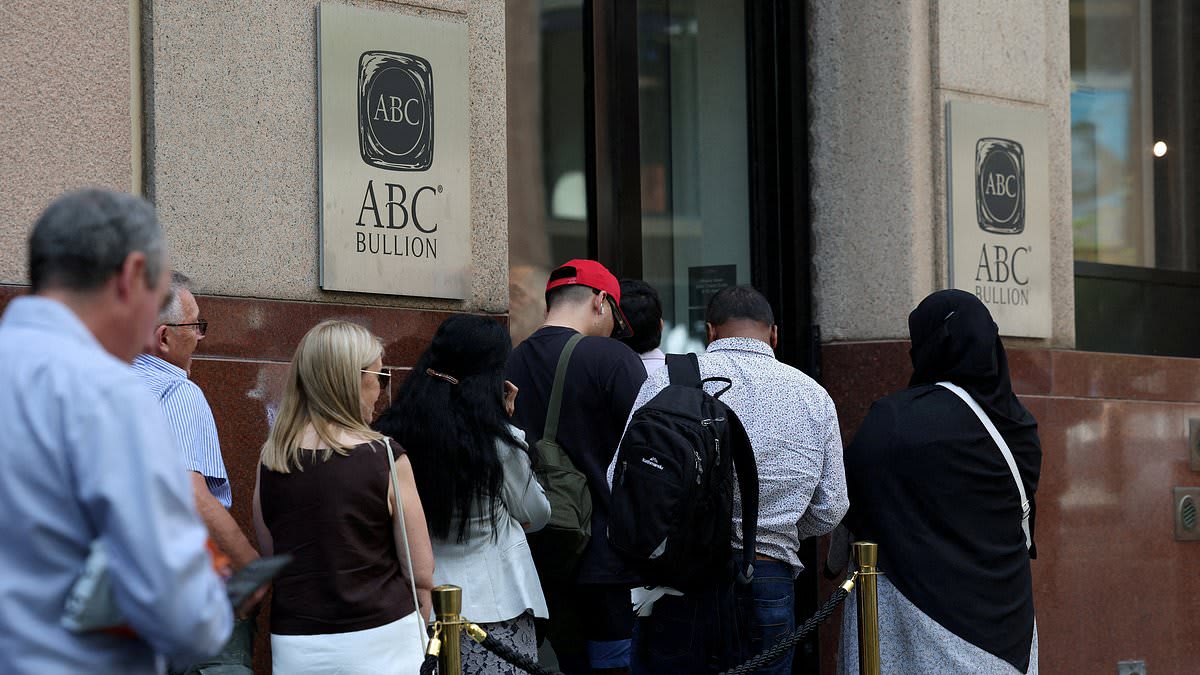
Australian financial media ran the same headline all week in various forms: gold crashing, safe-haven status questioned, rate fears mounting. Fair enough. Gold futures did fall 9.6% to US$4,574.90 per ounce by Friday, the ugliest weekly rout since September 2011, and ASX gold stocks followed it down. Northern Star shares dropped 9.5% on Thursday, Evolution Mining fell 9.6%, and Newmont's ASX-listed stock lost 5.8%.
KEY TAKEAWAYS
What the Shanghai trading floor sees
I spent eight years covering Asian markets from Hong Kong. When I read Australian gold coverage, I notice what's missing: the Asia bid. The Shanghai Gold Exchange benchmark price (SHAUPM) has held above RMB1,100 per gram through this correction. Chinese gold ETF holdings hit a record 290 tonnes in February and inflows accelerated in early March, even as Western bullion ETFs like GLD and IAU recorded outflows.
The World Gold Council's Ray Jia documented the pattern in his March update. Wholesale gold demand on the SGE totalled 85 tonnes in February, down just 5 tonnes year-on-year despite the Lunar New Year disruption. Chinese consumers bought the dip when prices briefly fell below RMB1,000 per gram in early February. They did the same when this week's correction pushed prices lower.
Rising safe-haven demand amid escalating global and regional geopolitical tensions is likely driving Chinese gold ETF inflows, despite the local gold price volatility.
— Ray Jia, Senior Analyst, World Gold Council
The PBOC has bought gold for 16 consecutive months, with reserves now standing at 2,309 tonnes and representing 10% of China's total foreign exchange holdings. The accumulation pace suggests strategic intent rather than tactical positioning, with Beijing building a gold allocation regardless of short-term price moves.
The rate shock mechanism
Gold fell because rate expectations reversed. The mechanism is straightforward.
The Iran war pushed Brent crude toward US$112 per barrel and WTI to US$98. Oil prices at these levels feed directly into inflation expectations. The International Energy Agency's Fatih Birol called it the greatest global energy security threat in history, larger than the 1970s oil crisis or the 2022 natural gas shock following Russia's Ukraine invasion. When energy costs spike, central banks have less room to cut rates.
Every major central bank held rates steady last week. The Federal Reserve, the Bank of England, the Bank of Japan. Markets had expected cuts. They got nothing. Then Fed Funds futures moved: a 33% probability of rate hikes by year-end, up from zero before the conflict began. Ten-year US Treasury yields climbed to 1.98%, a full Fed rate rise higher than pre-war levels.
Gold does not pay interest, so when real yields rise, its opportunity cost increases and investors sell bullion to chase yield elsewhere.
The Australian angle
The RBA already hiked once this cycle. Markets now price 74 basis points of additional tightening by December 2026. For ASX gold miners, this creates a double problem: the gold price is falling while funding costs are rising.
Northern Star dropped after issuing a production downgrade that compounded the gold price weakness, with the company's shares down roughly 15% from their early March peak. Evolution Mining and Newmont faced similar selling pressure without any company-specific news.
- Northern Star Resources: Down 9.5% on Thursday, 15% from March peak
- Evolution Mining: Down 9.6% on Thursday
- Newmont (ASX): Down 5.8% on Thursday
In AUD terms, gold traded around $6,885 per ounce on March 19. The Australian dollar's relative weakness against the US dollar has cushioned some of the blow for local miners with USD-denominated revenue, but not enough to offset the headline price collapse.
Two readings of the same data
Australian headlines: gold crashes, rate fears dominate, safe-haven status under question.
The Asian trading desk reading is different: gold corrects from a peak above US$5,000 per ounce while Chinese institutional and retail demand remains firm, with the PBOC continuing to accumulate and ETF inflows accelerating in Shanghai even as they reverse in New York. The divergence between Western and Eastern behaviour is the story, not the price move alone.
This pattern has repeated before. In 2013's gold crash, Chinese buyers absorbed significant Western selling, with the Shanghai Gold Exchange recording record withdrawals as prices fell and the premium on Shanghai gold versus London widening as local demand exceeded supply. Western investors saw a bursting bubble while Asian buyers saw a discount.
What matters next
If the Iran conflict escalates further, oil prices will keep climbing. That means more inflation pressure, more rate expectations, more downward pressure on gold in the short term. The logic is mechanical.
The indicators to watch are the Shanghai Gold Exchange premium, Chinese ETF flows, and PBOC reserve accumulation. If Asian demand holds firm through further price declines, it suggests a correction within a bull market rather than a trend reversal.
The view from Singapore and Tokyo trading desks last week was notably calmer than the Sydney coverage implied. Several institutional investors I spoke with are treating US$4,500 as a buying level, not a panic point.
Deutsche Bank maintained a US$4,400 price target earlier this year, calling the pace of appreciation unsustainable, and gold has now corrected to that neighbourhood. J.P. Morgan's commodities team flagged central bank buying above 750 tonnes annually as the floor beneath prices, with the PBOC alone running well above that pace.
Gold's worst week since 2011 makes for stark headlines. The full picture includes Asian buyers who see opportunity, central banks still accumulating, and a divergence between markets that tells its own story. The ASX gold miners took heavy damage last week. Whether that damage proves temporary depends more on what happens in Beijing and Singapore than what happens in Sydney.
TLDR
Gold futures fell 9.6% last week, the steepest weekly decline since September 2011. The Iran war oil shock pushed energy prices toward $100 per barrel, forcing central banks to hold rates steady and markets to price in hikes. But while Australian coverage focuses on ASX gold stocks falling, Chinese gold ETF inflows have accelerated and the PBOC has now bought gold for 16 consecutive months. The view from Asian trading desks is less panicked than the Sydney headlines suggest.
SOURCES & CITATIONS
FREQUENTLY ASKED QUESTIONS