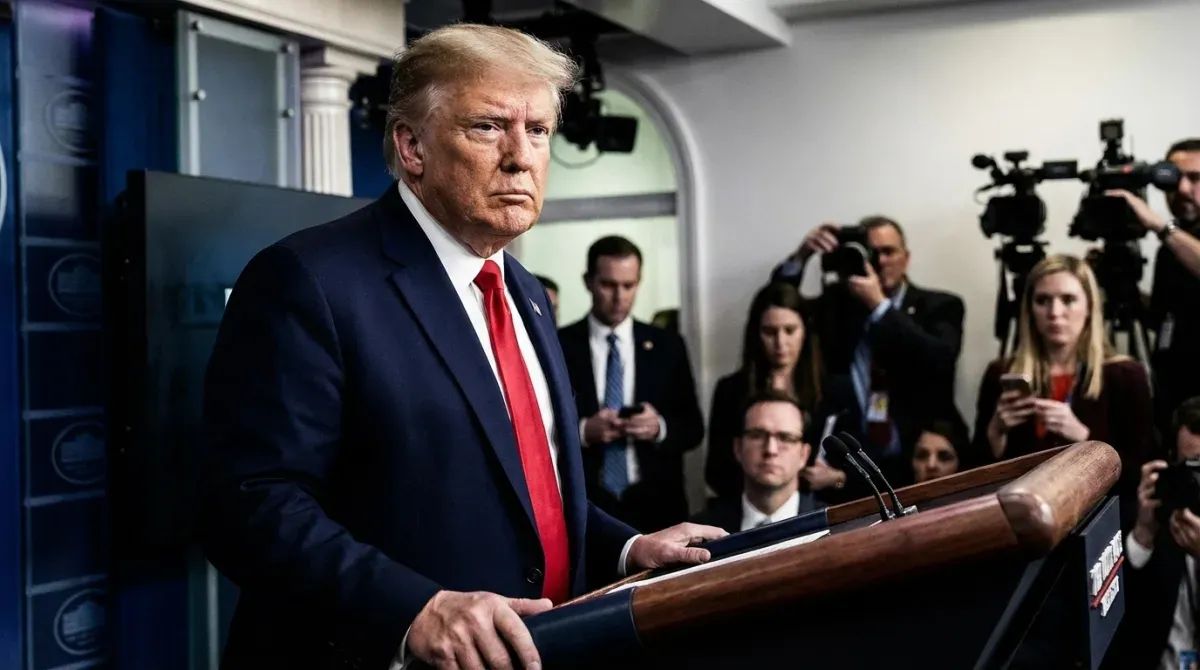
On Tuesday, April 7, 2026, Donald Trump posted a warning on TruthSocial that should have stopped the world. "A whole civilization will die tonight, never to be brought back again. I don't want that to happen, but it probably will," he wrote. By evening, it hadn't. Trump announced a two-week ceasefire contingent on Iran reopening the Strait of Hormuz, called Iran's peace proposal "a workable basis on which to negotiate," and confirmed talks in Islamabad beginning April 10.
TLDR
Trump threatened on April 7 that 'a whole civilization will die tonight' if Iran missed his ultimatum, then announced a two-week ceasefire hours later. The cycle of maximalist threat followed by swift retreat has analysts reaching for Cold War analogies, while Iran's foreign ministry says negotiations and ultimatums cannot coexist.
KEY TAKEAWAYS
The gap between the morning's rhetoric and the evening's diplomacy was, by any measure, considerable. What matters here is not simply whether the threats are real, but what function they serve. This is analysis, not verdict. The evidence is public.
The Pattern So Far
The conflict began February 28, 2026, when the United States and Israel launched coordinated strikes on Iran, killing Supreme Leader Ali Khamenei. Iran closed the Strait of Hormuz to most shipping, triggering what the Dallas Federal Reserve later described as the largest energy supply disruption since the 1970s. Brent crude surpassed $126 per barrel at its peak. The IRGC warned that any US military escalation would be met with responses extending beyond the region.
From Washington, the dominant rhetorical register since then has been the ultimatum. On March 21, Trump threatened to obliterate Iranian oil installations within 48 hours unless Tehran reopened the strait. When the deadline passed, he announced a five-day pause instead, citing what he described as indirect contacts with Tehran. The structure of April 7 was almost identical: a morning of apocalyptic language, an evening of diplomacy, and contact cited as the reason for retreat.
Trump told reporters on April 7 that he had a plan involving the destruction of every bridge and power plant in Iran. "We have a plan, because of the power of the military, where every bridge in Iran will be decimated, where every power plant in Iran will be out of business, burning, exploding, and never to be used again," he said. When asked whether the situation was escalating or winding down, he told reporters: "I can't tell you."
That answer, offered with apparent candour, sits at the centre of the strategic debate. There is a name for the deliberate cultivation of unpredictability as a foreign policy tool: the madman theory. Richard Nixon articulated it explicitly in 1968, telling Chief of Staff H.R. Haldeman: "I call it the Madman Theory, Bob. I want the North Vietnamese to believe I have reached the point where I might do anything to stop the war." Historians note that the strategy did not end the Vietnam War on American terms.
Professor Al Gillespie, an international law expert at Waikato University in New Zealand, described the current approach in those same terms on April 6, 2026. "The idea is that you don't know whether the person will or won't do it, and the opposition will be scared into making a deal," Gillespie said. His assessment of the strategy's effectiveness against Iran was blunter. "In the case of either religious regimes or autocratic regimes, they often don't have that fear," he said.
Glenn Altschuler, an emeritus professor of American studies at Cornell University, framed the inconsistency differently. "Trump really is a person who lives in the moment, who reacts to what he perceives as the opportunities or threats involved in the moment," Altschuler said. "That's why you get a lot of inconsistencies." Andrew Latham, a political scientist at Macalester College in Minnesota, went further, arguing that such threats devolve into noise and lose credibility over time.
Danny Citrinowicz, a former Israeli intelligence operative, was equally direct. "The assumption that pressure alone can break Tehran is not strategy," Citrinowicz said. "It is wishful thinking." Even major infrastructure strikes, he said, would not produce Iranian capitulation.
Iran's Response and the Nuclear Question
Iran's official posture has been to treat the ceasefire proposals as incompatible with the conditions under which they were offered. Esmail Baghaei, Iran's foreign ministry spokesperson, called a 45-day ceasefire proposal put forward by Egypt, Pakistan, and Turkey illogical on April 6. "Negotiations are entirely incompatible with ultimatums, crimes and threats of war crimes," Baghaei said. Iran's Culture Minister Seyed Reza Salehi Amiri characterised Trump as an unstable figure whose shifting positions make serious negotiation difficult.
Against that backdrop, the White House's handling of the nuclear question on April 7 deserves close reading. The administration denied having plans to use nuclear weapons against Iran. Vice President JD Vance had said US forces could employ tools they had so far not decided to use, a formulation critics read as deliberately ambiguous. Karoline Leavitt, Trump's press secretary, declined to give a categorical denial when asked by AFP. "Only the President knows where things stand and what he will do," Leavitt said.
The key point is that the White House declined to rule out nuclear use while simultaneously denying any such plan. That combination, deliberate or not, is consistent with the madman theory's core requirement: that the adversary cannot be certain what the leader will do.
Abbas Araghchi, Iran's foreign minister, confirmed what the ceasefire announcement had promised by the end of April 7. "For a period of two weeks, safe passage through the Strait of Hormuz will be possible via coordination with Iran's Armed Forces," Araghchi said. Trump told reporters that "almost all of the various points of past contention have been agreed to between the United States and Iran." Both statements have been contested by the opposing side.
What is observable, frankly, is the shape of the negotiation so far. Iran rejected a 45-day ceasefire as illogical, then accepted a two-week ceasefire with different framing. Trump called Iran's 10-point response not good enough in the morning, then described it as a very notable step by evening. Both sides are positioning for talks neither has publicly admitted wanting. Pakistan is hosting. The strait will be open, provisionally, under Iranian coordination.
The problem is whether this pattern can produce a durable settlement. Trump has now imposed and retreated from at least two major ultimatums since the war began February 28. Each retreat has come with a diplomatic flourish and a claim that progress is being made. Each new ultimatum has been louder than the last. Whether that trajectory ends in a deal, an escalation, or an indefinite series of two-week extensions is the question that analysts, mediators, and governments watching oil prices are trying to answer.
SOURCES & CITATIONS
- RNZ News: Trump's strategy with Iran is the 'Madman Theory', an international law expert explains
- Waikato University — Professor Al Gillespie, international law faculty
- Dallas Federal Reserve — Economic analysis of the 2026 Hormuz closure
- Euronews: Trump's Iran ultimatum: When does it expire and how serious is his threat?
- PBS NewsHour: Trump warns 'a whole civilization will die tonight'
FREQUENTLY ASKED QUESTIONS