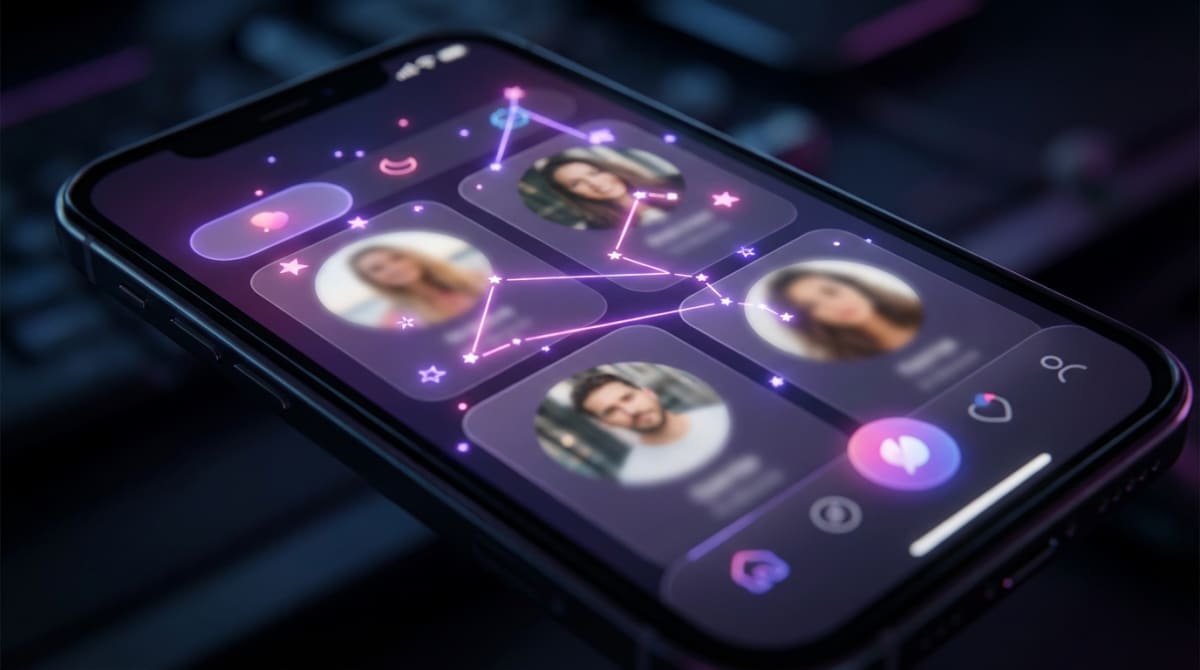
When you grant Tinder permission to analyse your camera roll, the app's AI will scan your photos for patterns: surfboards in the background, cookbooks on the counter, concert wristbands piled in a drawer. The system builds a profile of your interests without you typing a word.
TLDR
Tinder announced its biggest product overhaul in years at Tinder Sparks 2026, introducing an AI tool called Chemistry that analyses users' camera rolls, plus astrology-based matching and in-person dating events. The rebrand targets Gen Z users who report 78% burnout rates with dating apps, while paying Tinder subscribers dropped 8% to 8.8 million in Q4 2025.
KEY TAKEAWAYS
This is Chemistry, the centrepiece of Tinder's 2026 rebrand. The feature, announced at the company's first-ever product keynote last week, represents a bet that machine learning can fix what algorithmic swiping broke.
The problem with infinite swipes
Dating apps are losing the users they trained to swipe. A July 2025 Forbes Health survey found that 78% of Gen Z users report burnout, with more than half feeling exhausted often or always while using these platforms.
Tinder's subscriber numbers tell the same story from the revenue side. Paying members dropped 8% in Q4 2025, falling to 8.8 million. Match Group's guidance for 2026 projects Tinder's direct revenue will continue declining at similar rates.
CEO Spencer Rascoff, who took the role in late 2024, used the Tinder Sparks keynote to reframe what success looks like. The company is moving away from raw match counts toward connections that actually lead somewhere.
Just getting matches is not the goal. People are craving connection. Humans need humans.
— Spencer Rascoff, CEO, Match Group
How Chemistry works
Chemistry works in two parts: first, users answer a short series of questions about their preferences and dating goals, and second, with user consent, the system analyses patterns in their camera roll to surface visual signals about interests and lifestyle.
Tinder says it does not store the photos it analyses. The processing happens locally on the device, with only the extracted insights sent to Tinder's servers. The company, which was subject to an alleged data breach in January 2026, is clearly aware that camera roll access requires a higher trust bar.
The output is a daily curated match recommendation. Rather than encouraging infinite scrolling, Chemistry aims to reduce decision fatigue by presenting one high-confidence suggestion each day.
Astrology as product strategy
The second major feature is Astrology Mode, which lets users add their birth details to unlock Sun, Moon, and Rising signs. Profiles then display compatibility insights based on zodiac alignment.
Early testing showed a 20% increase in likes sent by women to profiles with astrology data. For a platform where 75% of American users identify as male, any feature that increases female engagement shifts the economics of the whole system.
The choice of astrology over other personality systems reveals a strategic calculation. Astrology is lightweight, shareable, and already part of how Gen Z talks about relationships. Unlike Myers-Briggs or attachment styles, it requires no assessment.
Events and the offline pivot
Tinder is also testing an Events feature in Los Angeles that connects users to in-person dating events. Think speed dating, but organised through the app you already use.
This is a tacit admission that digital-only dating has limits. Video speed dating, another upcoming feature, offers three-minute live video sessions for verified users who want to screen matches before meeting.
The company previously tried video chat during COVID with a feature called Face-to-Face, which was discontinued after interest dropped. User receptiveness after years of app fatigue is the variable Tinder is betting on.
Safety upgrades and AI moderation
Match Group is investing $125 million in trust and safety in 2026. Face Check, the facial verification system that launched in California last year, becomes mandatory worldwide.
On the safety side, the Are You Sure? feature, which warns users before sending potentially offensive messages, is being trained to understand context and recognise that a playful profanity between people who know each other is different from an unsolicited crude message to a stranger.
According to Yoel Roth, Tinder's head of trust and safety, the new LLM considers patterns associated with harassment, hate speech, sexual harassment, threats, and coercive behaviour. A new Auto Blur feature will hide harmful incoming messages before the recipient sees them.
Fake accounts remain the biggest moderation challenge, accounting for 98% of content moderation actions on the platform.
The AI efficiency play
Rascoff noted that AI now writes more than half of Tinder's new code. In May 2025, Match Group cut 13% of its workforce. The connection between these facts is not hard to draw.
The Singles in America 2025 survey found that 26% of American singles have already used AI to help build their dating profiles, write messages, or enhance their experience, which means Tinder's real question is whether it can capture that existing workflow within its own app.
Music Mode, which lets users link Spotify and display up to 20 songs on their profiles, and partnerships with Duolingo and restaurant app Beli are also coming. The strategy is to gather more signal about who users are, reducing the amount of text-based self-description that leads to formulaic profiles.
Can Tinder fix what it created?
Tinder launched in 2012 and reshaped how people date. The swipe mechanic was so successful that it became the default interface for dating apps globally, but the gamification that drove adoption also created the burnout that now threatens retention.
Bobby Fitzgerald, a 32-year-old nonprofit worker in Kansas City interviewed by WIRED, logged back onto Tinder in February 2026 with high hopes but left disappointed, finding the experience still felt like a game where nobody was playing honestly.
On paper, the new features address real problems: camera roll analysis reduces profile-writing friction, astrology matching gives women a reason to engage, and events bypass the awkward messaging phase entirely.
Whether these changes are enough depends on whether the core experience can escape the dynamics Tinder itself created. A platform optimised for engagement is not the same as a platform optimised for helping people find partners. Rascoff is betting AI can bridge that gap. Match Group's 2026 revenue guidance suggests investors are less certain.
SOURCES & CITATIONS
FREQUENTLY ASKED QUESTIONS