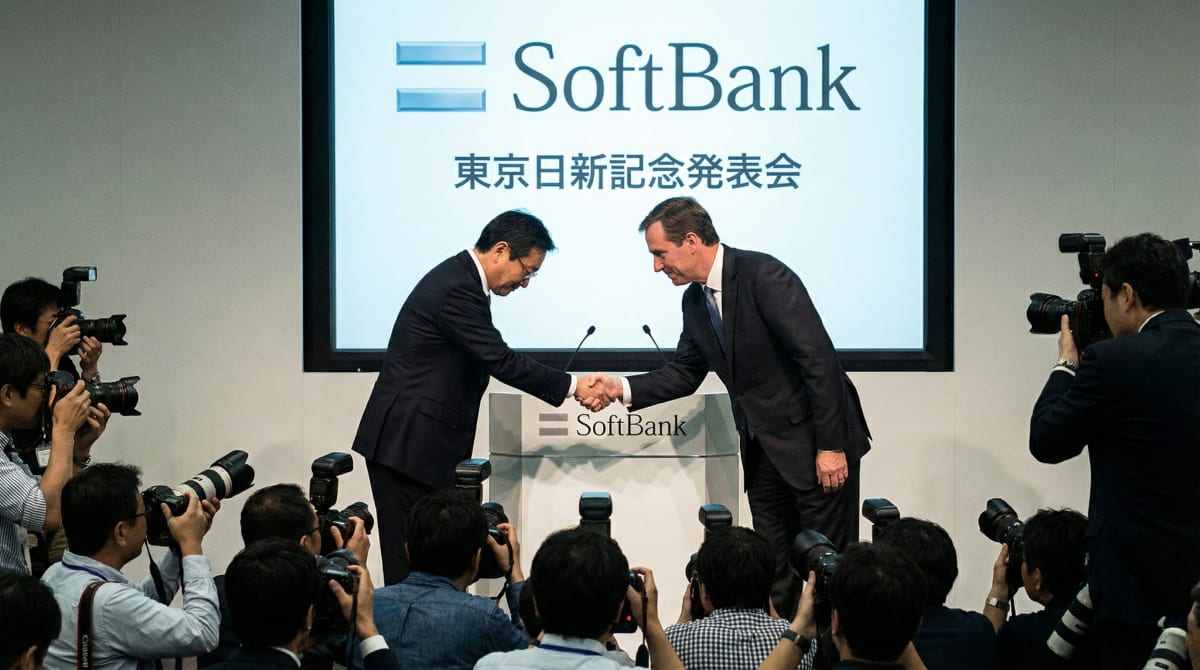
SoftBank announced Friday it has secured a $40 billion loan to cover its $30 billion commitment to OpenAI, ChatGPT's creator. What makes this deal striking isn't the sheer size (though $40 billion is a staggering number even by SoftBank's standards). It's the structure, and what that structure reveals about what Wall Street's biggest banks think is coming next for OpenAI.
KEY TAKEAWAYS
The loan is unsecured with a twelve-month term, meaning it must be repaid or refinanced by March 2027. That's aggressive, and it only makes sense if the lenders believe OpenAI's long-awaited public listing will happen later this year, giving SoftBank the liquidity to settle the debt from IPO proceeds.
JPMorgan Chase, Goldman Sachs, and four Japanese banks agreed to extend the credit. "This is a bridge to a liquidity event," said one source familiar with the deal, speaking on condition of anonymity as the financing terms are private. "Everyone involved is betting the IPO happens on schedule. The 12-month window tells you exactly what they think is coming."
The IPO play
OpenAI's IPO has been circled on calendars since its record-breaking $110 billion funding round in February. CNBC reported in mid-March that the company is preparing for a late-2026 listing. OpenAI hasn't confirmed the timing publicly, but insiders say preparations are well underway.
If it happens, it would rank among the largest public offerings in history. That liquidity event would give SoftBank the cash to settle its debt comfortably within the 12-month window. Without it, SoftBank's balance sheet starts looking uncomfortable fast.
The loan brings SoftBank's total exposure to OpenAI past $60 billion. "SoftBank is positioning itself at the center of the global AI race," the company said in a Friday statement. "This investment reflects our confidence in OpenAI's long-term vision and our commitment to leading the AI revolution," Son told investors in a briefing call. That's corporate speak for "we're all in," and this is his most aggressive bet yet on that vision playing out.
Why OpenAI needs the money
OpenAI's operational spending is forecast to hit $17 billion in 2026 alone, driven almost entirely by the compute infrastructure needed to train and run large language models at scale. Think hundreds of thousands of GPUs running 24/7. "We need compute-buying power to fulfill massive long-term contracts with cloud providers," Sam Altman told analysts earlier this year during OpenAI's fundraising roadshow, and he wasn't exaggerating.
AWS, Azure, and Google Cloud aren't giving discounts anymore, not at the volumes OpenAI operates at. The economics of LLM training get expensive fast when you're running hundreds of thousands of GPUs 24/7. Microsoft provides computing power and strategic funding, but OpenAI still relies on external capital to finance its infrastructure expansion across multiple cloud providers.
The company also faces structural risks that could constrain growth. Legal challenges from Elon Musk's xAI continue to play out in court. Global chip shortages, while easing slightly, still threaten to constrain AI scaling ambitions across the industry. The February raise bought OpenAI time, but an IPO would buy decades.
What could go wrong
The $40 billion loan is a massive bet on timing, and timing is the part nobody fully controls. If OpenAI delays its listing for any reason (market conditions, regulatory scrutiny, internal operational readiness), SoftBank faces a refinancing scenario that will be expensive and embarrassing.
Can OpenAI justify the valuation it's likely targeting? Revenue growth is real, but so are costs. LLM economics remain unproven at scale, and competitors like Anthropic, Google, and Meta are closing the technical gap month by month. "We're watching burn rate closely," said one institutional investor familiar with OpenAI's financials. "The numbers work if they hit their projections. If they don't, this gets messy fast."
For SoftBank, this territory is not unfamiliar. The Vision Fund's track record includes spectacular wins (Alibaba, early stakes in ByteDance) and catastrophic losses (WeWork being the poster child). OpenAI will be judged by whether it can deliver sustained profitability, not just revenue growth or hype cycles.
Here's the honest take from someone who's watched too many "sure thing" IPOs implode over the past decade in Silicon Valley: this entire structure only works if OpenAI goes public on schedule, and that's a massive assumption to build $40 billion of debt around. Wall Street has constructed the entire financing arrangement on the premise that ChatGPT's creator will list by late 2026. If the IPO slips to 2027 or beyond for any reason (regulatory delays, market volatility, operational readiness issues), the dominoes start falling in ways that are unpleasant for everyone involved, with SoftBank taking the biggest hit first.
Twelve months
JPMorgan and Goldman Sachs are betting this works. If they're right, this goes down as one of the boldest bets in AI funding history, the deal that positioned SoftBank at the center of the industry's most important public listing. If they're wrong, it becomes a case study taught in every business school on what happens when everyone assumes the liquidity event will arrive on schedule and nobody has a good Plan B.
The clock started ticking March 27. SoftBank has twelve months to prove everyone right.
TLDR
SoftBank has secured a $40 billion loan from JPMorgan, Goldman Sachs, and four Japanese banks to fund its $30 billion commitment to OpenAI. The loan's 12-month unsecured term strongly suggests lenders expect OpenAI's long-anticipated IPO to happen in late 2026, giving SoftBank liquidity to repay the debt. The deal brings SoftBank's total bet on ChatGPT's creator to over $60 billion.
SOURCES & CITATIONS
FREQUENTLY ASKED QUESTIONS