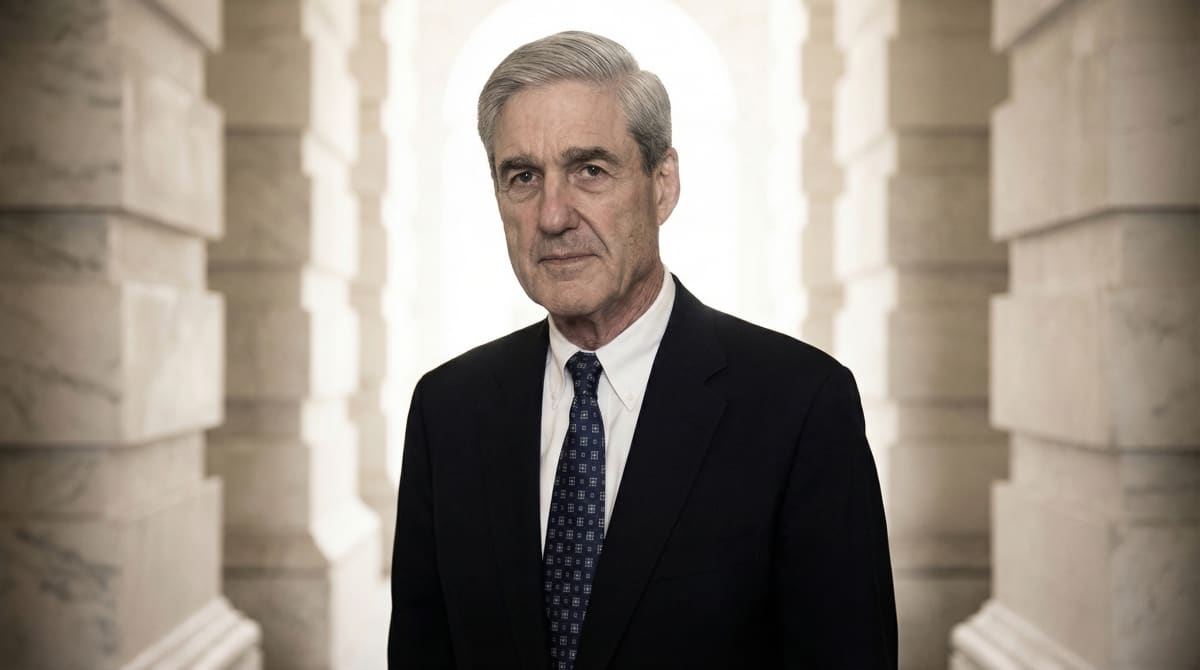
In the final act of Sophocles' Ajax, the great warrior falls not to his enemies but to his own unbending nature. He cannot adapt; he cannot compromise; he cannot live in a world that no longer rewards the rigid honour by which he has always defined himself. Robert Mueller, who died on Saturday at 81, was not a tragic hero in any theatrical sense. But he shared with Ajax a quality that his admirers called integrity and his critics called inflexibility: he would not bend the rules, even when the rules themselves had been hollowed out by those who faced no such constraint.
TLDR
Robert Mueller, the former FBI director who led the investigation into Russian election interference and Donald Trump's campaign, has died at 81. His 22-month investigation produced 34 indictments but stopped short of charging a sitting president. Trump celebrated his death on Truth Social, writing 'Good, I'm glad he's dead.'
KEY TAKEAWAYS
His former law firm, WilmerHale, confirmed the death and issued a statement praising his character. The New York Times reported last year that he suffered from Parkinson's disease.
President Trump, never one to let decorum intrude upon a grievance, offered his assessment on Truth Social within hours, declaring himself glad that Mueller had died and claiming the former prosecutor could no longer hurt innocent people. The exclamation mark in his post was, one feels, unnecessary, since the sentiment required no amplification.
The investigation that defined a presidency
In May 2017, Rod Rosenstein appointed Mueller as special counsel to investigate Russian interference in the 2016 election, and for twenty-two months, Mueller and his team proceeded with the methodical care of archaeologists excavating a contested site. The resulting 448-page report, dense with footnotes and careful hedging, secured thirty-four indictments and sent Trump's campaign chairman, his national security adviser, and his longtime political operative toward prison cells (until the pardons arrived, erasing the convictions if not the evidence that produced them). Mueller documented what he described as a 'sweeping and systematic' Russian campaign to tip the scales toward Trump.
And then, having assembled more evidence of presidential wrongdoing than any prosecutor since Archibald Cox, Mueller did something that baffled his allies and delighted his adversaries: he declined to draw a conclusion, retreating behind procedural barriers that his subject had never respected.
Justice Department policy, he explained with the patience of a law professor addressing first-year students, prohibited charging a sitting president with a federal crime. Fairness prohibited accusing a man who would have no forum to contest the accusation. He would document the obstruction; he would not name it as such.
Based on Justice Department policy and principles of fairness, we decided we would not make a determination as to whether the president committed a crime.
— Robert Mueller, Congressional testimony, 2019
In his halting congressional testimony, Mueller offered one clarification that cut through the procedural fog: 'The president was not exculpated for the acts that he allegedly committed.' It was the closest he would come to a verdict, and it satisfied almost no one. The prosecutor's craft, after all, lies in what can be proven, not what is believed, and Mueller had chosen to believe in the rules rather than the evidence those rules were designed to protect.
The rules and those who break them
To understand Mueller, you must understand that he was an institutionalist in an age when the institutions had begun to shake beneath everyone's feet. He believed in the Justice Department as one might believe in the Church of England: not for its perfection, but for its continuity, its capacity to outlast any single scandal or administration. The rules existed to outlast any single case, any single president, any single moment of political frenzy, and to bend them for a good cause, he reasoned, was to bend them for every cause that might follow.
This philosophy served him well enough during his twelve years as FBI director, a tenure longer than anyone except J. Edgar Hoover. He took over the bureau one week before the September 11 attacks and transformed it from a crime-fighting agency into a national security apparatus. When Bush administration officials tried in 2004 to reauthorise a domestic surveillance programme that the Justice Department had ruled unconstitutional, Mueller and his then-deputy James Comey threatened to resign, and they won that skirmish because the rules, for the moment, still commanded respect from both sides.
But rules require good faith from all parties, and when Trump fired Comey in 2017, citing the Russia investigation as the cause on national television, he revealed himself as a man who felt no particular obligation to the procedural norms that Mueller had spent his career upholding. Mueller was called back to investigate, and he investigated precisely as an institutionalist would: building the evidentiary record with painstaking care, securing convictions of those around the president, and then stopping short of the president himself because the rules, as he read them, said he must.
Trump, who had never displayed any particular attachment to rules that inconvenienced him, pardoned Manafort, pardoned Stone, and pardoned Flynn as soon as he could do so without political cost. The convictions vanished like writing in sand. The evidentiary record remained, but evidence without consequence is merely history, and history without accountability tends toward repetition.
What the investigation established
Mueller's report, for those who read beyond the redactions and the spin, established several facts that no amount of presidential bluster could erase, even as the bluster succeeded in drowning out the substance.
Russia interfered in the 2016 election, not as conjecture but as documented fact, with Mueller's team identifying specific Russian intelligence officers by name and military unit, tracking the hacked emails and coordinated social media campaigns and the timing of releases designed to maximise damage to Hillary Clinton.
The Trump campaign welcomed the interference with something between eagerness and gratitude. 'Numerous links' connected campaign officials to Russian agents, and the campaign 'expected it would benefit electorally from information stolen and released through Russian efforts.' When Donald Trump Jr. received an email promising Russian government support for his father's candidacy, he did not alert the FBI or express concern about foreign interference; he responded with enthusiasm.
The evidence did not establish criminal conspiracy to Mueller's satisfaction, though he chose his words with a lawyer's precision: the evidence did not establish conspiracy, which is not the same as saying conspiracy had not occurred, a distinction that mattered to prosecutors and no one else.
The president obstructed the investigation repeatedly, attempting to have Mueller fired, directing aides to limit the inquiry's scope, dangling pardons before potential witnesses, raging publicly and privately against anyone who cooperated. Mueller documented ten distinct episodes that could constitute obstruction of justice, assembling a case that any prosecutor would have been proud to bring against any defendant who was not, inconveniently, the President of the United States.
Before the investigation
Mueller came from the kind of American background that no longer produces public servants in the numbers it once did: Northeastern money, good schools, a sense that privilege carried obligations that could not be shirked. He attended Princeton and NYU before making the choice that would shape everything that followed, enlisting in the Marine Corps during Vietnam when he might easily have arranged to serve elsewhere or not at all.
He led a rifle platoon through jungle combat, was wounded, and earned the Bronze Star and Purple Heart for his service. His former superior, Massachusetts Governor William Weld, told the Times that Mueller 'really hates the bad guys,' which was the kind of statement that sounded admirable until you noticed that Mueller's definition of bad guys seemed to stop where institutional prerogatives began. Vietnam may have taught him that there were enemies worth fighting; it may also have taught him that even righteous causes are constrained by rules of engagement, and that breaking those rules, however tempting, corrupts the cause itself.
After the war, he went to law school at Virginia and became a federal prosecutor, rising through the Justice Department hierarchy to head the criminal division before President Bush chose him to lead the FBI in 2001. He was not, by any account, a warm man, nor was he charismatic, nor particularly good at political theatre, as his halting congressional testimony revealed to anyone watching. He was precise and formal, devoted to the belief that the law should apply equally to everyone, which was a beautiful belief that had never been entirely true and was becoming less so.
The question that will not be settled
History will render a verdict on Robert Mueller, though not the clear verdict he declined to render on his subject, and reasonable people will disagree about what that verdict should be for decades to come.
Some will call him a hero: the lifetime Republican, the decorated veteran, the FBI director of unimpeachable credibility who documented wrongdoing at the highest levels of American government and thereby preserved a record that future historians will study long after the participants are gone. If Mueller said the evidence fell short, who could argue with more authority? He bought the institutions time, even if time was not what they needed.
Others will call him a tragic figure who had the evidence to act and chose, in the name of rules that his adversaries never honoured, to remain silent at the decisive moment. He deferred to norms that existed only because people like him upheld them; when faced with someone who felt no such compunction, the norms collapsed, and Mueller's restraint looked less like integrity than a kind of learned helplessness in the face of shamelessness.
W.H. Auden, writing as Europe descended into war, captured the failure of decent men to halt what they could see approaching: 'The unmentionable odour of death / Offends the September night.' Mueller, one suspects, could smell what was coming and believed the rules would hold it back because the rules had always held it back before. The belief was touching, in its way, though it did not stop what followed.
Trump, characteristically, has no ambiguity to offer about the man who investigated him for nearly two years. 'Good,' he wrote on Truth Social, expressing his satisfaction that Mueller had died. There is a clarity to that sentiment, however vulgar, that Mueller never permitted himself. It is the clarity of someone who never understood what Mueller was trying to protect, and never needed to, because protection was always someone else's job. Mueller spent his career weighing evidence and procedure and precedent, all those shades of grey that made him an excellent prosecutor and a frustrating public figure. He died, as such men often do, before the verdict came in.
SOURCES & CITATIONS
FREQUENTLY ASKED QUESTIONS