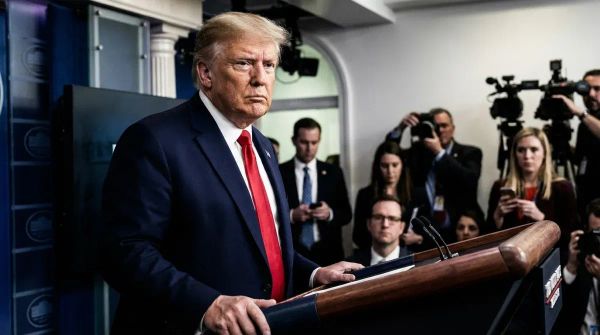
In one of his later novels, John le Carré described diplomacy as 'the art of saying nice doggy while finding a bigger stick.' Reading the responses to Trump's call for allied warships in the Persian Gulf, the observation feels almost too precise. The 'nice doggy' is present. The bigger stick, notably, is not.
TLDR
Trump's call for allied warships to reopen the Strait of Hormuz has met with polite silence or minimal commitments. Britain is offering mine-hunting drones instead of naval vessels. India is negotiating directly with Iran. Italy has scaled back its regional forces. France, Germany, and Japan have said nothing. The pattern suggests allies are managing domestic political constraints while hedging their bets on America's longer-term commitment.
KEY TAKEAWAYS
Trump's request was explicit: nations that benefit from the Strait of Hormuz should contribute militarily to keeping it open. The logic is reasonable. Roughly 20 per cent of global oil supplies pass through that waterway. Iran's blockade has disrupted shipping and spiked energy costs. The problem is real. The response from America's closest allies has been something else entirely—a masterclass in saying yes while meaning maybe, or perhaps later, or only if we can do it our way.
The British Offer
Consider Britain's position. Keir Starmer has spoken with Trump about 'the importance of reopening the Strait.' That is diplomatic consent. But when it came to substance, the offer was notably circumscribed. Energy Secretary Ed Miliband mentioned 'looking at any options,' which in Westminster-speak means 'we haven't decided and we want to buy time.' The specific option being explored? Mine-hunting drones. Not warships. Not sustained naval presence. Drones—machines that clear a channel without committing British personnel to the region's escalating tensions.
This matters for two reasons. First, it signals domestic political constraint. The Liberal Democrats, who hold meaningful balance-of-power leverage in Parliament, have explicitly opposed British warship deployment. Their leader, Sir Ed Davey, used words like 'reckless' and 'illegal' in describing the conflict. A British government sending warships despite that opposition would face parliamentary embarrassment it plainly cannot afford. Second, the drone offer itself is revealing: it provides just enough cover to claim cooperation while providing nothing that looks like full-throated military commitment. It is the cousin of the lukewarm endorsement.
The Indian Alternative
India's approach has been more interesting still. Foreign Minister Jaishankar, speaking to international media, revealed that India has negotiated the passage of two Indian-flagged gas tankers through the Strait directly with Iran. No US-led coalition. No warship escorts. A bilateral conversation conducted in the margins of the broader conflict.
This is strategic diplomacy at its finest, and it speaks volumes about why other nations aren't queuing up for Trump's coalition. India imports nearly 90 per cent of its liquefied petroleum gas from Saudi Arabia and the UAE, both of whom must pass through Hormuz. Dependence like that demands flexibility. When you are tied to multiple supply chains, you cannot afford to choose sides absolutely; you must maintain dialogue with all parties, even the ones blocking the strait. Jaishankar's approach acknowledges this reality. Why risk a warship strike when you can negotiate safe passage bilaterally? Why commit to an American-led coalition when you can secure your own national interest through quiet diplomacy? The answer, from an Indian perspective, is that you don't.
Tellingly, this negotiated passage worked. Two tankers moved through. The precedent is now set: alternatives to the coalition exist. Other nations will notice.
Italy Steps Back
Italy's position provides another data point in the same direction. The Italian Ministry of Defence acknowledged that a US–Italian base in Kuwait was struck by a drone attack in recent days. One remotely piloted aircraft was destroyed. No personnel casualties. But the incident prompted an immediate decision: scale back the Italian Task Force Air in the region. The response to an escalation was to reduce exposure, not increase it.
Here is what that signals. When your ally faces security risks, the traditional response of coalition partners is to demonstrate solidarity by increasing presence. Italy's choice to reduce rather than expand suggests a calculation that the regional situation is deteriorating, that American protection cannot be assumed as permanent, and that Italian forces are safer at a lower profile. It is the inverse of commitment.
The Silence of Others
France, Germany, and Japan have offered no public statements of support, no announced deployments, no ministerial visits. Their silence is not absence of opinion; it is a clear opinion held quietly. To commit would be to declare alignment with American military strategy in a region where long-term outcomes remain uncertain. To stay quiet is to reserve the right to negotiate independently later.
Trump's response to this non-response has been, characteristically, a threat. He warned that if allies don't help unblock the strait, it could be 'very bad for the future of NATO.' The statement is significant not as policy but as a confession. It reveals frustration—real frustration—that the coalition he requested is not forming. When a leader must warn his allies about the consequences of non-compliance, the coalition has already failed. What remains is a question of face-saving, not actual military coordination.
What Binds This Pattern
The reluctance across these allies is not random. It is disciplined. Each nation is managing genuine domestic constraints—British parliamentary politics, Indian supply-chain dependence, Italian security vulnerabilities—that make full coalition participation costly. But there is a deeper pattern beneath the surface constraints: uncertainty about America's staying power.
If these allies believed that American commitment to the Gulf was permanent and irrevocable, the calculus would shift. They would align. But they have watched American priorities shift before. They have seen how quickly administrations can change course. They have watched one Middle Eastern commitment after another dissolve or transform. Against that history, the prudent course is not to bet the warship, the tanker schedule, or the regional influence on a conviction that this conflict will resolve as Trump predicts.
Britain offers drones. India negotiates bilaterally. Italy pulls back. France, Germany, and Japan say nothing. The Strait of Hormuz remains blocked. Shipping costs rise. Oil prices remain elevated. Trump's coalition exists on paper but not on water.
The result is not quite failure and not quite success—it is the slow unraveling of the assumption that allies will follow America's lead reflexively. That assumption held through the Cold War and into the post-9/11 world. It does not hold anymore, if it ever truly did. What we are seeing in the Strait is the exhaustion of that model. Allies are becoming smaller powers pursuing smaller interests. The age of automatic coalition is ending, whether America acknowledges it or not.
SOURCES & CITATIONS
- BBC News, 'Trump warns of NATO consequences over Hormuz response', 16 March 2026
- Financial Times, 'India negotiates safe passage for tanker shipments through Hormuz', 15 March 2026
- UK Maritime Trade Operations, vessel attack reports, March 2026
- Italian Ministry of Defence statement, Task Force Air operations update, 16 March 2026
FREQUENTLY ASKED QUESTIONS