Wednesday, April 8, 2026
ASX 200: 8,412 +0.43% | AUD/USD: 0.638 | RBA: 4.10% | BTC: $87.2K
← Back to home
Culture

Restoration Breathing New Life Into Paris Catacombs

Curators are preserving and modernizing the tunnels while maintaining the macabre ambience of the city's home for the dead.

4 min read
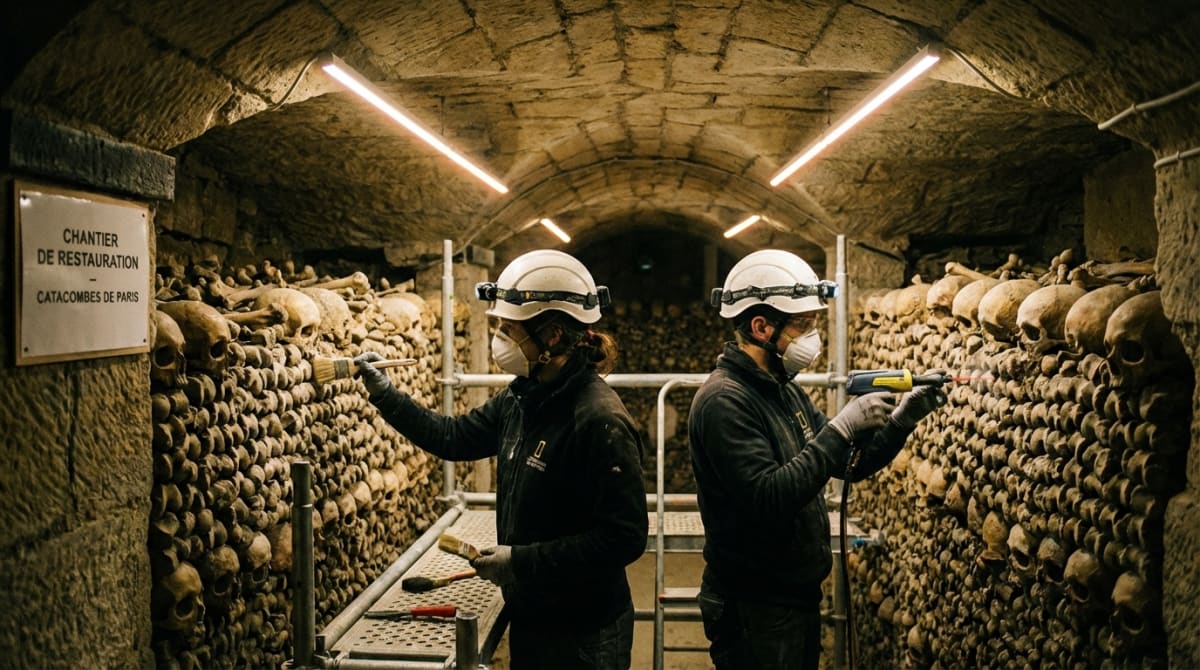
Paris Catacombs tunnel lined with neatly stacked skulls and bones, dimly lit underground ossuary
The walls of the Paris Catacombs are lined with bones. Photo: Editorial.
Editor
Apr 8, 2026 · 4 min read
By Margaret Hale · 2026-04-07

TLDR

Over the past five months, a major restoration project has been underway in the Paris catacombs. Architects and masons are installing new lighting and ventilation systems while preserving the site's spooky appeal. The mile-long section accessible to the public will reopen on Wednesday.

KEY TAKEAWAYS

01A five-month restoration of the Paris catacombs is nearing completion.
02The project includes new lighting, ventilation systems, and restored bone walls.
03The site draws 600,000 visitors annually to see the remains of up to six million Parisians.

For more than two centuries, tourists have descended beneath the streets of Paris to visit the catacombs. From floor to ceiling, the tunnels are lined with the bones of up to six million people who lived, worked, and died in this city between the tenth and eighteenth centuries, their remains transferred underground after the city's overflowing cemeteries became a public health crisis. Today they draw 600,000 visitors a year.

Parts of those gloomy passageways have now been given a much-needed face-lift. Over the past five months, architects and masons have been renovating this vast tomb.

Preserving the Macabre

"The goal isn’t to turn it into Disneyland," Isabelle Knafou, the catacombs’ administrator, told reporters. The project includes installing new lighting and ventilation systems.

"We want to preserve the authenticity of the site," Knafou said. Some elements of the labyrinth that were previously unlit will now be visible to visitors.

A Dark History

The network was converted in the 18th century to provide a novel remedy to a gruesome problem. The city’s cemeteries were overflowing, causing sanitation issues.

By the late 18th century, Paris's cemeteries had become a serious public health problem. In 1785, authorities began a systematic transfer of human remains from the overflowing churchyard burial grounds into the abandoned limestone quarry tunnels that had been carved beneath the city over centuries of construction, creating what would become the world's most visited ossuary. The process took decades.

Bones from the 10th to 18th centuries were stacked and arranged in the tunnels. The mile-long section open to the public closes during restoration and will reopen on Wednesday.

FREQUENTLY ASKED QUESTIONS

When did the Paris catacombs become an ossuary?
Authorities began moving the dead underground in 1785 to address overflowing cemeteries.
How many people's remains are in the Paris catacombs?
The catacombs hold the remains of approximately six million people, transferred from overflowing city cemeteries beginning in 1785. The bones were arranged decoratively in the late 18th and early 19th centuries by Inspector-General Louis-Étienne Héricart de Thury.
Can tourists visit the section being restored?
Access to the restoration zone has been restricted during rehabilitation work. The 2-kilometre public circuit beneath the 14th arrondissement — entered via Place Denfert-Rochereau — remains open with timed entry tickets. The restricted ossuary galleries are accessible only on specialist guided tours.
Who is funding the Paris catacombs restoration?
The restoration is funded jointly by the City of Paris and the French state, with contributions from the Paris Mémorial Foundation. The project is overseen by conservation specialist Isabelle Knafou and targets structural deterioration worsened by rising underground water tables and increased tourist traffic since the 1990s.
Editor

Editor

The Bushletter editorial team. Independent business journalism covering markets, technology, policy, and culture.
What's your reaction?