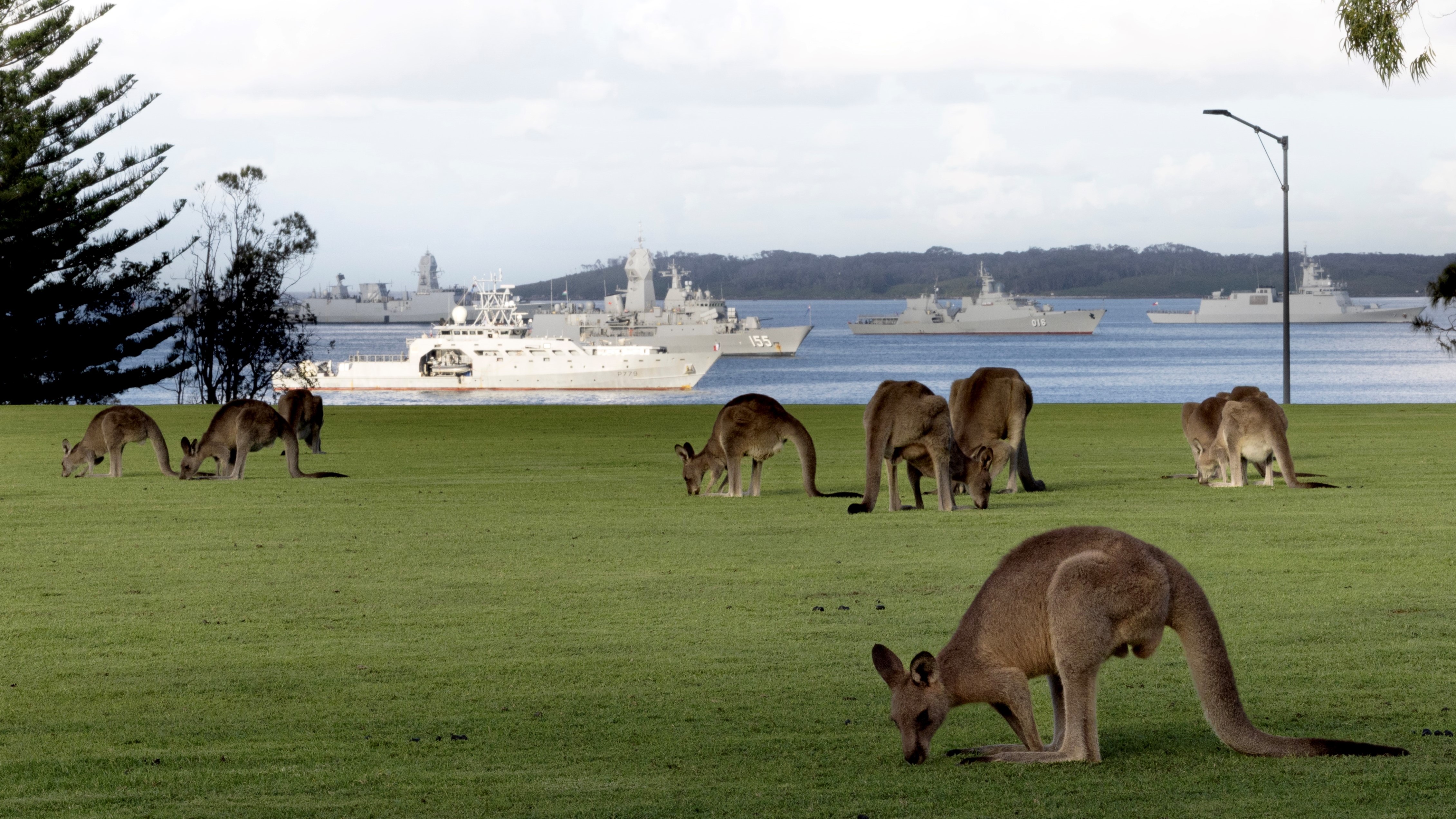
The waters off Sydney Harbour filled with grey hulls and white wakes on Saturday morning as 31 warships from 19 nations made their ceremonial entry for the 2026 Exercise Kakadu Fleet Review. It was the largest gathering of foreign naval vessels in Sydney since the centenary celebrations of 2013.
TLDR
Sydney Harbour became the backdrop for Australia's largest naval gathering in over a decade on Saturday, as 31 warships from 19 countries assembled for the Exercise Kakadu Fleet Review. The event marks 125 years since the formation of the Commonwealth Naval Forces, with Governor-General Sam Mostyn reviewing the international fleet from HMAS Leeuwin. More than 6,000 personnel are participating in the multinational exercise.
The occasion marked 125 years since the formation of the Commonwealth Naval Forces, the precursor to today's Royal Australian Navy. From 6am, vessels filed through Sydney Heads in staggered divisions, taking up positions at anchor points and berths scattered from Garden Island to Rose Bay.
The Review
Governor-General Sam Mostyn, accompanied by Deputy Prime Minister Richard Marles, Chief of Defence Force Admiral David Johnston, and Chief of Navy Vice Admiral Mark Hammond, boarded HMAS Leeuwin to conduct the ceremonial inspection.
The reviewing ship, a hydrographic surveyor last used in this role during the 2013 Fleet Review, proceeded past each anchored and berthed vessel, receiving ceremonial salutes as it passed. One column of ships sailed through the main channel, passing Leeuwin as they headed west toward the Harbour Bridge.
The Fleet Review highlights the depth of our partnerships across the region. The strength of these relationships and the importance of working together to ensure a secure maritime domain — that's what you see here today.
— Vice Admiral Mark Hammond AO RAN, Chief of Navy
19 Nations, One Harbour
The assembled fleet read like a roll call of Indo-Pacific naval power. Alongside Australia, vessels arrived from India, Japan, Indonesia, Malaysia, the Philippines, Singapore, Thailand, Vietnam, Canada, France, New Zealand, Fiji, Papua New Guinea, Tonga, Kiribati, Samoa, and the Cook Islands.
The Indonesian Navy deployed KRI Raden Eddy Martadinata-331, carrying personnel from the elite Kopaska frogman command. Japan sent destroyers bearing hull numbers visible from the shoreline. Ships from India, Malaysia, the Philippines, Thailand and Vietnam transited together from Darwin under the command of HMAS Choules.
The transit itself doubled as a training exercise. As Captain Darin MacDonald, commander of the Australian Maritime Task Group, noted: "Exercising with regional partner nations strengthens our ability to operate together at sea. It builds trust, mutual understanding and interoperability between our forces."
The Aerial Display
The centrepiece of the afternoon program came between 2:45pm and 3:15pm, when the Royal Australian Air Force joined the Navy for a combined aerial display over Sydney Harbour.
F/A-18F Super Hornets, EA-18G Growlers, and F-35A Lightning II jets traced paths across the harbour, their contrails visible from vantage points stretching from Mrs Macquarie's Chair to Bradleys Head. MH-60R Seahawk helicopters flew in formation, their echelon pattern silhouetted against cumulus clouds.
A ceremonial gun salute at 3:45pm punctuated the review, with the sound rolling across the water and echoing off the harbour's sandstone cliffs.
125 Years of the Australian Navy
The anniversary traces back to 1 March 1901, when Australia's colonial navies federated into the Commonwealth Naval Forces. Those forces would later merge with the Royal Navy's Australian Squadron to form the Royal Australian Navy.
Vice Admiral Hammond framed the anniversary around partnership: "For 125 years, Australia's Navy has defended our nation, protected our maritime approaches, and supported regional stability but we have never done it alone. Our partners and allies have played a critical role in our 125-year history."
Exercise Kakadu: From Ceremony to Training
The Fleet Review represents one phase of the broader Exercise Kakadu, Australia's premier multinational maritime exercise, held every two years since 1993 and now in its 17th iteration.
Following the ceremonial events in Sydney, the assembled forces will disperse for maritime training exercises, from constabulary operations to high-end warfare scenarios. The exercise area spans waters from Darwin to Cairns and down the eastern coast to Jervis Bay in New South Wales.
More than 6,000 personnel from the 19 participating nations will take part in the training phases. The exercise is designed to strengthen maritime security cooperation, improve interoperability, and build partnerships across the Indo-Pacific. These relationships underpin regional stability.
Evening Flotilla
The day concluded with a historical flotilla procession at 6:45pm, with vessels tracing a route from Farm Cove around Fort Denison, past the Opera House, and under the Harbour Bridge to Blues Point.
Tens of thousands of spectators lined the foreshore from North Head to Circular Quay. They witnessed a rare display of naval tradition and multinational cooperation, and a reminder that Australia's maritime security has always depended on partnerships forged beyond its shores.
KEY TAKEAWAYS
SOURCES & CITATIONS
- Department of Defence, 'Historic Fleet Review launches Exercise Kakadu in Sydney Harbour', 21 March 2026
- Royal Australian Navy, 'Exercise Kakadu Fleet Review', 21 March 2026
- Department of Defence, 'Six navies align for Exercise Kakadu', 16 March 2026
- Royal Australian Navy, 'Exercise Kakadu', 2026
- Defence Australia Twitter, Exercise Kakadu imagery, March 2026
FREQUENTLY ASKED QUESTIONS