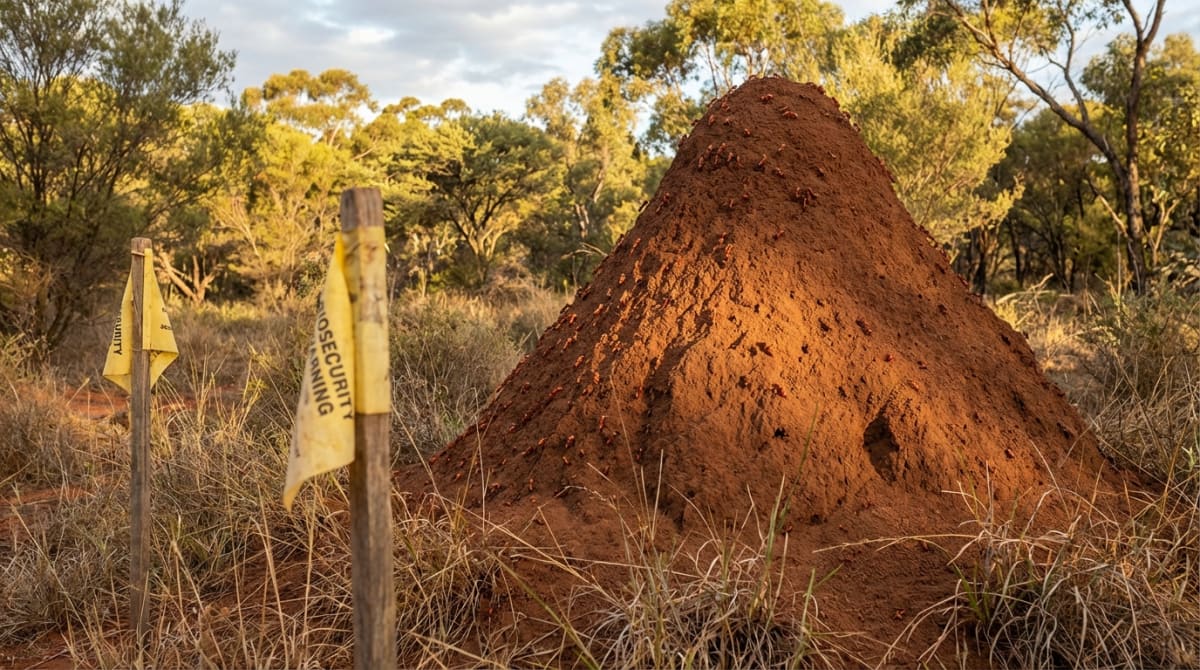
On March 5, 2026, a biosecurity officer knelt in the damp soil of Binna Burra and confirmed what ecologists had feared for two decades. Solenopsis invicta. The red imported fire ant. had breached the perimeter of the Gondwana Rainforests. For the first time, one of the world's most invasive species was inside a World Heritage site.
TLDR
On March 5, 2026, fire ants were detected at Binna Burra in the World Heritage-listed Gondwana Rainforests for the first time. Despite a $593 million eradication program and monthly biosecurity zone updates, the invasive species continues to spread. Experts warn that failure to contain the outbreak could cost Australia $2 billion annually and threaten 97% of the continent.
This was not just another suburban detection. Binna Burra is the gateway to Lamington National Park, a remnant of the ancient rainforests that once covered the supercontinent of Gondwana. Dr Erin Wallace, Principal Scientist at the National Fire Ant Eradication Program, described the location as having "very high social, cultural, and environmental significance." Her assessment is an understatement. If fire ants establish a foothold here, the ecological consequences for ground-dwelling species would be catastrophic.
The detection is an outlier, theoretically. But in a war that has already cost hundreds of millions of dollars, outliers are the first sign of a failing perimeter. The infestation at Binna Burra, along with recent clusters in the Isaac and Central Highlands regions, suggests the containment lines drawn on maps in Brisbane offices are not holding in the field.
The regulatory framework shifts
For years, the biosecurity zones governing fire ant movement were static, reviewed annually or ad-hoc. That has changed. Under the new Fire Ant Response Plan 2023–2027, the National Program has shifted to monthly updates of biosecurity zones. Effective March 17, 2026, suburbs in the City of Moreton Bay, Lockyer Valley, and Scenic Rim were added to the restricted list.
This regulatory acceleration is significant. It signals that the infestation is moving faster than previous bureaucratic cycles could manage. The mechanism for this control is the Biosecurity Act 2014 (Qld), specifically the General Biosecurity Obligation (GBO). This provision is the legal bedrock of the eradication strategy, and it shifts the burden of proof from the state to the citizen.
Under the Act, every Queenslander and business has a legal duty to ensure they do not spread the pest. The law does not require you to know you had fire ants; it requires you to take "all reasonable and practical measures" to prevent moving them. If you move soil, hay, mulch, or potted plants from a biosecurity zone without following risk mitigation strategies, you are liable.
The penalties are not trivial. For individuals, fines can exceed $500,000 or result in three years imprisonment. For corporations, the financial exposure is higher. Yet, despite these draconian powers, compliance remains the weak link. The spread to Binna Burra almost certainly hitched a ride on human transport. likely construction materials or landscaping supplies moved without inspection.
The economics of eradication
The current phase of the National Fire Ant Eradication Program is funded to the tune of $592.84 million, a cost shared between the Commonwealth and all state and territory governments. The objective is clear: complete eradication by 2032. This is the deadline Australia has set for itself to win a war that the United States lost decades ago.
Proponents of the spending point to the alternative. Analysis by the Queensland Government and independent economists suggests that if fire ants are allowed to spread unchecked, they could inhabit 97% of the Australian continent. The annual cost to the economy. across agriculture, tourism, and health. is estimated at over $2 billion. In that context, $593 million is a rational insurance premium.
Steven Torrisi, the program's Science Manager, argues the investment is working. "We have successfully eradicated 8 of 9 genetically distinct incursions," he stated in a recent scientific review. The program's data shows that without containment, fire ants naturally spread at a rate of 50 to 80 kilometres per year, as seen in China and the US. In Southeast Queensland, that rate has been suppressed to approximately 5 kilometres per year.
However, that 5 kilometres is still an expansion. The containment ring is growing, not shrinking. The program's success with isolated incursions at the Port of Brisbane or Gladstone obscures the reality of the main infestation, which continues to grind outwards into the Lockyer Valley and the Scenic Rim.
The human cost
The regulatory and economic arguments often abstract the physical reality of Solenopsis invicta. These are not nuisance ants. They are aggressive, swarming predators that can kill. When a mound is disturbed, the ants attack vertically, stinging repeatedly. The alkaloid venom causes a burning sensation. hence the name. And forms pustules that can become infected. For a small percentage of the population, the sting induces anaphylaxis.
In the United States, over 85 people have died from fire ant anaphylaxis. In Australia, we have avoided fatalities so far, but as the ants move into denser residential areas and recreational zones like national parks, the risk profile changes. A picnic at Binna Burra or a backyard cricket game in Ipswich becomes a different proposition when the ground itself is hostile.
The program has responded by mobilising the community. Treatment days at Bunnings stores, where residents can collect free bait, are now a regular feature of weekend life in affected suburbs. The bait itself. corn grit soaked in soybean oil and an insect growth regulator. is low toxicity for mammals but sterilises the ant queen. It is a slow weapon, requiring six rounds of treatment over two years to be effective.
A test of governance
The breach at Binna Burra forces a difficult question. Is the current strategy of containment and suppression sufficient to meet the 2032 eradication target? The Response Plan 2023–2027 was designed to be the final push. Instead, we are seeing the biosecurity zones expand monthly.
The outlier detections at Rathdowney, Baringa, and Forest Glen indicate that the perimeter is porous. While the Science Manager points to the suppression of natural spread as a victory, the artificial spread. through human movement of soil and freight. is outpacing the regulators. The monthly updates to the zones are a reactive measure, chasing the ant rather than blocking it.
As the infestation touches the edges of our World Heritage areas, the stakes have shifted. We are no longer just protecting suburban backyards or grazing land. We are defending the oldest rainforests on earth from an invader that has never known defeat.
KEY TAKEAWAYS
SOURCES & CITATIONS
- National Fire Ant Eradication Program, "Fire Ant Response Plan 2023–2027", Queensland Government.
- Queensland Government, "Biosecurity Act 2014", Queensland Legislation.
- Steven Torrisi, "Scientific evidence and collaboration", National Fire Ant Eradication Program, 6 March 2026.
- Dr Erin Wallace, "Protecting Wildlife at Binna Burra", National Fire Ant Eradication Program, 13 March 2026.
- National Fire Ant Eradication Program, "Fire ant biosecurity zone update for March", 17 March 2026.
FREQUENTLY ASKED QUESTIONS