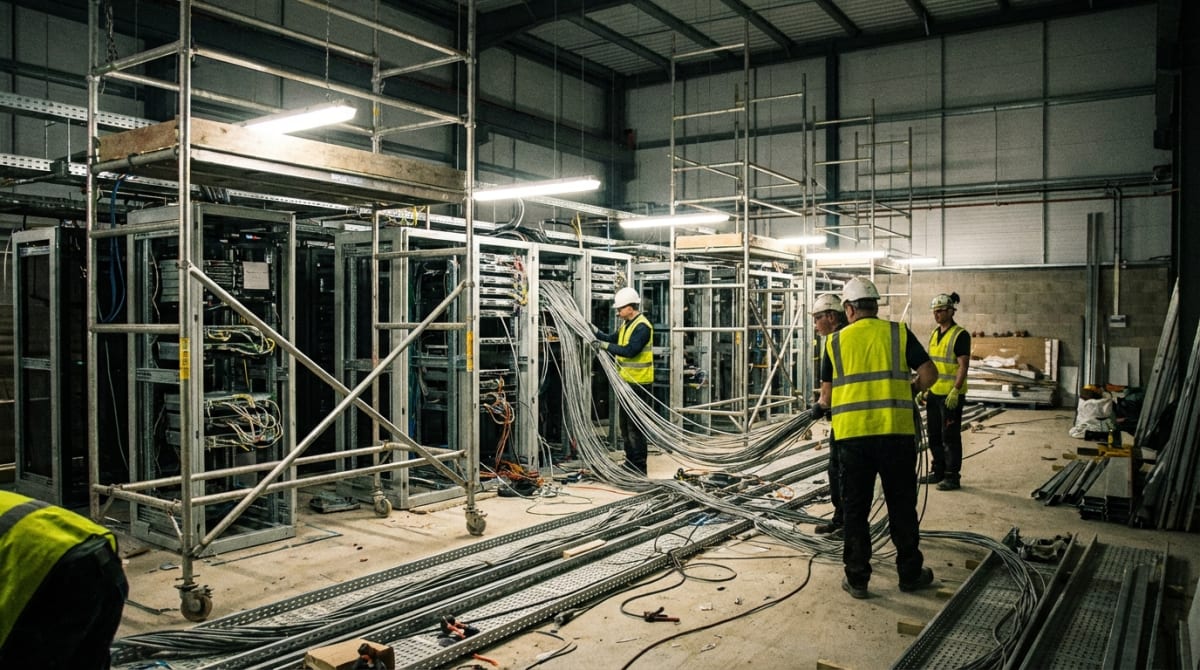
The scale of corporate investment in artificial intelligence has moved beyond 'significant' into the realm of 'historically unprecedented.' According to current guidance and infrastructure buildout rates, the four largest technology companies—Microsoft, Alphabet, Meta, and Amazon—are on track to have committed $650 billion to AI-related capital expenditure by the end of 2026.
KEY TAKEAWAYS
To put that in perspective: that is more than the total annual GDP of Sweden. It is an infrastructure bet larger than the Apollo program, adjusted for inflation. And it is happening in the space of just 36 months. The fundamental question for the market in 2026 is no longer what the technology can do, but whether it can generate a return on this level of capital.
The Blackwell-Rubin cycle
Much of this spending is being swallowed by hardware procurement. The cycle from NVIDIA's Blackwell (B200) architecture to the newly announced Vera Rubin generation has created a 'perpetual upgrade' environment. Hyperscalers cannot afford to be even six months behind on hardware performance, as that would mean losing the low-latency inference market to competitors.
Lead times for high-end GPUs still stretch to 24 weeks for the largest buyers, effectively forcing companies to place orders for infrastructure that won't be online for two fiscal quarters. This 'pre-ordering' of growth has created a disconnect between current balance sheet pain and future revenue potential. Capex is recognized now; revenue arrives much later.
Investor fatigue and margin pressure
For the first two years of the AI boom, stock prices rose in tandem with capex guidance. Investors treated spending as a proxy for ambition. That phase ended in late 2025. In 2026, the market is punishing companies that increase spending without showing proportional gains in free cash flow.
Meta, in particular, has seen its margins compressed by the sheer cost of maintaining its Llama 4 and 5 inference clusters. While Mark Zuckerberg has argued that the cost of under-investing is higher than the cost of over-investing, the reality is that depreciation costs are now a significant headwind to earnings per share. Cloud providers are hiking prices for premium AI instances to compensate, but competition is keeping a lid on pricing power.
The energy wall
Beyond the cost of the chips, Big Tech is now paying a premium for power. Data centre capacity in traditional hubs like Northern Virginia and Dublin is effectively sold out. Securing 100MW+ of grid connection now requires direct investment in energy generation—further inflating the capex totals.
Microsoft's recent decision to restart retired nuclear reactors is the most visible sign of this shift. Companies are no longer just software and service providers; they are becoming heavy infrastructure operators. The operational complexity of managing $650 billion in physical assets is a different challenge than managing code.
For the next 18 months, expect continued capex guidance increases, continued earnings pressure from margin compression, and continued hand-waving about "AI-driven revenue opportunities yet to be realised." For investors who bought these stocks for capital discipline and shareholder returns, that's a frustrating conversation. For investors who bought them for growth option value, it's expected.
The real test arrives in late 2026 or 2027 when the market starts asking harder questions about utilisation rates, effective returns on deployed capital, and whether the $650 billion was a strategic investment or an expensive hedge against obsolescence. That's when the actual balance sheet pressure becomes real, and that's when capital discipline decisions actually constrain acquisition and buyback flexibility.
For now, the spending is justified. Whether it remains justified once the bills come due is the question no one wants to ask.
TLDR
Combined capital expenditure from Microsoft, Alphabet, Meta, and Amazon is projected to hit $650 billion by the end of 2026, driven almost entirely by AI infrastructure. While revenue from cloud AI services is growing at 30-40% annually, the scale of investment is now large enough to impact total corporate margins. Wall Street is shifting from excitement over AI capability to scrutiny of capital efficiency. The core tension for 2026 is whether these 'hyperscalers' are building a productive foundation for the next decade of growth, or simply overbuilding in a desperate attempt to avoid being left behind by the Blackwell-Rubin hardware cycle.
SOURCES & CITATIONS
FREQUENTLY ASKED QUESTIONS