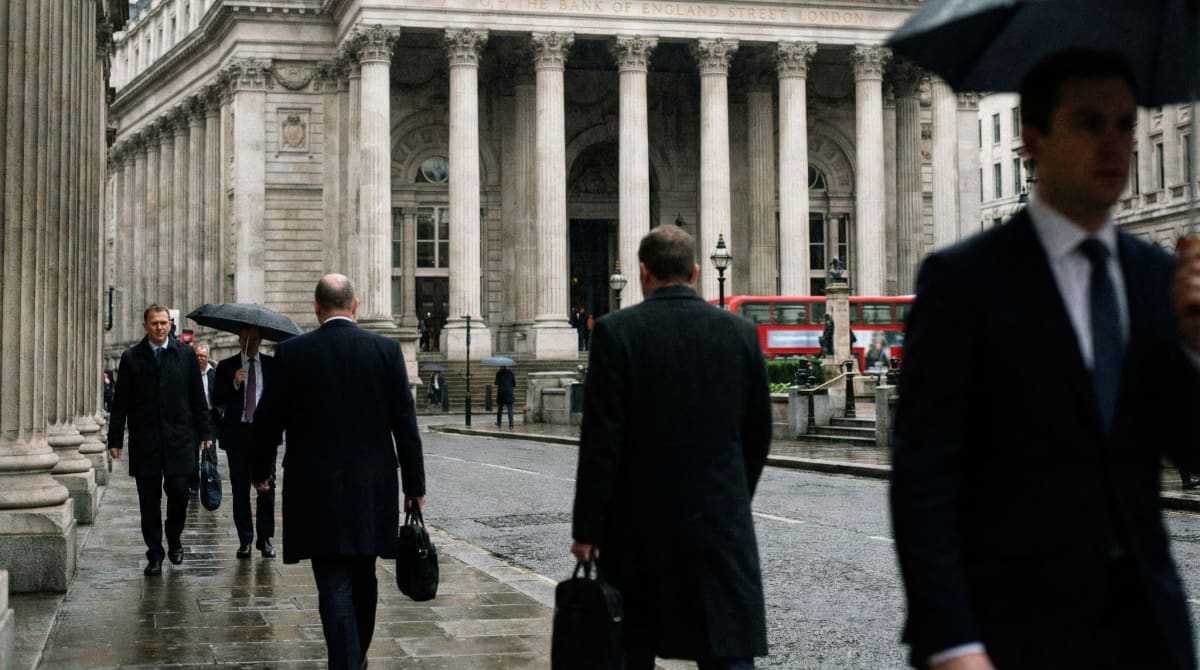
The Bank of England held its policy rate at 3.75% when the Monetary Policy Committee met on March 18, abandoning what had been an expected cut and instead pivoting to discuss whether the economic shock from conflict in the Middle East will force rate rises before the end of the year.
TLDR
The Bank of England held its policy rate at 3.75% on March 18 after conflict in the Middle East sent oil prices up 60% and closed the Strait of Hormuz. The decision was unanimous, the first in four and a half years, with the committee discussing whether rate rises would be needed if the shock persists. Markets now price in two hikes before year-end. Inflation is forecast to reach 3.5% by March, with household energy bills set to rise when the next Ofgem cap is recalculated in July.
KEY TAKEAWAYS
The vote was unanimous. That is the first time all nine members have agreed since September 2021, four and a half years ago. The February meeting had split 5-4, with the majority including Governor Andrew Bailey choosing to hold rather than cut. This month, even those who had been voting for easing backed a pause.
The reason is oil, and the Strait of Hormuz. Shipping through the strait has almost stopped since Iranian forces targeted vessels in retaliation for US-Israel military action. One-fifth of global oil supply and liquefied natural gas normally passes through that waterway. Brent crude has risen from around $62 per barrel in mid-February to over $100 in the days before the MPC decision. European wholesale gas prices, measured by the Dutch TTF benchmark, climbed from roughly €31/MWh to above €50. UK natural gas futures contracts for the next Ofgem price cap period, July to September, are up 35 to 40%.
What the minutes say about inflation
The Bank of England has had a crude awakening. The rise in energy prices threatens to push up inflation and force a hawkish pivot.
— Sanjay Raja, Chief UK Economist, Deutsche Bank
CPI inflation was 3.0% in January and had been forecast to fall back toward the 2% target by April. The February Monetary Policy Report projected 2.1% for Q2. The conflict has changed that. The committee now expects inflation close to 3.5% in March, almost half a percentage point higher than the February forecast, driven initially by fuel costs that feed through immediately at the pump.
Household energy bills will stay insulated for now because the Ofgem price cap for April to June was set before the conflict started. But if wholesale prices at current levels persist, the cap will mechanically rise when recalculated in July. Bank staff estimate the direct contribution of energy to CPI inflation in Q3 could reach three-quarters of a percentage point. Add indirect effects as businesses pass on higher input costs and the committee thinks inflation could hit 3.5% again in the third quarter.
The MPC minutes are explicit about what matters most: not the first-round price spike, which monetary policy cannot prevent, but second-round effects through wage and price-setting that would embed inflation above target. The risk, the committee says, is greater the longer energy prices stay elevated. Households and businesses have been through repeated supply shocks since 2022. They may be more sensitive to another inflationary pulse now, and inflation expectations at 3.5% are above the threshold at which households typically adjust their behaviour.
Policy stance has flipped
Markets had been pricing in rate cuts as recently as late February. That expectation has reversed. The market-implied path for Bank Rate now slopes upward through 2026, with traders anticipating two quarter-point hikes taking the rate to 4.25% before year-end. Financial conditions have tightened as a result. Term overnight indexed swap rates have risen back to levels last seen in early 2025, and mortgage lenders have already pulled hundreds of products and raised quoted rates on new fixed deals.
Governor Bailey warned against jumping to strong conclusions about raising rates. "The right place to be is on hold," he said at the press conference. But the minutes are clear that a larger or more protracted shock requiring tighter policy is one of the scenarios the committee is assessing. Several members noted in their individual statements that the balance of risks has shifted. Megan Greene said the risk of inflation persistence "has risen, perhaps significantly." Catherine Mann said the tension between rising inflation and softening activity has re-emerged and could worsen.
The Strait of Hormuz remains closed
There is no resolution in sight. The International Energy Agency coordinated a release of strategic oil reserves among member countries, but those barrels will take weeks to reach refineries and will only partially offset the supply shortfall. Market participants told the Bank their central expectation is for a relatively short conflict, but the distribution of possible outcomes has widened. Financial market options imply upside risks to oil and gas prices have increased significantly over the next few months.
Bailey called for the reopening of the Strait, describing it as the best and most appropriate solution to the energy price problem. Monetary policy, he said, cannot reverse a supply shock. Its job is to make sure the economic adjustment to that shock occurs in a way that brings inflation back to 2% sustainably. The committee is monitoring for signs that inflation expectations are becoming unanchored or that wage settlements are accelerating beyond what productivity growth can support.
Members who had backed cuts now vote to hold
Dave Ramsden had been voting for a 25 basis point cut and said he would have done so again at this meeting absent the Middle East conflict. He now votes to hold. Sarah Breeden said she would have expected to vote for a cut in March if the shock had not occurred, given that the underlying disinflation process was continuing broadly as she expected. She voted to hold. Alan Taylor, who also leaned toward easing, said there is now a high bar to hiking given the massive uncertainty around energy prices, but he prefers to wait and gauge the shock before calibrating policy.
The hawkish members remain cautious. Huw Pill noted that structural changes in price and wage-setting over the past decade have made the propagation of inflationary impulses more persistent than in the past. The Agents' pay survey was revised upward after the February meeting, with private sector settlements now expected to average 3.6% in 2026, up 0.2 percentage points. Pill said the potential for second-round effects is substantial and justifies caution.
What happens next
The committee meets again on April 30. By then there will be more clarity on how long the conflict lasts, how far energy prices have moved, and whether there is any early evidence of second-round effects in wages or price-setting. The minutes describe a range of possibilities for how policy might need to respond. A very short-lived shock would mean less restrictive policy. A larger or more protracted shock requiring action to contain second-round effects would mean a more restrictive stance.
Markets are not waiting. Mortgage borrowers who had been holding out for lower rates are locking in deals now rather than risk paying more in a few months. The stock of gilts held for monetary policy purposes stood at £528 billion as of March 18. That number will stay unchanged while the MPC is on hold, but quantitative tightening could slow or reverse if the committee shifts to hiking and wants to avoid an excessively tight policy mix.
The parallels with 2022 are obvious but incomplete. Then, Russia's invasion of Ukraine sent energy prices higher and central banks were criticised for acting too slowly. The lesson the MPC took from that episode is to exercise vigilance early rather than let inflation expectations drift. But the economy in March 2026 is weaker than it was in 2022. Growth is below potential, the labour market has slack, and the unemployment rate at 5.2% is above the Bank's estimate of equilibrium. The trade-off between controlling inflation and avoiding excessive damage to activity is real this time.
SOURCES & CITATIONS
FREQUENTLY ASKED QUESTIONS