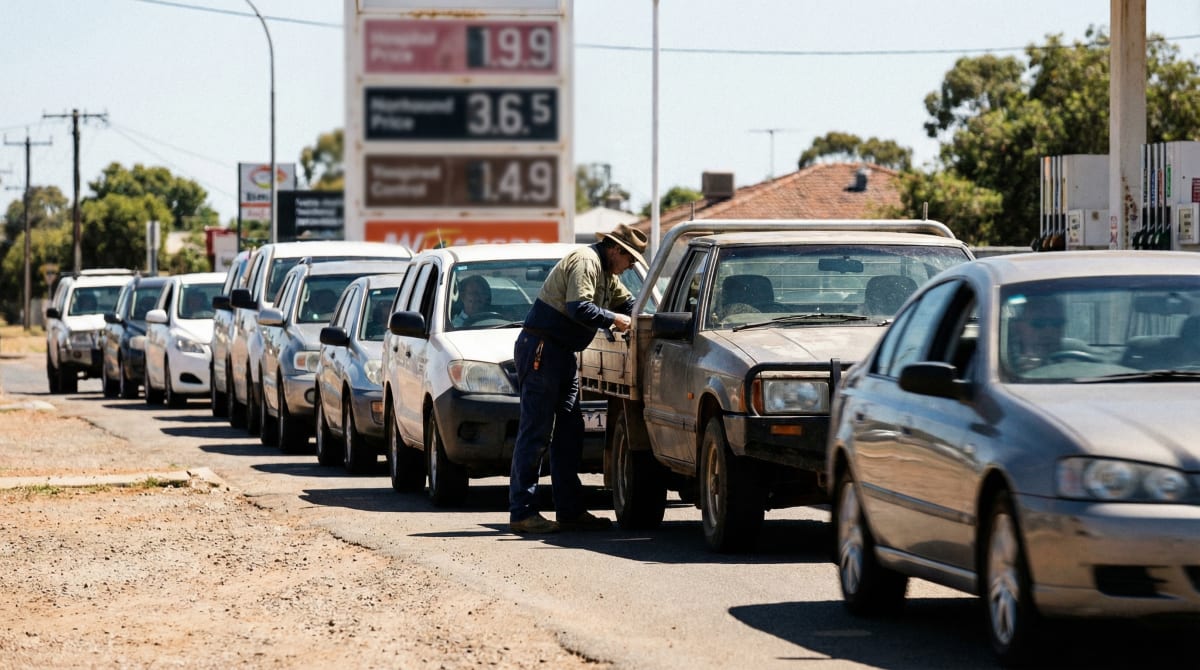
Sydneysiders are paying $3.15 a litre for petrol at some service stations this week. For American readers, that's approximately $7.60 USD per gallon — more than double US prices at the worst of the 2022 spike.
KEY TAKEAWAYS
Prime Minister Anthony Albanese announced emergency powers on Saturday allowing the government to underwrite private fuel imports, after a month of soaring prices and widespread shortages at regional service stations.
What Australians Are Actually Paying
The Australian Competition and Consumer Commission (ACCC) reported on March 25 that average diesel prices across the five largest cities reached 303.5 cents a litre, up 10% from the previous week. Regular unleaded petrol averaged 252.2 cents a litre, up 8%. Isolated reports of $3.15+ per litre have emerged from South Sydney and parts of Melbourne.
One Reddit user on r/AusFinance calculated the real cost for typical households. At average fuel efficiency (8L/100km):
• 230km/week (national average): $15 extra per week, $62/month • 400km/week (outer suburbs commuter): $27 extra per week, $108/month • 500km/week (regional/tradies): $34 extra per week, $136/month
I'm in a kinda small city and like 3 weeks ago we were at $1.50, today it's almost double. $50 used to fill my tank and now it's $100.
— Reddit user, r/australian
The national average retail price reached 238 Australian cents ($1.64 USD) per litre as of Sunday, compared to 171 cents four weeks earlier, according to the Australian Institute of Petroleum. But averages obscure the pain: diesel has passed $3 a litre in some areas, and prices peak on Thursdays before dropping early in the week.
The Government Response
Labor will introduce amendments to export finance laws on Monday allowing the government to underwrite purchases of petrol, diesel, fertiliser and 'other essentials' that private importers cannot secure on commercial terms.
This support from the government will not be business as usual. It has to be additional supplies that are available on the international market.
— Anthony Albanese, Prime Minister
The new powers will be administered through Export Finance Australia. Under the emergency arrangements, the agency can provide importers with insurance, loans, and other financial instruments to mitigate the risk of purchasing fuel in a volatile international market.
Supply Position
Energy Minister Chris Bowen said Australia's petrol supply had improved slightly to 39 days, or 1.6 billion litres. Diesel remained at 30 days (2.7 billion litres), with 30 days of jet fuel.
Of 81 fuel-carrying ships scheduled to arrive in April, six have been cancelled. Bowen said these had been 'more than replaced by new orders' but acknowledged the situation remained challenging.
The fact of the matter is, cargo internationally is available, but it is getting increasingly expensive and increasingly risky in a volatile environment.
— Chris Bowen, Energy Minister
The Second-Order Effects
The fuel price surge isn't just hitting drivers. With diesel up 130 cents per litre, freight costs are blowing out. The National Farmers' Federation has warned food prices could rise up to 50% if diesel shortages persist.
Add 1x for transport and 1x for local distribution/retail and honestly I fear that if the barrel price hits 160 next month, in a bad scenario we could end up paying a flat $3 AUD per litre petrol at the pump.
— Reddit user, r/AusFinance
That prediction has already come true in parts of Sydney. With Brent crude above $110 and the Strait of Hormuz effectively closed, there's no obvious ceiling.
Regional Australia Running Dry
The crisis has hit regional Australia hardest. Independent fuel distributors, who supply many country service stations, have struggled to secure wholesale supply from the four major companies that control 85% of Australia's liquid fuel imports: Viva Energy (Shell), Mobil, BP, and Ampol.
Unlike contracted retailers, independent distributors buy fuel on the wholesale market. Since the Iran war began, some have reported being unable to secure enough supply, resulting in service stations running dry.
'Not the Australian Way'
Albanese urged Australians to avoid panic buying, criticising images of 'multiple jerry cans being filled up' at service stations.
I've said we need to learn the lessons of the pandemic now. I don't want things to be mandated. This isn't toilet paper that's been piled up in some garages. It's actually fuel, and that's not sensible on a range of levels.
— Anthony Albanese
The PM said his 'strong preference' was for voluntary arrangements rather than mandates but did not rule out enforcing work-from-home orders or fuel rationing if supply issues worsened.
What Happens Next
The amendments will be introduced to parliament on Monday. Given Labor's majority in the House and likely crossbench support in the Senate, passage is expected within days.
Australia imports more than 90% of its refined fuel, making it acutely vulnerable to supply chain disruptions. The closure of Australian refineries over the past two decades has left the country dependent on imports from Singapore, South Korea, and Japan. Critics have long warned this dependency created national security risks; the Iran war is proving them right.
For now, the only practical money move is timing: ACCC price cycle data confirms prices peak Thursday and are cheapest early in the week. At current prices, that timing difference is worth around $9 on a 50-litre tank.
TLDR
Prime Minister Anthony Albanese announced emergency powers on Saturday allowing the government to underwrite private fuel imports. Australians are reporting prices above $3 per litre at the pump — equivalent to roughly $7.60 USD per gallon. Australia currently holds 39 days of petrol (1.6 billion litres) and 30 days of diesel (2.7 billion litres). The new Export Finance Australia arrangements will cover insurance, loans, and financial risk for importers purchasing additional cargo. Prices have risen 84 cents per litre for petrol and 130 cents per litre for diesel since mid-February.
SOURCES & CITATIONS
- Labor to use new fuel security powers to underwrite extra shipments to Australia, The Guardian
- Australia to amend export-finance laws to boost fuel security, Reuters
- Australia fuel crisis: Panic buying prompts PM to reassure nation over fuel supply, BBC
- Australia Fuel Crisis Deepens in March 2026, IBTimes Australia
- r/AusFinance fuel cost breakdown
FREQUENTLY ASKED QUESTIONS