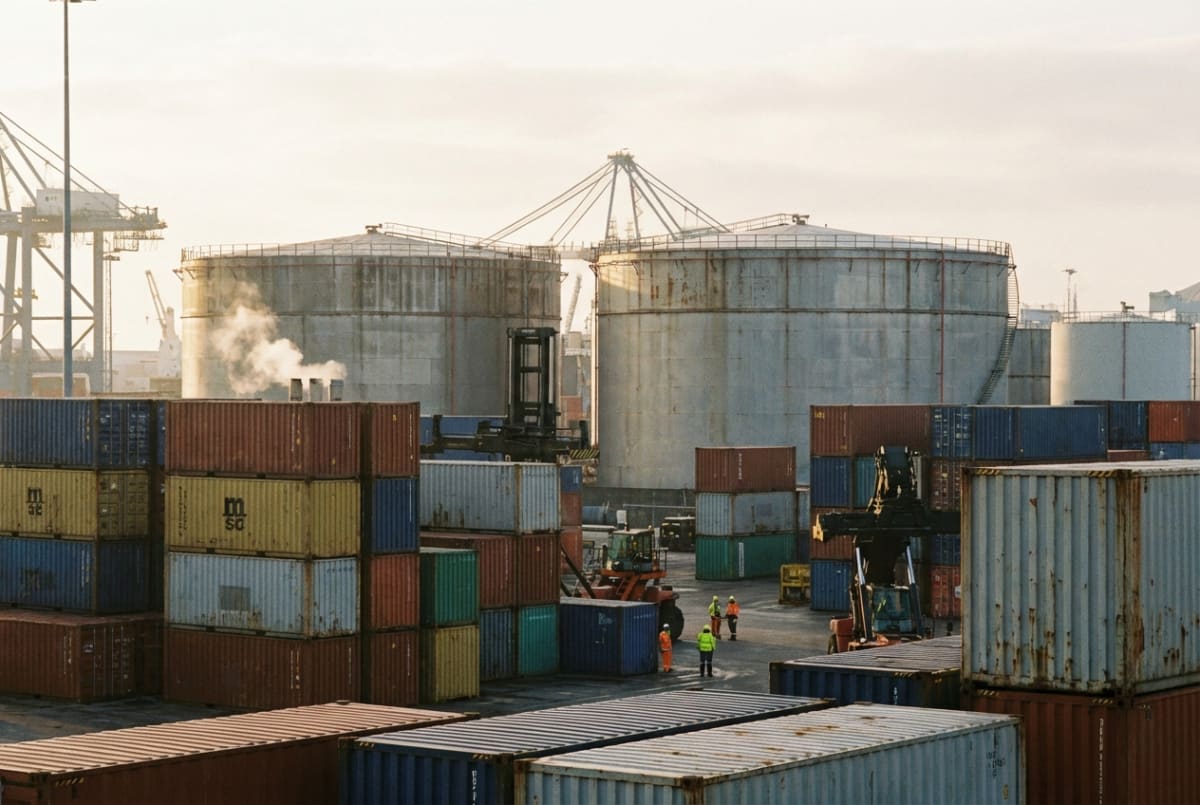
In the corridors of Australia's Treasury and the trade ministries of Canberra, the preferred narrative runs something like this: the relationship with China is stabilising, barley and wine are flowing again, and the worst of the trade war is behind us. In Beijing's Ministry of Commerce, officials tell a different story. They point to diversifying iron ore sources, manufacturing self-sufficiency, and a deliberate strategy to reduce dependence on Australian commodities.
TLDR
Australia's bilateral trade surplus with China has fallen from USD $45 billion to $19 billion since 2021, driven by declining commodity exports and rising manufactured imports. Iron ore shipments dropped for the second consecutive year while Chinese machinery, electronics, and transport equipment now account for two-thirds of Australian imports from China. The classic commodities-for-manufactures exchange continues, but with shrinking buffers.
KEY TAKEAWAYS
Both narratives contain truth. But the numbers tell a third story, one that neither government is particularly eager to discuss: Australia's bilateral trade surplus with China has collapsed from USD $45 billion in 2021 to approximately $19 billion in 2025. That is a 58% decline in four years.
The Australian view: export values are softening
From Canberra's perspective, the headline concern is export revenue. At its 2021 peak, Australia shipped $118 billion worth of goods to China annually. By 2025, that figure has fallen to roughly $102 billion. Some of that decline reflects softer commodity prices. Iron ore averaged USD $92 per tonne in the first quarter of 2026, down from the $160-plus highs of 2021. But volume is weakening too.
Iron ore exports to China dropped 2% last year, marking the second consecutive year of decline. For an economy that still concentrates 80-85% of its China-bound exports in minerals and energy, this is not a rounding error.
Structural shifts in China and changing global supply chains are pushing Australian exporters to diversify. The concentration in resources has always been a vulnerability. What's changed is that the vulnerability is now materialising.
— Commonwealth Bank of Australia, Economic Outlook, February 2026
CBA economists are not alone in sounding cautious notes. The broader context includes China's slowing economy, rising debt levels, property sector distress, and an ageing population that is softening domestic demand for construction materials. None of these factors are temporary.
The view from China: diversification is deliberate
What Australian analysis often misses is the strategic intent behind these numbers. China imported over 1.1 billion tonnes of iron ore in the first eleven months of 2025, up 1.4% year-on-year. The volume is not falling. But the source mix is shifting.
In Mandarin financial media, the term commonly used is "供应链分散化" (gōngyìng liàn fēnsàn huà), supply chain diversification. This is not a slogan but a policy directive. Chinese steel mills have been directed to increase purchases from Guinea, Brazil, and domestic sources where possible. The Simandou project in Guinea, backed by Chinese and Singaporean capital, is expected to ship 60 million tonnes annually by 2028.
From Beijing's perspective, reducing dependence on Australian iron ore is both economic prudence and geopolitical insurance. The 2020-2021 trade tensions demonstrated that Australia could not be treated as a reliable supplier under certain political conditions. Chinese policymakers drew conclusions.
The import side: where Australia is becoming more dependent
While Australian exports to China have declined, imports have moved in the opposite direction. Australia imported $73 billion worth of Chinese goods in 2021. By 2025, that figure reached $83 billion, a 14% increase over the period.
The composition tells the story. Machinery, electronics, and transport equipment now account for approximately two-thirds of Australian imports from China. This includes solar panels, battery components, electric vehicles, telecommunications equipment, and industrial machinery.
- Machinery and mechanical appliances: $19.2 billion (up 22% since 2021)
- Electrical machinery and equipment: $17.8 billion (up 18%)
- Vehicles and transport equipment: $8.4 billion (up 31%)
- Furniture, bedding, lighting: $4.1 billion (steady)
- Plastics and articles: $3.7 billion (up 8%)
The surge in vehicle imports reflects the BYD and MG effect. Chinese automakers captured 8.4% of the Australian new car market in 2025, up from effectively zero five years earlier. But the dependence runs deeper than consumer products. Australian manufacturing, construction, and renewable energy deployment all rely on Chinese-made components and machinery.
The structural shift: manufacturing moves, but not where Australia expected
One of the more optimistic Australian narratives holds that supply chain diversification away from China will benefit Australian exporters. If Apple and Samsung are moving factories to Vietnam and India, surely Australian minerals will follow?
The reality is more complicated. Manufacturing diversification to Southeast Asia and Mexico is reducing the flow of Australian inputs through China. Vietnam and Thailand use less iron ore per unit of GDP than China's construction-heavy economy. The regional shift in manufacturing is not a simple substitution that benefits Australian commodity exporters.
Asia excluding China now accounts for more than 8% of Australian production demand. That sounds like diversification, but it's coming off a very low base. The mathematics of replacing China are brutal.
— Macquarie Bank, Commodities Outlook, January 2026
Macquarie's commodity analysts forecast a 200 million tonne iron ore surplus over the 2026-2028 period. That projection assumes current production levels and weakening demand from China. It does not assume a global recession or further deterioration in Chinese property markets.
ChAFTA 2.0: the green supply chain question
Diplomatic and trade officials on both sides are engaged in discussions about updating the China-Australia Free Trade Agreement. The phrase used in briefings is "ChAFTA 2.0" and the focus is green supply chains.
Australia produces lithium, rare earths, and other minerals essential for batteries and renewable energy. China dominates the processing and manufacturing of those same materials into finished products. In theory, there is complementarity. In practice, the negotiating positions are not aligned.
Australia wants to move up the value chain and process more minerals domestically. China wants continued access to raw materials without enabling Australian industrial competition. Neither position has shifted meaningfully in eighteen months of discussions.
What the surplus decline means
The shrinking trade surplus is not a crisis in isolation. Australia still runs a surplus. It still sells more to China than it buys. But the buffer is narrowing at both ends, with exports falling and imports rising, and the trajectory is not reversing.
For Australian policymakers, the strategic implications are twofold. First, the concentration in minerals and energy exports means Australia's China revenue is tied to Chinese construction and steel production, both of which face structural headwinds. Second, the rising import dependence on Chinese manufactured goods creates its own vulnerabilities.
The classic commodities-for-manufactures exchange that has defined the bilateral relationship for two decades continues. But the terms are shifting. China is paying less for Australian rocks while Australia is paying more for Chinese machines. The trade surplus that once looked like a permanent structural feature of the relationship is starting to look like something that requires active management.
Australian reliance on Chinese export supply chains has halved since 2018, and the West now accounts for a larger share of Australian exports than China. But the import side tells a different story. The relationship is not decoupling symmetrically.
SOURCES & CITATIONS
FREQUENTLY ASKED QUESTIONS