
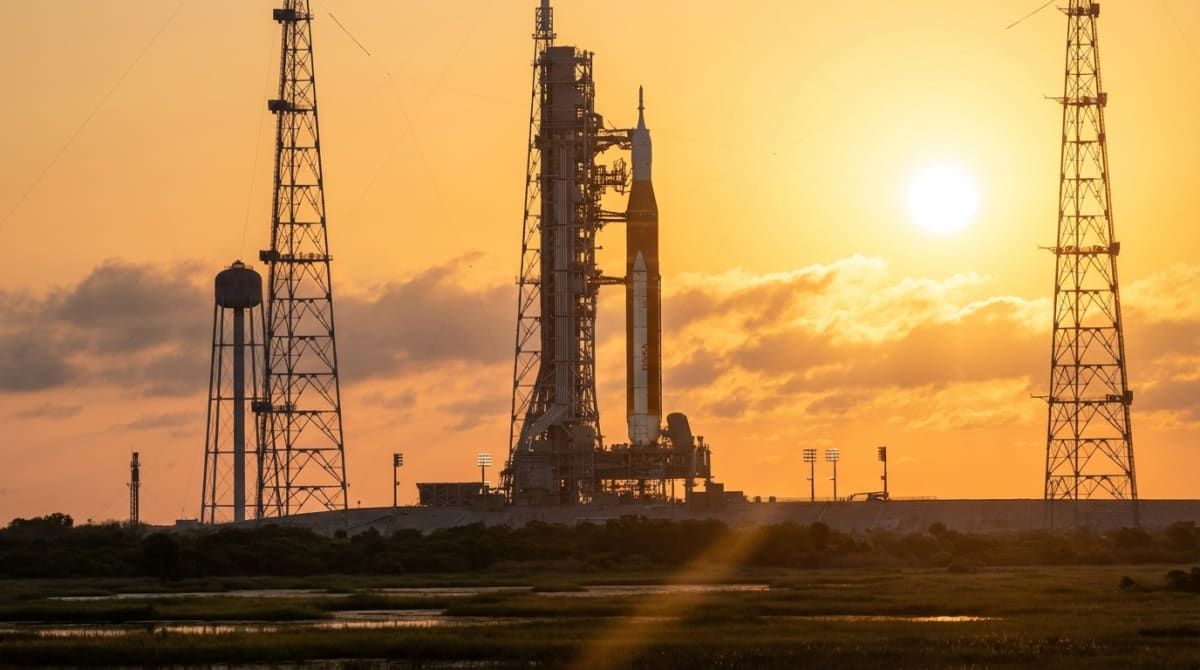
The Space Launch System lifted off from Kennedy Space Center at exactly 11:15 am local time on Wednesday. The launch sent four astronauts on a 10-day trajectory around the Moon. This marks the first crewed lunar flight in 54 years and pushes NASA into the next phase of deep space exploration. The mission cost the agency more than $23 billion in development, and each subsequent launch of this rocket carries a price tag of $4 billion.
TLDR
NASA launched the Artemis II mission on April 1, sending four astronauts on a 10-day lunar flyby. The mission marks the first crewed flight beyond low Earth orbit in 54 years.
Donald Trump addressed the United States regarding Iran at the exact hour the rocket cleared the launch tower in Florida. The split-screen broadcast aired across major networks and highlighted competing national priorities.
The Crew and the Flight Profile
Commander Reid Wiseman leads the mission after previously serving as Chief of the Astronaut Office.
Victor Glover serves as the pilot and is the first Black astronaut to fly to the Moon. Glover spent 168 days in space during Expedition 64.
Christina Koch is a mission specialist who holds the record for the longest single spaceflight by a woman. Koch is now the first woman assigned to a lunar mission.
Jeremy Hansen represents the Canadian Space Agency on the flight. Canada secured the seat by contributing the Canadarm3 robotic system to the planned Lunar Gateway station.
The Orion capsule will not enter lunar orbit during this flight. The spacecraft follows a free-return trajectory that will fly 10,427 kilometres beyond the far side of the Moon. Earth's gravity will naturally pull the spacecraft back toward home. The mission tests the life support systems ahead of Artemis III, which plans to put humans directly on the lunar surface.
Australia's Role in the Deep Space Network
The physical rocket launched from Florida, but the data flows directly through Australia. The Canberra Deep Space Communication Complex is tracking the Orion capsule from its location in the Tidbinbilla valley outside the Australian capital. It operates as one of three primary stations in NASA's Deep Space Network.
The Canberra station took primary control of communications 12 hours after launch. The facility uses a 70-metre antenna to receive telemetry and voice communications while transmitting commands back to the spacecraft.
The tracking station represents a supply chain of data. Australia provides geographic positioning and infrastructure support while the United States provides the hardware. This relationship has existed since the Apollo missions and remains a central pillar of the bilateral space agreement.
The political climate in Washington threatens this stability as the new administration views international partnerships through a transactional lens. The $23 billion cost of the SLS program is a clear target for budget cuts. If Artemis III is delayed or cancelled, the data supply chain through Canberra sits completely idle.
The Economics of the Artemis Programme
The Artemis programme operates as a financial anomaly in a sector where commercial companies are driving launch costs toward zero. SpaceX and Blue Origin are building reusable architectures designed for frequent flights. NASA built a disposable rocket using refurbished Space Shuttle engines that are intentionally destroyed.
The four RS-25 engines on the Artemis II core stage flew on 14 separate shuttle missions before this week. They fall into the ocean after launch and are not recovered for future use.
The Artemis programme relies on a fragmented manufacturing model that spreads production across multiple states. The core components come from four primary contractors:
- Boeing manufactures the core stage at the Michoud Assembly Facility in Louisiana.
- Lockheed Martin builds the Orion crew capsule at facilities in Colorado and Florida.
- Aerojet Rocketdyne refurbishes the RS-25 engines at the Stennis Space Center in Mississippi.
- Northrop Grumman produces the solid rocket boosters in Utah before shipping them across the country.
These companies rely on cost-plus contracts that pay them for their expenses plus a guaranteed profit margin. This contracting structure removes the incentive to innovate and rewards complexity across the manufacturing base. The political logic secures votes across congressional districts, even as the economic logic collapses under the weight of the supply chain.
KEY TAKEAWAYS
SOURCES & CITATIONS
FREQUENTLY ASKED QUESTIONS