
TLDR
NASA's Artemis II mission broke Apollo 13's 56-year record for the farthest distance humans have travelled from Earth, reaching 252,756 miles during a lunar flyby on April 6. The four-person crew includes the first woman, first person of colour, and first non-American to fly around the Moon. They completed their closest approach at 4,067 miles above the lunar surface and are returning to Earth.
KEY TAKEAWAYS
The record Apollo 13 set in April 1970 had always felt accidental. Jim Lovell and his crew didn't travel 248,655 miles from Earth on purpose. An oxygen tank had exploded, and they needed the lunar gravity to slingshot them home. For 56 years, that involuntary trajectory held the record for the farthest humans had ever been from Earth.
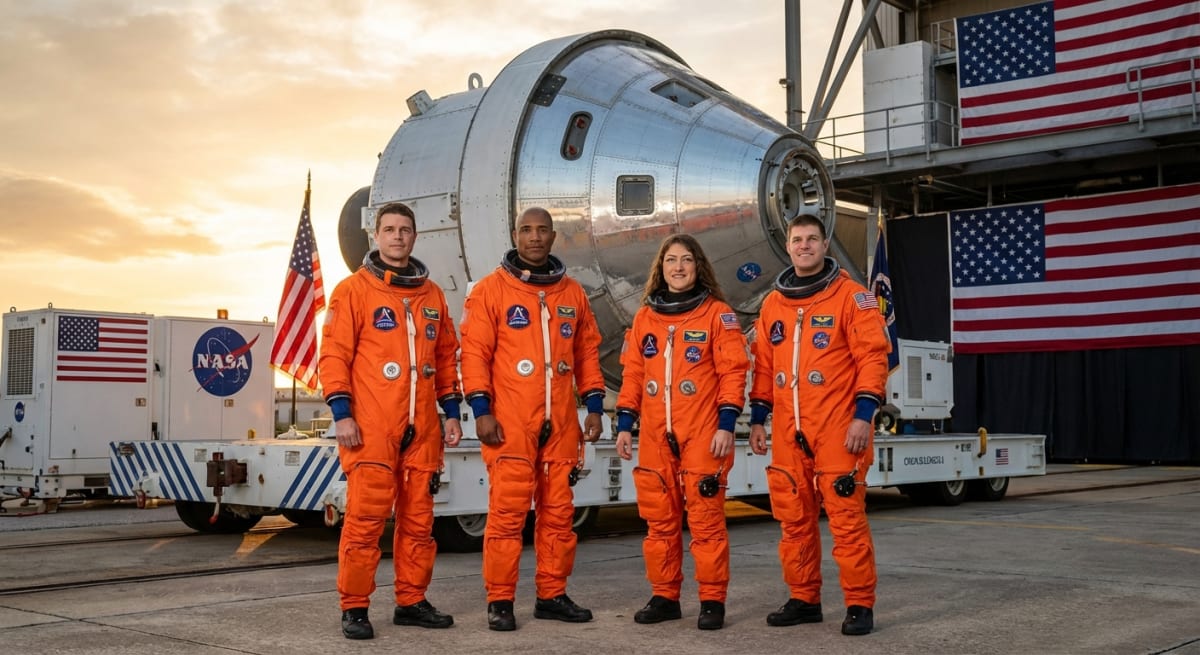
On Monday, April 6, NASA's Artemis II crew beat it. At their maximum distance, Reid Wiseman, Victor Glover, Christina Koch, and Jeremy Hansen were 252,756 miles from Earth, 4,111 miles farther than Lovell, Jack Swigert, and Fred Haise managed in a crippled spacecraft using manual calculations on a slide rule. The Artemis crew had the Orion capsule's digital guidance system, four operational engines, and a mission designed to go exactly this far, and the record holds regardless.
What Actually Happened Technically
Orion reached its closest approach to the Moon at 4,067 miles above the lunar surface, travelling at approximately 60,863 miles per hour relative to Earth. At that speed, the spacecraft covered a distance equivalent to Sydney to London in about three minutes. The crew flew over parts of the Moon's far side, the hemisphere that permanently faces away from Earth, and became the first humans in history to see those features with the naked eye rather than through a camera lens or photograph.
NASA confirmed the crew "eclipses record for farthest human spaceflight," noting the Orion capsule also set a record for the most people in deep space simultaneously at four, beating Apollo 8's three-person crew from 1968.
On the shoulders of giants... 🧑🏼🚀
— NASA (@NASA) April 7, 2026
The Artemis II crew aboard Integrity have officially traveled farther into space than any humans before, passing the record set during Apollo. Our live coverage continues:https://t.co/do2p0Gvxdu
NASA on X — April 6, 2026
New record🥇
— NASA Earth (@NASAEarth) April 6, 2026
The Artemis II astronauts are now farther from Earth than humans have ever been! At 1:57 p.m. EDT, they broke the record set by Apollo 13 in 1970.
Their journey around the far side of the Moon today will take them a maximum distance of 252,752 miles from Earth. pic.twitter.com/P5Swojpn0n
NASA Earth on X — April 6, 2026
Orion used the Moon's gravity to alter its trajectory, the same principle Apollo 13 relied on in 1970, but controlled and planned rather than desperate. The free-return trajectory requires no propulsion to execute once the spacecraft is on the right approach path. The Moon's gravity bends the orbit and sends Orion back toward Earth. Mission Control confirmed the burn was clean, and the crew are inbound.
The Records Worth Noting (and One Worth Questioning)
NASA has framed Artemis II as a mission of firsts. Victor Glover is the first person of colour to fly around the Moon, Christina Koch is the first woman, and Jeremy Hansen is the first non-American. All genuine firsts worth noting. The record for most people in deep space simultaneously, four versus Apollo 8's three from 1968, is also real, though 'deep space' here means beyond low Earth orbit, which is how NASA uses the term.
The thing that deserves a closer look is what Artemis II did not do. Unlike Apollo, this mission carries no lunar lander. The crew did not orbit the Moon multiple times or descend to the surface. Artemis II is a shakedown flight for the Orion capsule: its job is to verify that human-rated deep space hardware works before NASA attempts Artemis III, which will land astronauts on the lunar south pole. The distance record is real. The mission is also, in engineering terms, a test flight. Calling it a moon mission in the Apollo sense would overstate it.
That said, the hardware test is the point. The Orion capsule is the most complex spacecraft NASA has built since the Space Shuttle, with life support, radiation shielding, and re-entry systems designed for multi-week deep space missions. If Monday's flyby revealed any anomalies, NASA needs to know now, not during Artemis III when two crew members are descending to the lunar surface.
Why This Matters Beyond the Record Books
The 54-year gap between Apollo 17 in 1972 and Artemis II in 2026 is long enough that most people alive today have no direct memory of humans travelling beyond low Earth orbit. For the international crew, Hansen is the first Canadian to fly beyond Earth orbit, Monday's flyby represents a genuine expansion of human spaceflight. Canada's contribution to the Artemis programme, including the Canadarm3 for the future Gateway lunar space station, earned Hansen's seat. That is a straightforward example of what multilateral space cooperation can produce.
"This is an unbelievable experience," Wiseman told Mission Control during the lunar flyby, according to NASA's live updates. "The Moon looks incredible from here."
The return trajectory brings Orion through the Van Allen radiation belts, one of the re-entry system checks NASA most wants to complete. High-energy particle exposure is a key concern for longer missions to the Moon and for any eventual Mars mission. Artemis II's radiation dosimetry data will inform crew exposure limits for every deep space mission that follows it.
What Comes Next
Orion is expected to splash down in the Pacific Ocean later this week. If the mission closes without anomalies, Artemis III moves to its targeted 2027 launch window. The SpaceX Starship human landing system, which will carry two crew members from lunar orbit to the surface, completed its final uncrewed landing test in late 2025. The schedule is tight but no longer obviously unrealistic.
Whether Artemis establishes a permanent human presence on the Moon, or becomes another Apollo, a series of brilliant missions followed by decades of no follow-through, depends on funding, political continuity, and whether the Gateway station gets built. Apollo 13's record stood for 56 years. The programme that broke it did not continue. Artemis II broke that record on Monday. The question is whether anyone will break Artemis II's.
SOURCES & CITATIONS
- NASA | NASA's Artemis II Crew Eclipses Record for Farthest Human Spaceflight
- NASA Mission Blog | Artemis II Flight Day 6: Lunar Flyby Updates
- CBS News | Artemis II crew completes record-breaking trip around moon, now on path back toward Earth
- CNN | Live updates: Artemis II astronauts break Apollo record on historic moon flyby
- NPR | Watch live: NASA's Artemis II crew flying around the moon today
- Houston Public Media | NASA's Artemis II mission sets record as it flies by the moon
FREQUENTLY ASKED QUESTIONS