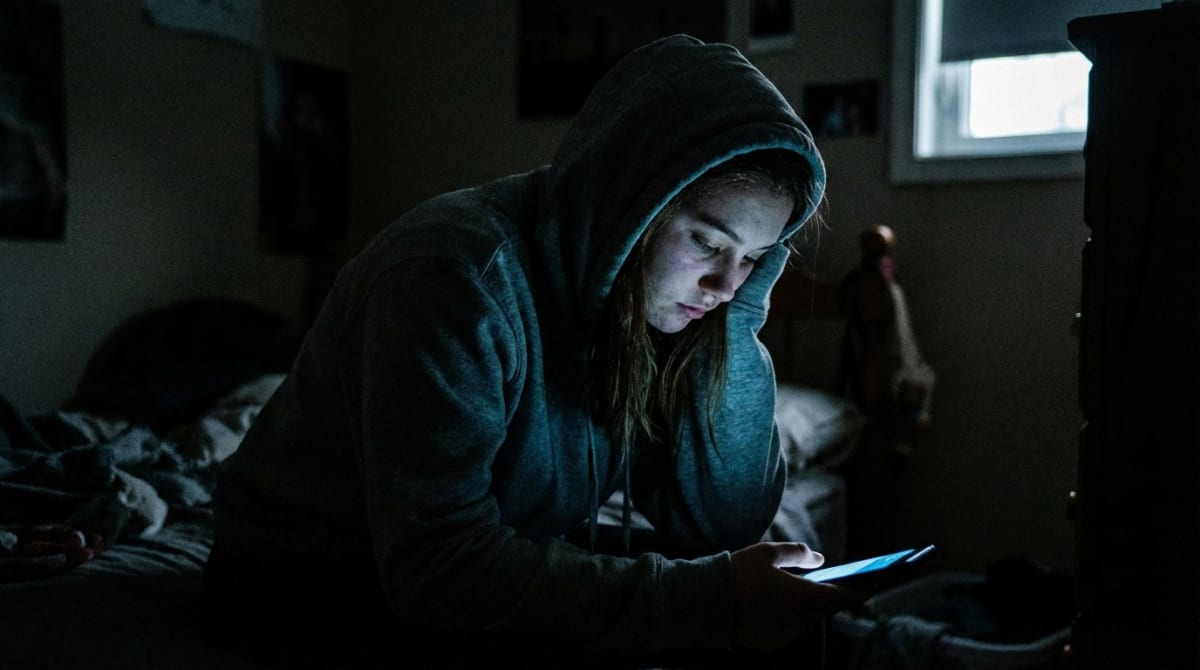
A quarter of American teenagers aged 13 to 14 spend seven or more hours each day on social media. When researchers from the World Happiness Report surveyed these heavy users alongside their peers who scroll for under an hour, the wellbeing gap between the two groups was stark enough to shift population-level measures of mental health.
TLDR
The World Happiness Report 2026 presents data from 47 countries linking heavy social media use to declining teen wellbeing, with teenage girls in Western nations most affected. Teens using platforms for seven or more hours daily report significantly lower life satisfaction than those using them for under an hour. Australia remains at 15th in the global rankings, outside the top 10 for a second consecutive year.
KEY TAKEAWAYS
The 2026 report, released this week by the Oxford Wellbeing Research Centre and the UN Sustainable Development Solutions Network, dedicates two chapters to examining how algorithmically-driven platforms are reshaping adolescent psychology. The findings arrive as Australia's social media age restrictions take effect and other countries weigh similar measures.
What the numbers show
Across 47 countries with comparable data, teenagers who used social media heavily reported life satisfaction scores roughly 0.8 points lower on a 10-point scale than their peers who used platforms lightly. To put that in perspective: the wellbeing gap between employed and unemployed adults is typically around 0.6 points.
The Pew Research Center's 2024 survey of US teens found that 34% of girls and 20% of boys said social media makes them feel worse about their own lives. Among teenage girls specifically, one in four said social media harms their mental health, and half said it disrupts their sleep.
The harms and risks to individual users are so diverse and vast in scope that they justify the view that social media is causing harm at a population level.
— Jonathan Haidt, World Happiness Report 2026
The researchers found a counterintuitive pattern in the data. Young people who used social media for under one hour daily actually reported higher wellbeing than those who avoided platforms entirely. The optimal dose appears to be minimal use rather than zero use, suggesting complete abstention carries its own social costs.
Why English-speaking countries are different
The correlation between heavy social media use and poor wellbeing varies substantially by region. In the United States, Canada, Australia, and New Zealand, the negative associations are particularly strong. In Latin America and the Middle East, the same hours of use correlate with smaller wellbeing drops.
Jan-Emmanuel De Neve, an Oxford economics professor who co-edits the report, suggested this may relate to how social media interacts with existing social structures. In cultures where face-to-face community ties remain strong, heavy phone use appears less damaging than in societies where digital interaction has more fully replaced in-person connection.
For the second consecutive year, no English-speaking country appeared in the top 10, with Australia holding steady at 15th while the United States came in at 23rd, Canada at 25th, and the UK at 29th. Finland claimed the top spot for the ninth year running, followed by Iceland, Denmark, Costa Rica, and Sweden.
The teenage girl problem
A decade of workplace research on gender differences in how people experience stress tells a consistent story: men and women report similar levels of workplace pressure, but women are more likely to internalise that pressure as self-criticism. The social media data follows a remarkably similar pattern.
Teenage boys and girls in Western countries use social media for roughly similar amounts of time, yet the mental health impacts diverge along gender lines that researchers are still working to explain. In the Pew surveys, girls were nearly twice as likely as boys to say social media makes them feel worse about their own lives, and they were also more likely to report that platforms hurt their confidence and disrupted their sleep.
The mechanisms behind this gap are reasonably well understood at this point. Instagram and TikTok expose teenage girls to a curated stream of idealised bodies, faces, and lifestyles, filtered and edited to impossible standards, and then serve algorithmically amplified content about diet culture, cosmetic procedures, and wellness trends that often promote disordered eating. Boys are not immune to comparison effects, but the platforms appear to serve them somewhat less appearance-focused content.
What workplaces should understand
The Gen Z workers now entering Australian offices and job sites are the first cohort to have spent their entire adolescence with smartphones and social media. Managers complaining about young workers' attention spans or anxiety levels may be observing real differences, but those differences have structural causes.
The average US teenager now spends nearly five hours daily on social media: roughly two hours on YouTube, 90 minutes on TikTok, and an hour on Instagram. That time investment during the years when brains are most plastic and habits most formative shapes how people process information, tolerate boredom, and manage emotional discomfort.
The implication here is not that employers should lower expectations for young workers but rather that they should understand what they are working with. A 22-year-old who spent ages 12 to 18 receiving algorithmically optimised dopamine hits every few seconds will likely struggle with tasks requiring sustained focus in ways that a 45-year-old did not at the same age. This is a training and support challenge, not a moral failing.
The policy response
Australia raised the minimum age for social media platforms from 13 to 16 late last year, with enforcement beginning in 2026. Denmark, France, and Spain are considering similar restrictions. The World Happiness Report's authors explicitly note that their findings are intended to inform policymakers weighing such measures.
The effectiveness of age restrictions remains an open question, given that previous attempts to enforce minimum ages have failed and determined teenagers have consistently found workarounds. The report's authors suggest that the more effective intervention may be changing platform design itself, distinguishing between algorithmically-curated feeds that show negative associations with wellbeing and connection-focused features that show positive associations.
Young people who use social media for less than one hour per day report the highest levels of wellbeing, higher than those who do not use social media at all.
— World Happiness Report 2026
What remains, and what policy alone cannot solve, is the collective action problem: individual parents who restrict their children's social media access impose social costs on those children, who may feel excluded from peer conversations and group chats. The report notes that in surveys, many teenagers say they would prefer reduced access if everyone reduced access simultaneously, which suggests the problem is coordination rather than preference.
What comes next
The World Happiness Report's authors are explicit about their position. They came to this research having written The Anxious Generation, a book arguing that social media poses significant risks to young people. They describe themselves as making the case for the prosecution, and they note the existence of researchers who disagree and encourage readers to engage with opposing views.
Academic debates about causation versus correlation will continue for years, but the 2026 data adds weight to what parents, teachers, and clinicians have observed anecdotally since the mid-2010s. The platforms that promised to connect people are, for a substantial subset of young users, making them lonelier and more anxious, and whether Australia's policy response proves effective, the underlying diagnosis appears increasingly settled.
SOURCES & CITATIONS
FREQUENTLY ASKED QUESTIONS