If you view Wimbledon as a legacy software system rather than a sporting event, its defining characteristic is resistance to updates. The code has run largely unchanged for 148 years, and when patches do arrive in the form of roofs, tie-breaks, or electronic lines, they are deployed only after the other three Grand Slams have completed exhaustive beta testing.
TLDR
Wimbledon will introduce video review technology on six courts for the 2026 tournament, allowing players to challenge judgment calls like double bounces and net touches with no limit on the number of reviews. The system operates independently from the Electronic Line Calling infrastructure introduced in 2025. The move brings Wimbledon into line with the US and Australian Opens after 148 years of relying on human judgment for these calls.
KEY TAKEAWAYS
On Saturday, the All England Club announced the final refactoring of its officiating protocol, with video review technology going live on six courts for the tournament beginning June 29. This is not a line-calling system but rather an error-correction layer for the chaotic physical edge cases that Hawk-Eye cannot see: double bounces, net touches, hindrances, and the contentious 'not-up' calls that have generated controversy at previous Championships.
The architecture of unlimited challenges
The implementation details reveal a significant divergence from previous officiating logic. Since 2006, the Hawk-Eye challenge system has operated on a scarcity model where players received three incorrect challenges per set, gamifying the pursuit of truth by forcing players to weigh the probability of an error against their remaining inventory.
The new video review protocol removes this inventory cap entirely, placing no limit on the number of reviews a player can request. If a player believes the ball bounced twice, they signal for a review, the Chair Umpire consults a screen, and the decision is rendered in binary form before play proceeds. This shift changes the unit economics of a dispute fundamentally.
Previously, the cost of a frivolous challenge was high because players risked depleting a scarce resource. Under the new system, the only cost is time, and that trade-off acknowledges that judgment calls are rare, high-leverage events where the cost of a mistake outweighs the cost of a brief delay. The model suggests that the All England Club studied the US Open's implementation data before committing to the unlimited approach.
The introduction of video review covers those instances that electronic line calling does not. It allows us to assist the Chair Umpire in making the correct decision on specific judgment calls.
— Sally Bolton, Chief Executive, All England Club
Patching the user interface
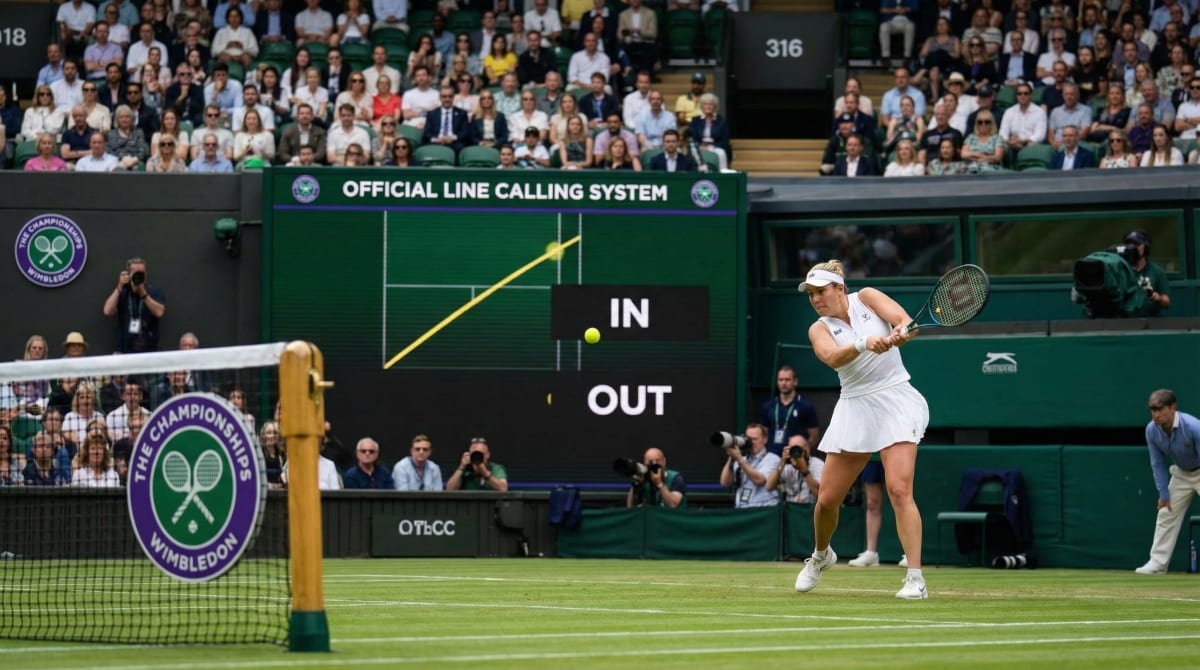
The rollout also addresses a specific user experience failure from the 2025 tournament, when Wimbledon replaced human line judges with Electronic Line Calling but failed to communicate decisions clearly. Players and fans often did not know why play had stopped, and while the system was accurate, the communication layer was opaque.
The 2026 iteration adds a visual feedback layer in the form of scoreboard indicators that will display explicit 'OUT' and 'FAULT' calls triggered by the system. This is a small UI fix that closes the latency gap between the machine's decision and the crowd's understanding, bringing Wimbledon closer to the broadcast-friendly presentation that the US Open has refined over several years.
The pattern is familiar from enterprise software deployments where the initial technical implementation works correctly but the user interface requires iteration based on production feedback. The All England Club is now applying that iteration process to a stadium environment where 15,000 spectators constitute the user base.
Deployment strategy
The rollout follows a standard enterprise deployment pattern by securing the critical nodes first. The technology will cover Centre Court and No. 1 Court for all matches, plus No. 2, No. 3, Court 12, and Court 18 for singles. This ensures that matches with the highest viewership and revenue impact have the highest integrity guarantees.
Technologically, the move brings Wimbledon to parity with the US Open, which debuted video review in 2023, and the Australian Open, which adopted similar technology the following year. The delay was a feature rather than a bug, because by waiting, the All England Club avoided the early implementation glitches seen in New York and adopted a mature, stable version of the stack.
The result is a system where the Chair Umpire's role transitions further from arbiter of reality to administrator of process. They no longer need to see the double bounce with human eyes but only need to manage the process of verifying it through recorded footage. The human judgment that defined tennis officiating for over a century has been abstracted into a review workflow.
Implications for the officiating stack
The combination of Electronic Line Calling and video review creates a two-tier officiating architecture. The first tier handles the high-frequency, deterministic decisions about whether a ball landed in or out, and this runs automatically without human intervention. The second tier handles the low-frequency, judgment-based decisions about physical infractions, and this runs on-demand through player-initiated review requests.
This architecture mirrors patterns seen in other sports officiating technology. Cricket's Decision Review System separates automated edge detection from umpire judgment on lbw appeals. Football's VAR system separates goal-line technology from subjective foul assessment. Tennis is converging on a similar hybrid model where automation handles what can be automated and video review handles the rest.
For fans and players, the practical impact is reduced controversy over officiating errors at the highest-profile matches. For technology observers, the implementation represents another data point in the systematic replacement of human judgment with machine verification across professional sports, a trend that shows no signs of reversing regardless of traditionalist objections.
SOURCES & CITATIONS
FREQUENTLY ASKED QUESTIONS