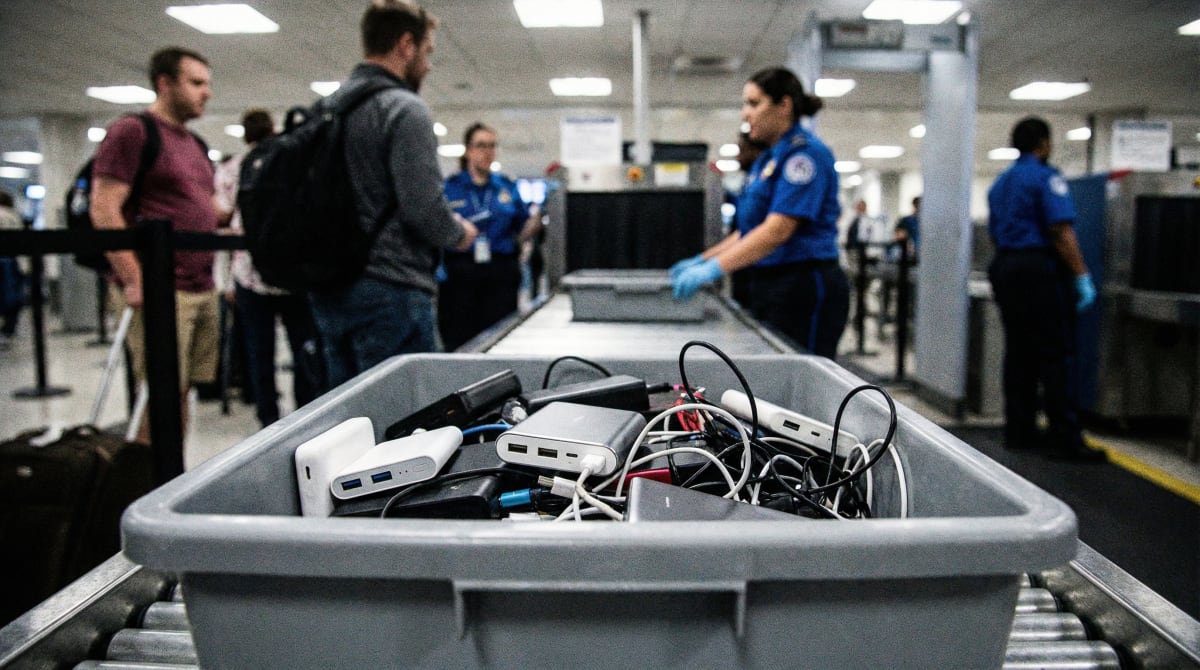
Picture this: you're at Sydney Airport on Easter weekend, three power banks packed in your carry-on for the family trip. Your kids burn through phone battery faster than you can say "are we there yet," so you came prepared. Security stops you at the checkpoint and tells you only two can go through, while the third gets confiscated on the spot. That's your $50 Anker gone forever.
KEY TAKEAWAYS
The International Civil Aviation Organization changed the rules on March 27, capping passengers at "two power banks per person on all flights worldwide with no in-flight charging allowed under any circumstances," according to the official ICAO announcement. The rules apply across all 193 member countries, which affects everyone flying anywhere this Easter break and beyond.
What actually changed
ICAO's new regulations set a hard limit: "two power banks maximum in your carry-on luggage, with none allowed in checked bags," which was always prohibited though now there's an explicit cap on carry-on quantities too. "Passengers can't recharge devices using a power bank during any flight," the rules say, even on the 14-hour Sydney-to-Los Angeles haul when a toddler's iPad hits 2% three hours before landing.
Airlines are enforcing strict visibility requirements. "Power banks must remain visible and accessible throughout the flight," Qantas said in their December announcement, with some carriers banning overhead bin storage completely. Policies vary by carrier, so travelers should double-check specific airline requirements before departure to avoid last-minute hassles at the gate.
The safety crisis behind the rules
Lithium batteries don't catch fire often, though when they do the consequences are serious enough to ground aircraft and endanger passengers. The US Federal Aviation Administration recorded "552 separate incidents involving lithium-ion batteries between March 2006 and November 2025," with "73% of those cases involving portable electronics like power banks that passengers brought on board," according to FAA data cited by Aviation Week.
Virgin Australia experienced the tipping point in July 2025 when "a power bank ignited inside the overhead locker of a Boeing 737 while passengers were still boarding," as ATSB reported. Crew extinguished the fire quickly without injuries, yet the incident sent alarm bells ringing through global aviation safety bodies who had already been tracking a worrying upward trend in battery-related events.
The new specifications will address emerging risks... These improvements reflect ICAO's continuing commitment to enhancing aviation safety.
— ICAO official announcement
Air Busan suffered an even worse fate in January 2025: the carrier's Airbus A321 was completely destroyed on the ground in South Korea after a lithium battery fire erupted during routine maintenance, resulting in the total loss of the aircraft. ICAO decided the pattern had become untenable. Two power banks per passenger, no in-flight use, rules effective immediately on March 27.
Australian airlines moved faster than the rest of the world
Qantas and Virgin Australia banned in-flight power bank usage in December 2025, several months before the UN mandate officially kicked in globally. Both carriers conducted full internal safety reviews following the July Virgin fire, consulted closely with the International Air Transport Association about emerging battery risks, and anticipated that ICAO would implement stricter regulations within months.
The changes are informed by planned updates from the International Civil Aviation Organisation (ICAO), expected in 2026.
— Qantas spokesperson, December 2025 announcement
Anyone who's flown domestically in Australia since December has already adapted to these restrictions without realizing they were ahead of the international curve. What felt like a local policy shift is now the standard for every flight worldwide.
How to pack and travel under the new rules
Pack a maximum of two power banks in your carry-on luggage only. Checked baggage remains off-limits for any lithium batteries. "Each power bank needs to stay under 100 watt-hours," according to ICAO's technical instructions, though most consumer models already comply with this threshold without issue.
If you're unsure about your power bank's capacity, the calculation is straightforward: "multiply the milliamp-hours by the voltage, then divide by 1000 to get watt-hours," as TSA guidance explains. A typical 27,000mAh power bank operating at 3.7V works out to roughly 99.9Wh, just under the cutoff, which is why popular brands like Anker size their products this way.
Keep your power banks visible and accessible during the flight instead of shoving them deep into the overhead bin. "Some airlines now prohibit overhead storage for these devices completely," notes Aviation Week's safety coverage. Do not plug your phone into a power bank mid-flight under any circumstances. Crew will instruct you to stop immediately, and some airlines may issue warnings or flag your passenger record for repeated violations.
Penalties for breaking the rules
Airport security will confiscate any power banks beyond the two-unit limit at the checkpoint, with no option to retrieve them later or ship them home. Anker's popular 20,000mAh models cost between $40 and $60, so that's money gone if travelers show up with three.
Flight crew will issue a verbal warning on the first offense if they spot passengers attempting to charge devices with a power bank during the flight. Airlines log formal warnings in their systems for passengers who ignore crew instructions, and carriers can restrict future travel for repeat offenders. Policies differ by airline, though no one's willing to risk battery fires for the sake of passenger convenience anymore.
Alternatives that still work
In-seat power outlets remain fully functional where available, which solves the charging problem entirely if aircraft have them installed. Not every plane does, especially on regional routes and older aircraft, so travelers should check seat maps during booking if this matters for their trip.
Pre-flight preparation makes the biggest difference: charge phone, iPad, laptop, wireless earbuds, and any other devices to 100% before boarding. It sounds basic, yet travelers routinely forget this step and regret it six hours into a flight.
Airplane mode dramatically extends battery life when activated immediately upon sitting down, as phones stop constantly searching for cellular signal at 35,000 feet (a process that drains power faster than almost any other function). Fully charged phones last surprisingly long when they're not working overtime trying to connect to nonexistent towers.
Battery cases with integrated power remain legal under ICAO's regulations, though they count toward the two-power-bank limit. Phone cases with built-in batteries get treated exactly like standalone power banks for compliance purposes.
What this really costs you
Anyone booking Easter weekend flights needs to rethink their packing strategy right now. Two power banks maximum, so choose the highest-capacity models you own. A family of four sharing just two power banks across multiple devices and a long flight day isn't an ideal situation, though that's the constraint everyone's working within now.
Long-haul travelers will feel these restrictions most acutely, as 14-hour flights without backup charging become a real endurance test for your devices unless your seat includes built-in power. Check this detail before finalizing your booking if staying connected matters for work or keeping children entertained.
Business travelers who routinely carry multiple devices face hard prioritization choices: two power banks total, so select capacity over quantity and leave the extras at home. The days of traveling with a dedicated power bank for every device are over.
These rules aren't going anywhere. 552 battery fire incidents over 19 years provided regulators with overwhelming evidence that the previous permissive approach created unacceptable safety risks. Australian carriers have already demonstrated that airlines can enforce these limits effectively through existing security checkpoints and onboard monitoring. Expect compliance checks at every stage of your journey from bag scan through landing.
Will your Anker get confiscated at security? Only if you pack more than two.
TLDR
As of March 27, 2026, ICAO limits passengers to 2 power banks maximum per flight. No in-flight charging allowed. Australian carriers (Qantas, Virgin) already enforcing since December 2025 after 552 lithium battery fire incidents.
SOURCES & CITATIONS
- ICAO announces new power bank restrictions for international aviation
- How Large an Onboard Safety Concern Are Device Power Banks?
- Power bank fire highlights importance of passengers keeping lithium battery devices easily accessible
- Qantas and Jetstar to introduce new safety measures for power banks on all flights
FREQUENTLY ASKED QUESTIONS