Police raid Catholic charity over banner
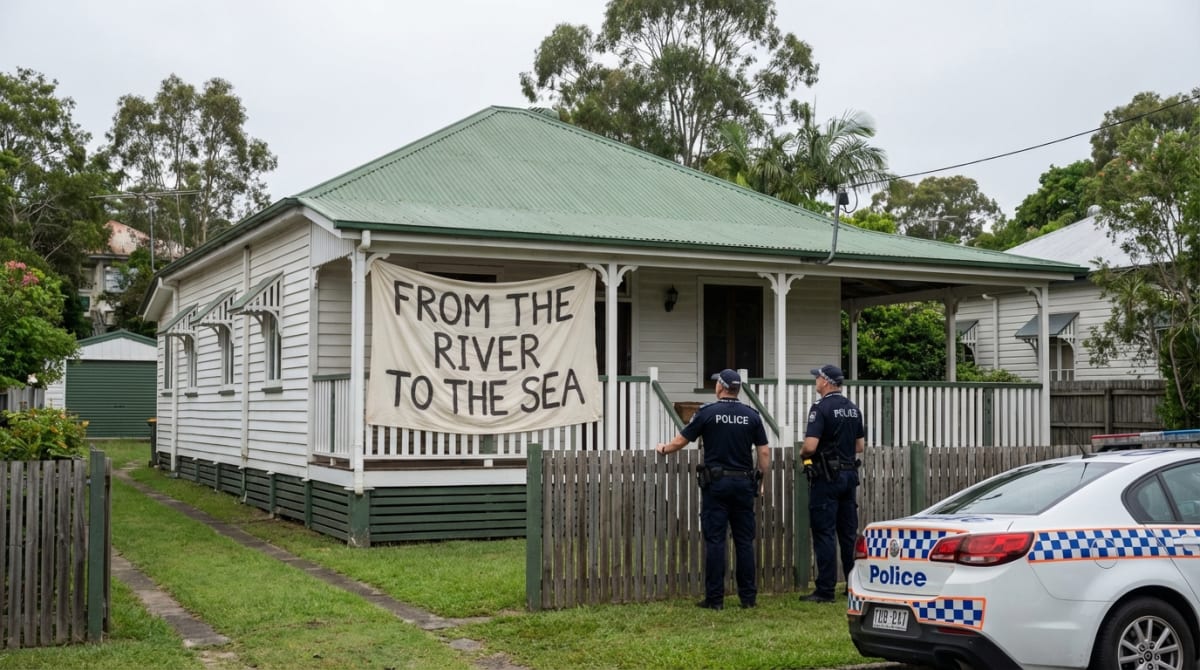
BRISBANE — Queensland Police raided a Catholic charity on Friday morning over a bedsheet banner reading "From the River to the Sea, come get us Crisafulli."
TLDR
Queensland Police raided Dorothy Day House, a Catholic charity in Brisbane, seizing a banner reading 'From the River to the Sea, come get us Crisafulli.' Resident Franz Dowling has not been charged but had his digital devices confiscated. The raid is the first property search under Queensland's new prohibited expression laws.
KEY TAKEAWAYS
Officers from the Security Investigation Team executed a search warrant at Dorothy Day House in Greenslopes at approximately 8:30am on March 20. The organisation, part of the Catholic Worker movement, provides food and emergency housing to homeless people and refugees across Brisbane's south side.
Resident Franz Dowling told reporters that police seized the banner along with his digital devices, including his mobile phone and laptop. Dowling said he had not been charged with any offence but was informed that investigators would contact him with updates in the coming days.
"This new law is terrifying," Dowling said in an interview outside the property following the raid. "This is fascism on the rise, and if we submit to this, if we are cowardly enough to not say these prohibited words, then we are headed to very dark times."
Search warrant cites public offence
The search warrant, which was shown to reporters at the scene, stated that the banner "might reasonably be expected to cause a member of the public to feel menaced, harassed, or offended." The warrant authorised officers to search the premises and seize items deemed relevant to the investigation.
Queensland became the first Australian state to explicitly ban the phrase "From the River to the Sea" when the Criminal Code amendments took effect on March 11. The Criminal Code (Prohibited Expressions) Amendment Act 2026 carries penalties of up to two years imprisonment for breaches. The legislation also bans the phrase "Globalise the Intifada" under similar conditions.
Dowling said police informed him during the raid that people who shared photographs of the banner on social media platforms could also face investigation under the prohibited expression laws. Queensland Police Service declined to confirm or deny this when contacted for comment.
A spokesperson for Queensland Police confirmed officers had executed the search warrant but said they could not provide additional details. "Police from the Security Investigation Team have executed a search warrant at a Greenslopes address today, March 20, as part of an ongoing investigation," the statement read. "The investigation relates to the public display of material being assessed under section 52DA of the Criminal Code, which addresses the public recital, distribution, publication or display of prohibited expressions."
First private property search under new laws
Dorothy Day House is named after Dorothy Day, the American Catholic social activist and journalist who co-founded the Catholic Worker Movement in 1933 alongside Peter Maurin. The Brisbane house has operated for several decades as an informal community providing support to people on the margins of society, including those experiencing homelessness and refugees seeking asylum.
The Catholic Worker movement, which has chapters across the United States, Europe, and Australia, emphasises voluntary poverty, hospitality for the poor, and nonviolent activism. The movement has historically engaged in civil disobedience on issues including war, nuclear weapons, and labour rights.
Friday's raid marks the first documented instance of police searching private property under Queensland's new prohibited expression laws. All previous enforcement actions had targeted public protests and demonstrations.
On March 11, hours after the legislation took effect, police arrested two demonstrators outside Queensland Parliament House during an unauthorised protest. A 33-year-old man was detained after chanting the banned phrase during a speech to gathered activists. An 18-year-old woman was also arrested for wearing a singlet with the slogan printed on the front.
Police released the woman with an adult caution. The man, identified as Students for Palestine organiser Liam Parry, was issued with a Notice to Appear and is scheduled to face Brisbane Magistrates Court on April 8 on charges of recital, distribution, publication or display of prohibited expressions.
Political battle over antisemitism legislation
The Queensland government introduced the prohibited expression laws as part of a package of measures it said were designed to combat antisemitism. Attorney-General Laura Gerber described the banned phrases as "antisemitic dog whistles" when the legislation passed through parliament last week.
The laws received support from both the Liberal National Party government and Labor opposition, passing with minimal parliamentary debate. Queensland Greens MP Michael Berkman was among the few voices opposing the legislation in the chamber.
Responding to the March 11 arrests, Berkman said the enforcement had "all the hallmarks of an authoritarian police state, with the police all too happy to act as the thought police on behalf of the LNP state government." He compared the laws to the anti-protest regime that operated under Premier Joh Bjelke-Petersen during the 1970s and 1980s.
The Queensland Council for Civil Liberties has called the legislation an overreach that threatens free speech protections. The council said the laws were drafted too broadly and could capture legitimate political expression.
The phrase "From the River to the Sea" refers to the geographic area between the Jordan River in the east and the Mediterranean Sea in the west. The full slogan, "From the River to the Sea, Palestine will be free," has been a fixture at pro-Palestinian protests worldwide for decades.
Pro-Palestinian activists argue the phrase is a call for freedom, dignity, and equal rights for all people living in the region. Jewish community organisations, including the Executive Council of Australian Jewry and the Zionist Federation of Australia, argue the phrase implicitly calls for the elimination of the State of Israel and the displacement or worse of its Jewish population.
Premier defends legislation
Premier David Crisafulli defended the laws when speaking to reporters at a press conference last week. "Queenslanders expect their government to stand against antisemitism," Crisafulli said. "These laws send a clear message that hate speech has no place in our state."
When asked whether the laws could be used to target legitimate political speech, Crisafulli said the legislation contained appropriate safeguards. The laws include exemptions for academic and journalistic purposes, meaning media organisations can report on the phrases without risking prosecution.
Dowling told reporters he painted the banner on an old bedsheet after reading about the new legislation in the news. He said he felt compelled to protest what he described as an unjust attack on free speech and political expression.
The banner included a direct challenge to the Premier, reading "come get us Crisafulli" after the banned phrase.
Dowling said he was aware of the legal risks when he hung the banner outside the property but believed civil disobedience was necessary. He referenced the tradition of nonviolent protest within the Catholic Worker movement.
Queensland Police said the investigation is ongoing. No court dates have been set for any matters arising from the Greenslopes raid.
SOURCES & CITATIONS
FREQUENTLY ASKED QUESTIONS